Cabinetmaker, Carpenter, Kitchen Designer: Who Does What, and Who to Call
The three titles show up in the same searches and the same conversations, without it always being clear what separates them. This guide names the training, the workshop, and the finished product behind each one, so you know who to call before you dial.
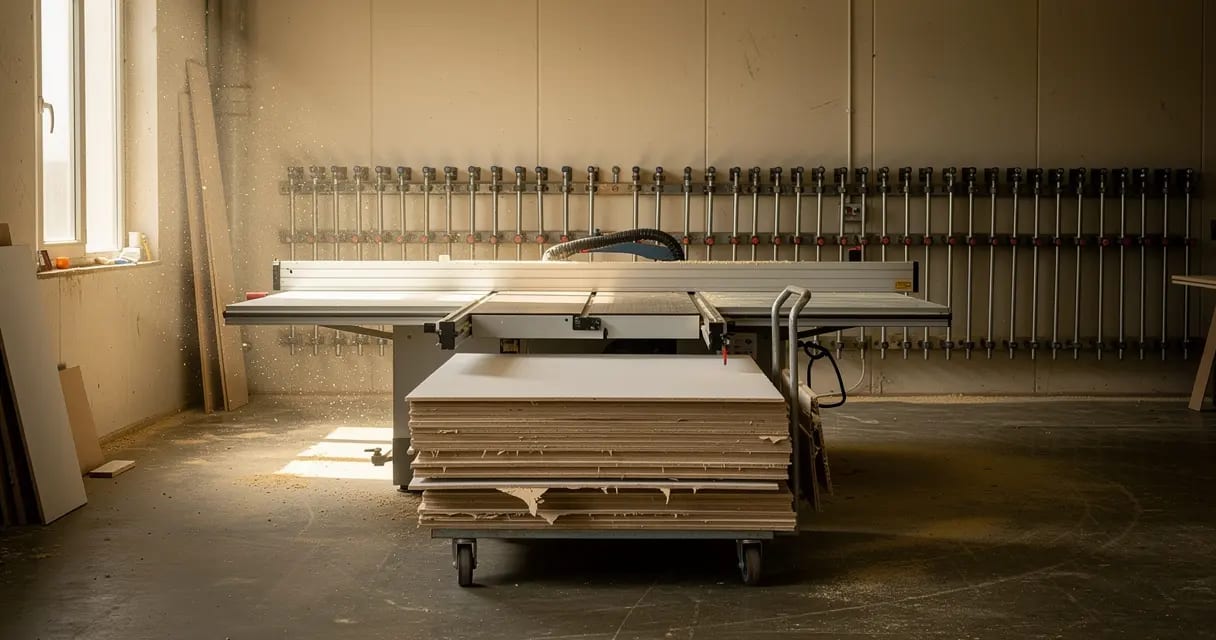
A kitchen or custom furniture project usually starts with a phone call, and that call usually starts with a hesitation. Cabinetmaker, carpenter, kitchen designer: none of the three is a stand-in for the other two.
Three trades, three training paths, three different workshops
In Quebec, cabinetmaking and carpentry are trained as two separate trades. They are not two names for the same skill set, and the two diplomas do not substitute for one another.
The vocational diploma (DEP) in Ébénisterie runs about 1,650 hours of training, under the Wood and Related Materials sector. The DEP in Charpenterie-menuiserie runs about 1,350 hours, under the Construction sector, program code 5319. Two diplomas, two vocational training centres, two different skill sets. A kitchen designer has no dedicated DEP at all: it is a commercial title defined by the Office québécois de la langue française (OQLF).
| Criterion | Cabinetmaker | Carpenter | Kitchen designer |
|---|---|---|---|
| Training | DEP in Ébénisterie, about 1,650 hours | DEP in Charpenterie-menuiserie, about 1,350 hours (code 5319) | No dedicated DEP |
| Typical workplace | Fabrication workshop (CNC, benches, finishing booth) | Construction site, sometimes a millwork shop | Showroom, often tied to a manufacturer |
| What they build or deliver | Custom furniture and cabinet boxes, fitted to real dimensions | Structures, doors, windows, structural millwork | A plan and an order; fabrication is sometimes subcontracted |
| Status of the title | Trade recognized by a DEP | Trade recognized by a DEP, overseen by the CCQ for site work | Commercial title defined by the OQLF, not a regulated trade |
Source: Emploi-Québec, charpentiers-menuisiers occupation profile
These three columns do not substitute for each other. A cabinetmaker does not take a carpenter's training, and the reverse is also true. A kitchen designer may hold neither diploma, and that is not a problem in itself: the role does not require a fabrication diploma. The problem only shows up when the actual role is not the one you assumed on the phone.
What a cabinetmaker does that a carpenter does not, and the reverse
The word ébéniste comes from ebony. In the 17th century, it named the joiners who worked exotic woods in veneer and marquetry, while carpenters worked local woods in solid pieces. The distinction has since widened: by the 19th and 20th centuries, ébéniste came to mean any artisan who builds furniture. It still left a useful trace today: the cabinetmaker stays associated with the finished piece and precision joinery, the carpenter with the building and its structure.
Concretely, a cabinetmaker designs and builds in a workshop, from a plan, pieces fitted to precise dimensions: kitchens, vanities, built-in furniture, custom cabinet boxes. A carpenter, or charpentier-menuisier in the regulated-trade sense, builds and installs elements fixed to the building: framing, doors, windows, structural millwork. Here is where the difference shows up in practice:
- The cabinetmaker builds in a workshop, from a plan and to precise dimensions, a piece that is either free-standing or built-in.
- The carpenter builds or installs on site, working around the building's actual conditions.
- The cabinetmaker delivers a finished piece, ready to install, with its own finish applied in the workshop.
- The carpenter fits and fastens on site, often ahead of the finishing work, within the wider scope of a construction job.
The two trades cross over at times. Some carpenters build cabinet boxes; some cabinetmakers install their own pieces. The distinction still helps locate where one trade starts in a workshop and the other starts on a job site, even when a single company covers both ends.
Source: OQLF, Grand dictionnaire terminologique, ébéniste entry
The kitchen designer: a salesperson, a planner, or a builder?
According to the OQLF, a cuisiniste is a specialist in kitchen design and layout. The entry also notes that the same specialist may cover bathrooms, under the combined title cuisiniste et bainiste. The term can also name a company specialized in selling and installing kitchen furniture and accessories, not just a person.
Nothing in that definition implies fabrication. That is the part the title leaves open, and it is exactly why it is worth asking directly rather than assuming it from the word itself.
- A sales-side kitchen designer presents a catalogue of models and colours, built by a third party.
- A planning-side kitchen designer draws the layout and plan for the room, without necessarily building the boxes.
- A builder-side kitchen designer, rarer, designs and builds in their own workshop, the way a cabinetmaker would.
All three models are legitimate. None is more honest than the other on its own: selling a well-designed catalogue is a complete job, and so is drawing a layout without building it. The issue only shows up when a project is presented as custom-built while it is actually pulled from a standard-size catalogue.
Building in-house versus assembling ordered cabinet boxes
Behind the three titles sit two production models, and that is what actually determines what you receive, more than the title on the business card.
- Building in-house means cutting every panel on a CNC router, to your exact dimensions, with tolerances around ±0.1 mm, then finishing by hand. The box is born for your room.
- Assembling ordered cabinet boxes means receiving pre-built boxes in standard modular sizes, delivered flat-packed or already assembled, then set in place.
- The first model absorbs an angled wall, a low ceiling, an odd-shaped cottage space, with no compromise on dimension.
- The second model works well in an already-standard room, where catalogue sizes fit and turnaround time matters more than the fit.
Neither model is inherently better. The right choice depends on the room and the budget, not the title on the sign out front.
At Atelier Multidécor, fabrication happens under one roof in Saint-Siméon-de-Bonaventure: CNC 4x8 cutting, textured panels from Uniboard, Olon, Sublime Collection, and AGT, and hand finishing. Full material detail is on the materials page.
See the materials →The question to ask on the phone to know who you are talking to
The title on the door or in the ad does not always tell you who builds what. Five questions, asked on the phone before the first meeting, do.
- Do you build the cabinet boxes yourselves, or order them from a supplier?
- Where are the pieces built: in your own workshop, or elsewhere?
- Does the same person take the measurements, draw the plan, and build the piece?
- Who installs: your own team, or a subcontractor?
- Do you hold an RBQ licence for the installation work?
The answers reveal the production model, no matter what title is printed on the invoice.
What Atelier Multidécor does
A complete workshop in the Gaspésie since 1994: design from plans, CNC cutting, hand finishing, and installation, all under one roof in Saint-Siméon-de-Bonaventure. We answer the five questions above directly.
Frequently asked questions
What is the difference between a cabinetmaker and a carpenter in Quebec?
A cabinetmaker builds in a workshop, from a plan, furniture pieces or cabinet boxes fitted to precise dimensions. A carpenter, or charpentier-menuisier, builds and installs elements fixed to a building, often on a job site. These are two distinct DEP diplomas in Quebec, trained at different centres.
Does a kitchen designer build the cabinets themselves?
Not always. The kitchen designer title covers selling, planning, or building, depending on the company. The only way to know is to ask directly where and by whom the cabinet boxes are built.
Who needs an RBQ licence: the cabinetmaker, the carpenter, or the kitchen designer?
An RBQ licence applies to the contractor performing construction or renovation work, regardless of the trade title displayed. Ask for the RBQ licence number before signing any contract that includes installation.
Can a cabinetmaker build a complete kitchen?
Yes. A kitchen is one of the most common projects for a cabinetmaking workshop: cabinet boxes, doors, countertops, and built-in storage, designed from a plan and built to the room's real dimensions.
How do I know if my project needs a cabinetmaker or a carpenter?
A finished-furniture project, a kitchen, a vanity, or built-in storage, falls to the cabinetmaker. A project touching the building's structure, framing, doors, or windows, falls to the carpenter. A project that mixes both may need both trades, one after the other.
Related reading