Custom wood business signs: what a CNC and laser shop can do
A well-made sign reads from across the street and lasts fifteen years. Here is how it gets built, what the formats allow, and what Quebec law has required since June 2025.
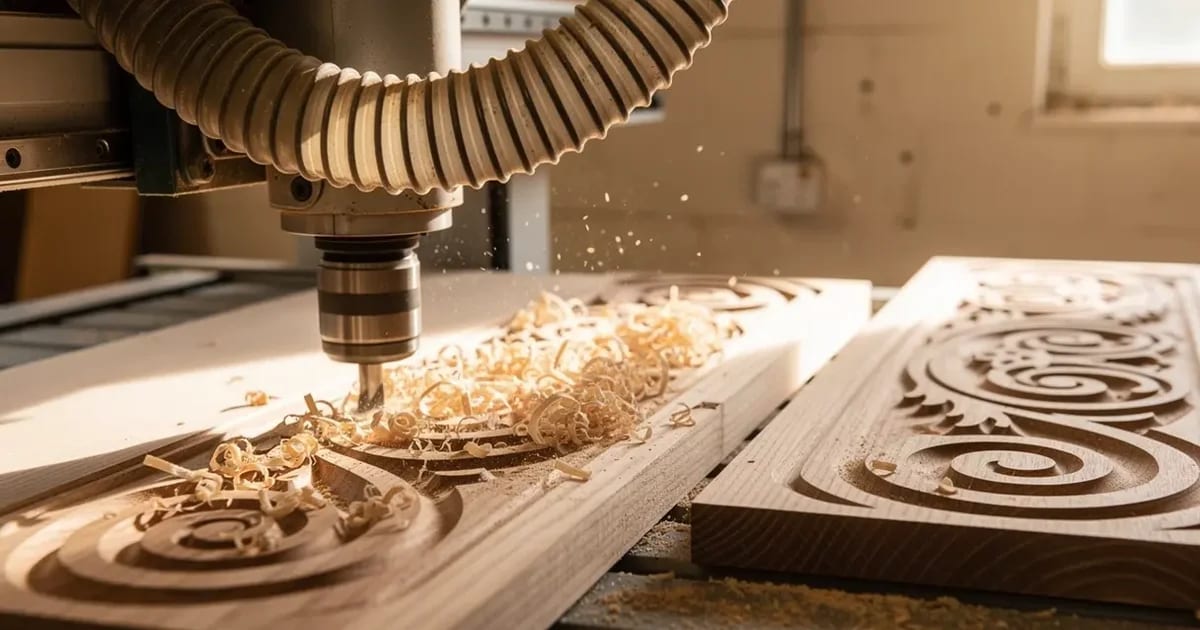
A sign is the only part of your business that works twenty-four hours a day. It is seen by people who have never heard of you, often at forty kilometres an hour, often in the rain. A printed panel warps in three or four years. A wooden sign that is properly machined and sealed lasts fifteen, and ages well along the way.
Why wood, still
Wood is not a nostalgic choice. It is a technical one that answers constraints aluminum and plastic handle poorly.
- Depth. A letter cut six millimetres deep casts a shadow that shifts with the hour. A printed panel stays flat no matter the light.
- Repairability. A wood panel can be sanded and resealed in place. A delaminated composite gets replaced entirely.
- Coherence. A restaurant, a microbrewery, an inn or a marina are selling a handmade experience. A brushed aluminum plate tells a different story.
- Cost over time. Wood costs more up front and less across ten years, because it gets refinished instead of discarded.
The counter-argument is real and worth stating: near the sea, a wooden sign needs maintenance that aluminum does not. We come back to that below, with numbers.
Three techniques, one shop
Most suppliers master one technique. We run three under the same roof, and the real value is in combining them.
| Technique | What it produces | When to use it |
|---|---|---|
| CNC cutting | Outlines, standalone letters, free-form shapes up to 4 x 8 feet | Silhouettes, cut-out logos, large-format panels |
| CNC engraving | 3 to 15 mm depth, crisp edges, relief visible from a distance | Primary lettering, storefronts, road-facing signs |
| Laser engraving | Detail down to a tenth of a millimetre, textures, halftones | Complex logos, plaques, interior wayfinding |
| Combination | Panel cut and carved on the CNC, fine detail added by laser | Most commercial signs |
A concrete example. The business name is carved twelve millimetres deep on the CNC so it reads from across the street. The logo, the founding year and the civic number are laser-engraved on the same panel, at a level of detail the router bit cannot reach. One piece of wood, two machines, no subcontracting and no waiting on a second supplier.
Format decides everything
This is the constraint that settles half of a sign project, and the one almost nobody raises first.
- Our CNC takes 4 x 8 foot panels (1220 x 2440 mm). That is the standard North American panel size, which means a full-height sign comes out of a single piece with no seam.
- Our 80 W CO2 laser covers 915 x 458 mm in one pass. Most engraving shops in Quebec work with 40 to 55 W machines on beds around 600 x 305 mm.
- Beyond those formats, a sign is built in assembled sections. That is common and structurally sound, but the seam has to be designed in and placed where it will not show, not improvised at the end.
In practice: if your sign is under 4 x 8 feet, it comes from a single panel. If your logo needs strokes finer than a millimetre, it goes to the laser. If both are true, you only need one supplier.
What we build
- Storefront signs. Full panel or standalone letters, wall-mounted or on a frame.
- Hanging signs, double-sided, on a steel bracket. The format for main streets and old village cores.
- Inn, cottage and marina signs. Often the best work, because the shape is unconstrained.
- Interior wayfinding. Door numbers, room names, office plaques, directional panels.
- Memorial and donor plaques, laser-engraved on wood or slate.
- Municipal and institutional panels. Village welcome signs, rest areas, trails, parks.
See your project in this list? One call or email is enough to find out whether wood, laser or CNC suits your sign. We answer in the first exchange, before any drawing.
Surviving on the coast
A sign installed in the Gaspésie faces salt, wind, frost and a temperature swing of more than sixty degrees across the year. Four decisions separate a sign that lasts four years from one that lasts fifteen.
- The species. Cedar resists naturally. Oak and ash hold up very well once sealed. Yellow birch and maple are beautiful but belong indoors.
- Grain direction and the shape of the carved recesses. A correctly oriented panel sheds water instead of trapping it at the bottom of the letters.
- The sealer. A penetrating exterior product, applied to every face before installation, including the bottom edge and the back nobody will ever see.
- The standoff. A sign pressed flat against the wall rots from behind. Twenty millimetres of clearance and venting at the top solve it.
With those four points, an exterior sign needs the sealer refreshed every three to five years depending on exposure. That is half a day of work, not a replacement. Without them, the finish fails around year four and the whole panel goes with it.
French signage: what changed on June 1, 2025
Since June 1, 2025, the Charter of the French Language imposes new obligations on exterior signage that displays trademarks and business names. If your mark contains an expression in another language and it is visible from outside, French must be markedly predominant.
- Markedly predominant has a measurable definition: the French text must occupy at least twice the space of the text in the other language, within the same visual field.
- The visual field is what can be seen and read at a glance without moving. Each façade visible from the street must satisfy the rule on its own.
- The French text must also be at least as legible and as permanently visible as the rest. A temporary, poorly lit or removable addition does not count.
In practice this often means adding a French descriptor or tagline beside an English mark, and sizing it correctly at the drawing stage. It is far simpler to resolve before fabrication than after installation. We account for the rule in the plan we submit, but compliance for your signage rests with your business. The official reference is the Office québécois de la langue française.
Office québécois de la langue française: signage of trademarks and business names
What we need from you
- Your logo in vector format (AI, EPS, SVG or vector PDF). A JPEG pulled off a website cannot be engraved: it has to be redrawn, and that is billable time.
- The available dimensions, measured on site. Wall width, clear height, reading distance.
- A photo of the location taken from a distance. It tells us more than three paragraphs of description.
- The exposure: full south, facing the wind, under an overhang. It determines the species and the sealer.
- The exact text, in French, exactly as you want it to read. Accents included.
From there we produce a dimensioned drawing with species, engraving depths and mounting method. You approve the drawing before a single piece of wood is touched.
A sign project for your business
We build for businesses, municipalities, inns and marinas across the Baie-des-Chaleurs, and we ship signs elsewhere in Quebec. Send us your dimensions and a photo of the location: you get a reply with a ballpark figure, not a form.
Frequently asked questions
How long does a wooden sign last outdoors?
Twelve to twenty years with a suitable species, an exterior sealer applied to every face, and a refresh every three to five years. Without maintenance, expect four to seven years before the finish degrades, even though the wood itself lasts longer.
What is the largest single-piece sign you can make?
4 x 8 feet (1220 x 2440 mm), the full standard panel size, on our CNC. Beyond that a sign is built in assembled sections, which is routine and gets designed in from the start.
Can you engrave a complex logo?
Yes. Our CO2 laser resolves down to a tenth of a millimetre and renders textures and halftones the CNC bit cannot produce. We need the original vector file to reach that level of detail.
Does my sign have to be in French?
Exterior commercial signage must be in French. Since June 1, 2025, French must occupy at least twice the space of a mark written in another language, within the same visual field. We account for the rule at the drawing stage. For your specific case, the reference is the Office québécois de la langue française.
Do you deliver and install?
We deliver and install across the Baie-des-Chaleurs. Elsewhere in the Gaspésie it is on request, case by case. For the rest of Quebec we ship the sign ready to mount, with hardware and a mounting plan.