Custom solid wood bed frames in Canada: how a king frame gets built
You want a solid wood bed frame and the market offers imported bases in three finishes. Here is how a frame built to your dimensions is actually ordered, what CNC machining changes, and what ships versus what has to be installed.
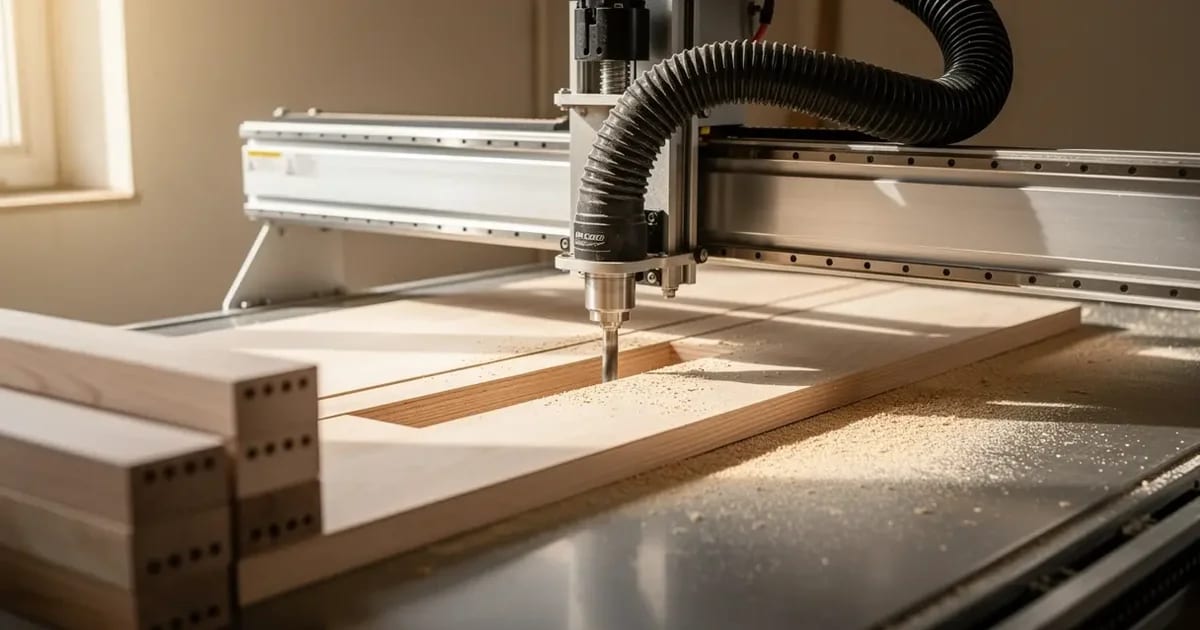
A bed is the heaviest and longest lived piece of furniture in a house. It carries two people every night for twenty years. It is also the piece most often bought in an afternoon, from a photo. This guide takes the other route. It covers the vocabulary, the real Canadian sizes, the species available in Quebec, and what a workshop with a CNC router can build that a production line cannot.
Frame, base, box spring, headboard
Four words that name four different parts. Ordering the wrong one is common.
- The bed frame is the visible structure: rails, legs, and usually a headboard.
- The bed base is what carries the mattress. In Quebec French this is « base de lit », the everyday term, while a queen is a « grand lit » and a king a « très grand lit ».
- The box spring sits between base and mattress. A platform bed does not use one, because slats or a deck carry the mattress directly.
- The headboard is the vertical panel at the head. It can be ordered on its own, and it is often a first project.
If you are shopping for a solid wood king, what you want is a solid wood platform frame. The most searched phrase is not always the one that describes your project.
Canadian mattress sizes
Two naming systems coexist in Quebec. Canadian buying guides and the Office québécois de la langue française use the French forms, while buyers type the English ones. Both are listed below.
| Size | Quebec French term | Mattress dimensions |
|---|---|---|
| Twin | Lit simple | 39 x 75 in |
| Double / Full | Lit double | 54 x 75 in |
| Queen | Grand lit | 60 x 80 in |
| King | Très grand lit | 76 x 80 in |
Source: Office québécois de la langue française, « grand lit » entry
A Canadian king is 76 in wide by 80 in long. Some manufacturers list 78 in, so check your mattress spec sheet before a base is built. Two inches shows on a finished bed.
Custom work earns its place exactly where the table stops: an oversized mattress, a low ceiling that rules out a standard headboard, an angled wall, a cottage bedroom whose door will not pass an assembled base.
What a CNC router changes
A CNC 4x8 router does not make a prettier bed. It makes a bed that comes apart and goes back together without slop, which is a difference in kind rather than degree. Every part of a given bed is machined from the same digital reference, holding tolerances on the order of ±0.1 mm. In practice:
- Knockdown joinery is machined, not fitted. Hardware pockets, through bores and dados land on the same coordinates on every part. Rails bolt to legs on the first try.
- The bed reassembles identically. Move house, repaint the room, change floors: it comes apart and goes back together without the frame loosening.
- A part can be remade years later. The machining program still exists. A replacement rail is cut to the same dimensions and finds the same holes.
- Headboard patterns repeat exactly. Fluting, V grooves, geometric patterns, perforated panels: the machine holds spacing across a 76 in headboard, which hand layout does not guarantee over that span.
Finishing stays manual. The machine cuts, the hand finishes. Both happen under one roof in Saint-Siméon-de-Bonaventure.
What can be built
- Platform bed. A frame and slatted deck carrying the mattress with no box spring. Height and rail thickness are yours to set.
- Storage bed with drawers. Drawers under the deck on one or both sides, on full extension slides. In a bedroom without a closet, a king recovers the storage of a dresser.
- Lift up storage bed. The deck lifts to open the full volume underneath. Useful for seasonal bedding and luggage.
- Headboard only. Wall mounted or frame mounted, ordered without changing the rest of the bed.
- Loft and bunk beds. For children's rooms and cottages, sized to the room rather than to a catalogue.
Species, and the other material worth naming
Solid wood is chosen by species, not by the phrase "fine hardwood".
- Yellow birch, called merisier in Quebec, is the province's emblem tree. Fine grain, honey tone that darkens with age, heavily used in cabinetmaking here.
- Walnut gives the strongest contrast, chocolate brown through to purple tones. It is the species for beds where the wood is the subject.
- Oak shows an open, pronounced grain and holds pale stains well.
- Maple is dense and light with quiet figure, for a bedroom where the bed stays calm.
- Ash reads close to oak with more regular grain, usually at a lower cost.
Species are oil finished. That is a stated choice: the workshop has no spray room, so wood is oiled rather than lacquered, and an oiled finish can be touched up at home without taking the bed apart.
Alongside solid wood, textured melamine deserves to be named for what it is. Panels from Uniboard, Olon, Sublime Collection and AGT give a uniform, scratch resistant, low maintenance surface in a range of colours and textures no species covers. For a platform bed with integrated storage it is often the better technical choice: the case is cabinetmaking, and melamine holds large flat spans better than a solid panel. Melamine kitchens built in this shop more than 30 years ago are still in service.
Two materials, two projects. Solid wood when the wood is the subject. Melamine when the surface and the storage are.
Materials and species →What ships and what gets installed
Two regimes, covering different territory.
Work that needs installation stays local
A wall mounted headboard, a wall bed, storage built into the room: it has to be measured and installed on site. Full service covers the Baie-des-Chaleurs. The rest of Gaspésie is handled case by case, depending on the project.
Work that comes apart ships
A frame designed to knock down leaves flat, as machined and labelled parts with its hardware. You reassemble it with an Allen key. This is what digital fabrication makes possible: parts align because they were bored together, not because someone fitted them on delivery. A knockdown king reaches Quebec City, Montreal or the Côte-Nord as readily as Bonaventure.
Ordering a custom bed
- Mattress dimensions. Brand, size and thickness. Thickness sets the deck height and how much headboard shows above the mattress.
- The room. Ceiling height, door width, angled walls or sloped ceilings. This decides whether the bed has to knock down.
- The type. Platform, drawers, lift up storage, or headboard alone.
- Material and finish. Species and oil, or textured panel and colour.
- The quote. Build and lead time according to model and material.
A bed is ordered once in twenty years. Those five questions take one meeting, and they prevent the bed that will not fit through the bedroom door.
Let us talk about your bed project
Write to us with your mattress size and the room measurements. We answer with a quote and a lead time. Atelier Multidécor has built custom furniture in Saint-Siméon-de-Bonaventure, Gaspésie, since 1994: CNC 4x8 and hand finishing under one roof.
Frequently asked questions
What are the dimensions of a king bed in Canada?
A Canadian king takes a mattress 76 in wide by 80 in long. Some manufacturers list 78 in. Check your mattress spec sheet before a base is built, because two inches shows on a finished bed.
What is the difference between a bed base and a bed frame?
The base carries the mattress. The frame is the visible structure: rails, legs, headboard and footboard. A platform bed combines both functions in one piece.
Does a platform bed need a box spring?
No. The slatted deck carries the mattress directly. That is what lets a platform bed sit lower than a traditional bed, and it removes the cost of a box spring.
Do you ship custom bed frames outside Gaspésie?
A frame designed to knock down ships anywhere in Quebec. It leaves flat, as machined and labelled parts, and reassembles with an Allen key. Work that requires on site installation, such as a wall mounted headboard, is full service in the Baie-des-Chaleurs and handled case by case elsewhere in Gaspésie.
Which wood should I choose for a bed?
Yellow birch and maple for a dense, quiet frame. Walnut when the wood should be the subject of the room. Oak and ash for visible grain at lower cost. All five are oil finished, and an oiled surface can be touched up at home.