CNC-Machined Doors and Panels: What the Machine Allows That a Catalogue Doesn't
A catalogue door is cut to a handful of standard sizes. A CNC-machined door is cut to the exact dimensions of your kitchen, with a pattern that exists nowhere else.
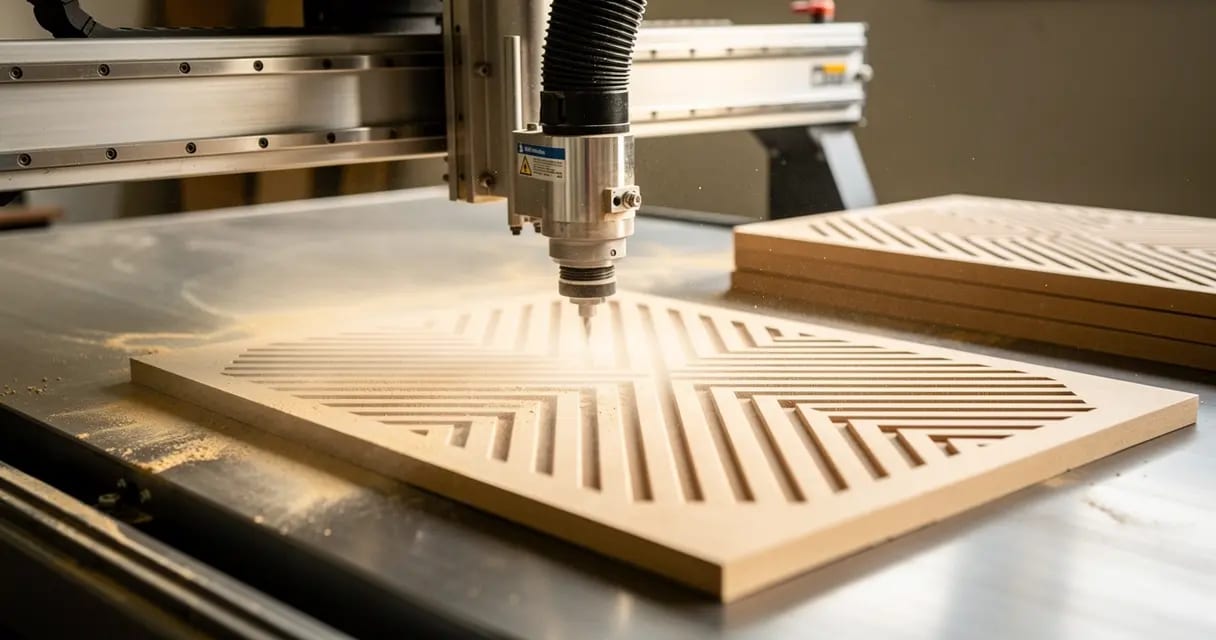
We machine doors and panels on our CNC at the workshop in Saint-Siméon-de-Bonaventure. This page explains what changes between a catalogue door and a custom CNC-machined door: dimension, pattern, tolerance, and which panels accept which type of machining. It applies as much to a residential kitchen as to a commercial project where several doors need to match end to end across one installation.
CNC Machining vs. Catalogue Doors: What Changes in the Part
A catalogue door starts from a fixed template. The supplier produces a range of standard sizes, and the kitchen builder picks the closest one to the actual opening. The gap gets closed with a filler strip or an on-site adjustment, often visible once the door is hung.
A CNC-machined door starts from the measurement of your opening. The digital file programs the exact dimension, the hinge boring, and the pattern in the same operation. Machining and hand finishing happen under the same roof, at the workshop, with no middleman between the drawing and the delivered part.
- Exact dimension to the opening, no filler strip by default.
- Hinge boring positioned from the file, not drilled by hand on site.
- One pass from machining to finishing, no subcontracting on precision.
What that means for a renovation: the door arrives ready to hang, at a dimension already verified, rather than something to adjust once it's in place. Our doors collection shows the base styles the workshop offers. This page explains what happens before a door makes it there.
See the doors collection →Exclusive Patterns: Bookmatch, Geometric, Floral, and Their Limits
The workshop engraves three families of CNC patterns. Each has its own mechanics and its own limits.
- Bookmatch: two adjacent panels machined as mirror images in the same run, so the pattern continues from one door to the next without a break. Useful on an island or a pair of tall doors, where the eye follows the continuity of the design.
- Geometric patterns: repeated vector paths cut across the panel surface, constant depth from edge to edge. The file repeats without variation, which keeps the pattern regular across the whole face.
- Floral patterns: surface engraving on a supplied or adapted design, depth limited by the thickness of the panel. Fine detail needs a panel thick enough to hold the relief without weakening it.
Bookmatch is ordered as a pair from the start. It can't be added after the fact to a single panel, because the continuity of the pattern depends on the two panels being machined together. A single panel's size is limited by the bed of the CNC 4x8. A larger pattern is built from several joined panels, not one. Each pattern file is specific to your project: no timeline is promised until the file is approved.
Tolerance: What 0.1 mm Means When the Door Closes
The CNC cuts to a tolerance of ±0.1 mm. That is the precision of the cut, not a promise about the whole project.
A door cut from a standard size range often needs on-site adjustment: planing, shims, a filler strip. A door cut to ±0.1 mm on the exact measurement of the opening removes that step in most cases, because the file already holds the right number instead of a range approximation.
- A consistent reveal between neighbouring doors, end to end across the kitchen.
- The hinge lands in the right spot the first time.
- A clean close, without on-site adjustment in most cases.
The workshop machines and installs. The tolerance in the file carries through to the install, with no middleman reworking the measurement between the drawing and the site. On a multi-door project, like a full kitchen or a commercial fit-out, that continuity keeps small gaps from stacking up from one part to the next.
Melamine, MDF, Polymer: Which Panels Accept Which Machining
Not every panel accepts the same operation. Here is what the CNC allows, and does not allow, panel by panel.
| Panel | What the CNC allows | Limit to respect |
|---|---|---|
| Textured melamine (TFL) | Precise cutting and boring. Shallow surface patterning on the ranges that accept it. | Deep relief cuts through the printed decor layer. Reserved for surface patterns, not sculpted relief. |
| MDF | Cutting, boring, and deep relief, with no grain to work around. A common base for a shaker profile. | Never leaves bare: always covered in polymer or polyester. No paint, no paint room at the workshop. |
| Polymer and thermoplastic | Matte or satin finish applied over already-machined MDF. Uniform surface, durable, easy to maintain. | The finish is applied after machining. The file has to account for the thickness the covering adds. |
Melamine carries a printed decor layer: relief cut too deep goes through it and damages the surface. MDF is uniform, with no grain and no decor layer to protect, which makes it versatile for a marked relief. The choice depends on the pattern wanted, not just on which panel is on hand. The workshop confirms feasibility before machining, based on the file and the chosen material, and flags any adjustment the pattern needs before cutting begins.
Our melamine panels come from suppliers like Uniboard, Olon, Sublime Collection, and AGT.
Materials and species →What the Workshop Doesn't Do: No Paint Room, No Painted Shaker
A stated limit beats a disappointed expectation.
- No paint room: no painted door leaves the workshop.
- No painted shaker door, ever, not even in melamine or MDF.
- No panel beyond the 4x8 format: a larger project is built from several joined panels.
A shaker profile is still possible. It's built in polymer or polyester over machined MDF, never painted. The distinction is about the process, not the style: the shaker profile exists, painting does not. That limit applies to every material on the list above, melamine and MDF alike.
Discuss Your Door Project
Bring your dimensions, your photos, or your pattern ideas. The workshop reviews the file, the material, and the feasibility before pricing the project.
Frequently asked questions
What exactly is a CNC-machined door?
It's a door where a digital file drives the machine directly: dimension, hinge boring, and pattern are programmed and then cut into the panel in one pass. A catalogue door starts from a fixed template. A CNC-machined door starts from your measurement.
Does the bookmatch pattern work on every material?
No. Bookmatch needs two adjacent panels machined as mirror images in the same run. They're ordered together from the start. It can't be added after the fact to a single panel.
What does a 0.1 mm tolerance change for my kitchen?
The reveal between two doors stays consistent from one end of the kitchen to the other, and the hinge lands in the right spot the first time. The file holds the exact dimension of your opening, so on-site adjustment becomes the exception rather than the rule.
Which materials can the CNC machine a pattern into?
Textured melamine accepts cutting, boring, and a shallow surface pattern. MDF accepts deeper relief, with no grain to respect, and serves as the base for a polymer or polyester finish. The choice depends on the pattern wanted, not just the budget.
Do you make painted shaker doors?
No. The workshop has no paint room and paints no door, shaker or otherwise. A shaker profile is still possible, finished in polymer or polyester over machined MDF.