Laser-engraved wood, designed and built in-house
We laser-engrave wood pieces for businesses and homeowners, at the same workshop that has designed and built our custom cabinetry and furniture since 1994. We ship anywhere in Quebec.
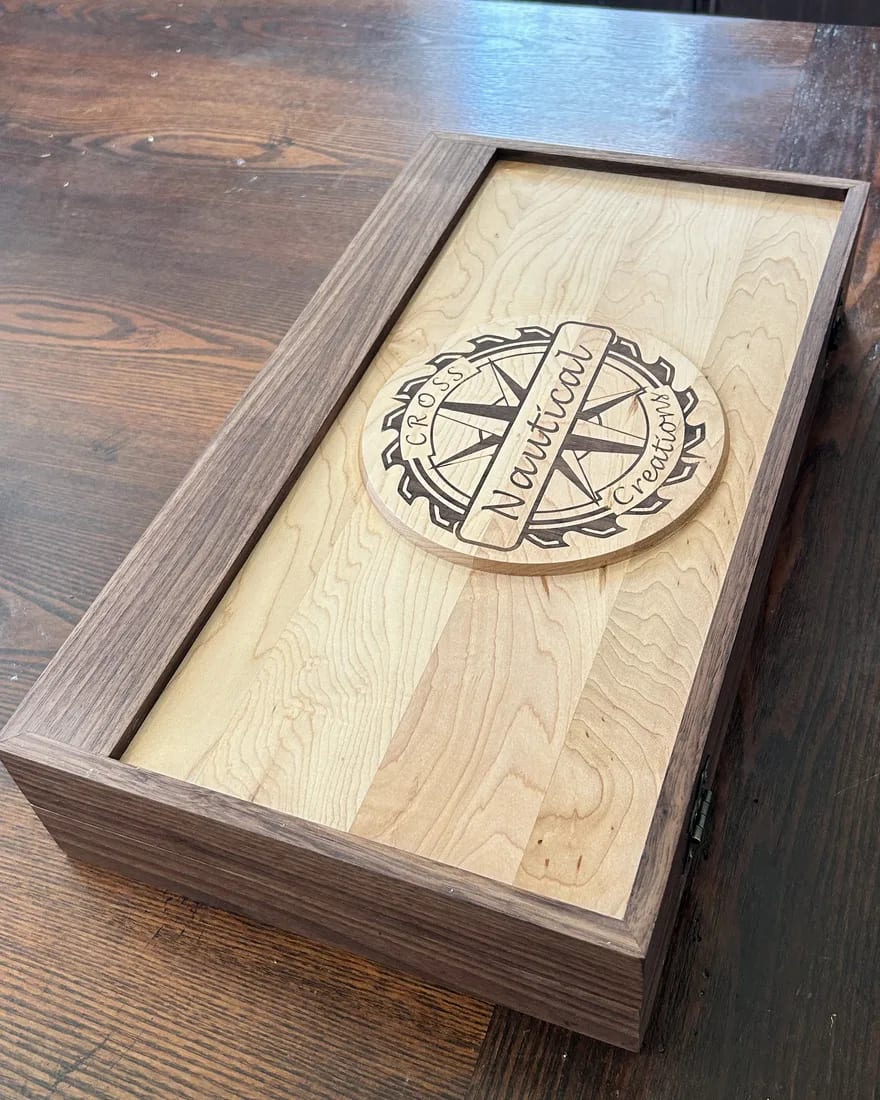
What we engrave, and on what
In Gaspésie, laser engraving joins tools already in place at the workshop. The workshop uses two complementary engraving methods. CNC engraving carves wood in relief, for sculpted patterns and bookmatched panels. Laser engraving marks the surface with precision, with no contact and no tool that wears down, for text, fine lines and images. Both methods live in the same shop, chosen by the look the project needs and the budget behind it.
Wood is the material we know best: walnut, oak, cherry, maple, ash. Each species takes the laser differently. A pale grain like maple gives a softer mark. A dark wood like walnut gives a sharper, more contrasted line. The result also depends on the grain direction and the finish applied before or after engraving.
Three uses come up most often with our clients:
- ›Outdoor and indoor signage in machined wood, for businesses, offices and commercial buildings.
- ›Door plates and office signage, as part of a full commercial fit-out.
- ›Decorative engraving built into a piece of furniture, a cabinet or a counter made at the workshop.
All three of these come out of the same shop that has been machining our cabinets, our furniture and our signage for years. Laser engraving adds to that skill set. It doesn't replace it. For a project outside these three uses, tell us about it. We'll confirm what's possible before committing to anything, the same way we would for a custom cabinet.
Designed, built and engraved in one shop
Quebec's laser engraving market splits into three types of players, visible on any quick search. None of them design or build the object they engrave, and none shows up in the results paired with a cabinet shop.
The service bureau takes a file the client sends in and engraves or cuts it, without ever seeing the object before the order, and without taking part in designing it. The trophy shop engraves an object already made, bought from a supplier, often the same one used nationwide. The fablab rents machine time by the hour, to whoever knows how to run it, with no design support included. All three split design, fabrication and engraving into three different trades, sometimes three different businesses, which adds middlemen between your idea and the finished object.
| Type of shop | What it does | What it's missing |
|---|---|---|
| Service bureau | Cuts and engraves a file the client sends in | Doesn't design or build the object |
| Trophy shop | Engraves an object bought from a supplier | Doesn't build the object itself |
| Fablab | Rents machine time by the hour | No cabinet shop, no design support |
| Atelier Multidécor | Designs, builds and engraves the whole piece | No subcontractor between the design and the finished piece |
Our workshop has done all three steps under one roof since 1994: design, fabrication and engraving. A door plate or a sign made here is drawn, machined and engraved by the same team, in the same building, not assembled from parts ordered from three different suppliers. It's a cabinet shop that added a laser to its tools, not an engraving bureau that added wood to its catalogue.
One-off piece, small run, series
Demand varies widely: a single gift, signage for an office, a run for an event or a business. Laser engraving serves all three.
Laser engraving scales with the order. A single piece works the same way as office signage ordered in several copies: the file gets prepared once, then engraved as many times as needed.
A larger order mostly changes the setup time relative to the engraving time itself. Positioning and calibrating the first piece takes the most time. Once that setup is done, the following pieces run faster than one another, which is why the per-unit price drops as quantity grows.
The vector file prepared for laser engraving also works as a reference for CNC machining, when a project combines both techniques. One drawing can guide the whole piece, from the sculpted relief to the fine surface mark.
Every project is designed around the file provided, the target format and the quantity you need. Tell us about your project, whether it's a single piece or a series, and we'll confirm what fits before any production starts, the same way we scope a custom cabinet before cutting a single board.
What sets the price: engraved area, material, quantity, file
Four factors set the price of an engraved piece. We don't quote a price before seeing the project, the file and the target quantity.
Engraved area
A larger surface to engrave means more machine time, and the price follows.
Material
The wood species you choose affects the contrast of the mark, the prep time and sometimes the finish applied after engraving.
Quantity
A series spreads the setup cost across more pieces, which lowers the per-unit price as quantity grows.
File
A ready-to-engrave vector file costs less than a logo or image we have to redraw before production.
We set a price after seeing your project, never before. Tell us about the piece, the material you want and the quantity, and we'll come back with an exact price, not a generic range. The same principle applies to a single piece or a series.
Shipping across Quebec
The reach of a service depends on what it produces. A piece that stays put has a limited radius. A piece that travels doesn't.
A cabinet, a vanity or a commercial fit-out gets installed on site, by our team or by our directions. Our full-service radius stops at the Baie-des-Chaleurs. The rest of Gaspésie is handled case by case, depending on the scope of the project, and Rimouski stays reserved for larger-scale projects.
An engraved piece works differently. It packs and it ships, like any parcel. Nothing to fasten to a wall, nothing to fit into an existing room, nothing to adjust on site. It's the widest-reaching service in our whole catalogue: available anywhere in Quebec, not only in Gaspésie and the Baie-des-Chaleurs. That reach is the plain difference between a piece that ships and a piece that gets installed.
If you're in Montreal, Quebec City, the Eastern Townships or anywhere else in the province, a piece engraved at our workshop reaches you the same way an order from an online supplier would. The difference is that it comes out of a cabinet shop, not a production line.
Price and shipping timelines get confirmed at quote stage, along with the rest of the project.
Frequently asked questions
What's the difference between laser engraving and CNC engraving?
The laser marks the surface with a concentrated beam of light, with no contact and no tool that wears down, for text, fine lines and images. The CNC router carves wood deeply for relief patterns and sculpted assemblies. Our workshop uses both techniques and picks the one that fits the project.
What materials do you laser engrave?
We work in wood: walnut, oak, cherry, maple and ash, the same species we use for our cabinets and furniture. For another material, tell us about your project and we'll let you know if it fits.
Do you ship engraved pieces outside Gaspésie?
Yes. An engraved piece packs and ships, unlike a cabinet installed on site. It's the widest-reaching service we offer: available anywhere in Quebec, not just within our usual Gaspésie and Baie-des-Chaleurs service radius.
Is there a minimum order quantity?
It depends on the project. Format, file and target quantity all factor into how we produce the piece. Tell us about your project, whether it's a single piece or a series, and we'll let you know what fits.
What file should I provide for an engraving?
A vector file gives the best result, sharper than a pixel-based image. If you only have a logo as a JPEG or PNG, tell us about your project and we'll see what's possible before production, with or without a ready file.
Have a piece to engrave?
Tell us about your piece, your sign or your office signage. We'll confirm the material, the format and the price before any production starts, wherever you are in Quebec.
Talk about your project