Epoxy Countertop Cost: Real Prices in Quebec
An epoxy countertop runs from a few dollars to more than two hundred dollars per square foot. Here is why, and how to place your project before the consultation.
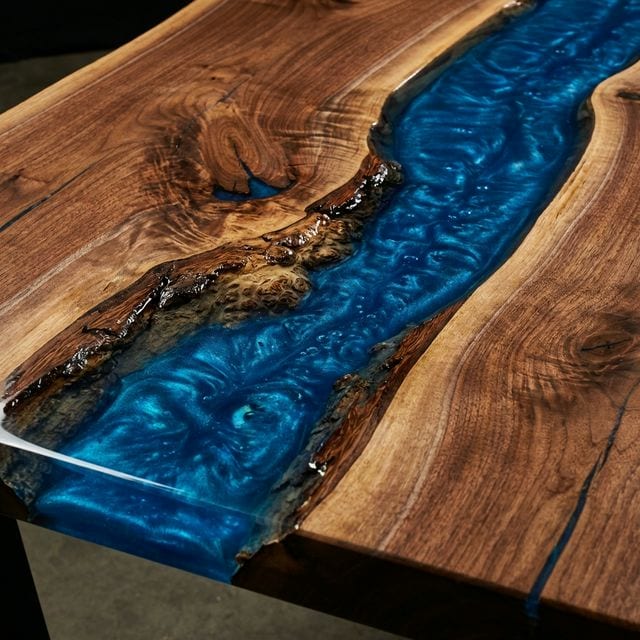
You look up the cost of an epoxy countertop and you find figures running from a few dollars to more than two hundred dollars per square foot. The gap is not a mistake. An epoxy countertop is made to order, one piece at a time, and its cost depends on the material, the format, and the actual labour. No single in-store rate exists. This guide explains why, gives the Quebec market ranges, and compares epoxy to quartz and granite, so you arrive at your consultation with the right expectations.
Epoxy Countertop or Epoxy Flooring: Two Products, Two Prices
The first source of confusion is a mix of two different products. When you type epoxy price into a search engine, most results are about epoxy flooring, not countertops. Epoxy flooring is a poured floor coating, often in a garage or a basement. In Quebec, it runs around $3 to 12 per square foot (source: SoumissionRénovation).
An epoxy countertop is a different trade. The resin is poured in a thick layer over a prepared substrate, worked by hand, tinted, then finished coat by coat. The result is a one-off piece, not an industrial coating. Comparing a floor price to a countertop price is like comparing floor paint to a piece of furniture. The $3 to 12 figure never applies to a countertop. Keep that marker in mind while you shop, and you will avoid the most common surprise.
Epoxy Countertop Price: Market Ranges
To place an epoxy countertop, you first need to see where the other countertop materials sit in Quebec. Here are the common ranges, installation included.
| Material | Price (CA$/sq ft installed) |
|---|---|
| Laminate | $6 to 30 |
| Wood | $13 to 120 |
| Tile (ceramic) | $30 to 100 |
| Quartz | $50 to 150 |
| Granite | $50 to 190 |
| Marble | $45 to 250 |
These Quebec ranges are in Canadian dollars, installation included (source: SoumissionRénovation, 2025). In the Gaspésie, transporting heavy materials often pushes costs toward the high end of each range.
Where does epoxy land in all this? At the top of the scale, with the artisanal surfaces. Most published ranges for an installed epoxy countertop come from the US market. Converted to Canadian dollars, they give an order of magnitude, not a Quebec price:
- standard epoxy countertop: about CA$62 to 206 per square foot;
- metallic finish: about CA$103 to 171 per square foot;
- river-table style: about CA$137 to 274 per square foot.
These figures come from US-market estimates, converted (source: Slabwise). They help you form an idea, not price a Quebec project.
Converting a US price to Canadian dollars is not enough on its own. The Quebec market for epoxy countertops is small, skilled makers are rare, and both raw material and transport cost more than in the United States. That is why a Quebec price almost always sits at the high end of the converted range, not in the middle. It is better to start from Canadian data when it exists.
Real Canadian data is rarer but more telling. River-table countertops sold by Canadian makers sit around $185 to 210 per square foot. That is the most reliable anchor for a project here. A custom epoxy countertop cost compares to high-end quartz and granite, and often goes past them, because this is artisanal work made one unit at a time. Custom work in Quebec trends toward the high end of these ranges, not the low end. In other words, the cost of an epoxy countertop is more than a single figure per square foot: it is the price of a piece that exists nowhere else.
Epoxy Countertop vs Quartz and Granite
The question comes up often: is an epoxy, a quartz, or a granite countertop the better pick? All three play in the same price range per square foot. The choice rests mostly on the character of the surface.
Epoxy vs Quartz Countertop
Quartz is a manufactured surface, uniform and predictable from one slab to the next. You know exactly what the finished product will look like before fabrication. Epoxy does the opposite: each pour is unique, with its own veins, depth, and colours. Quartz wins on consistency and easy upkeep. Epoxy wins on visual effect and the made-to-order piece. On price, the two overlap. A heavily worked epoxy countertop often costs more than standard quartz, because it carries more labour time.
Epoxy vs Granite Countertop
Granite is natural stone, so it is already unique from one block to the next, and very resistant to heat and scratches. Epoxy offers a range of colours and effects that no stone can match, but it asks for more care against direct heat: a trivet stays in order near the cooktop. Granite is the choice for raw, durable stone. Epoxy is the choice for the made-to-order artistic surface. At a comparable square foot, the price of the two overlaps.
Neither surface is better in absolute terms. They answer different intentions. Epoxy is a special project, chosen for its one-off character, not a stock countertop. If you are still unsure, ask yourself a simple question: are you after a predictable surface that is easy to replace, or a signature piece that becomes the focal point of the kitchen? The answer steers the budget as much as the material.
What Makes an Epoxy Countertop Price Vary
Two epoxy countertops of the same size can show very different prices. Here are the factors that weigh most in a quote.
- Size and cuts: the larger the surface, the more resin and time it takes. Islands, sink cut-outs, and corners add work in a way that is not proportional.
- Resin type and thickness: a deep-pour resin, resistant to UV and heat, costs more than a standard surface resin. The thicker the pour, for example a 1 to 3 inch river, the higher the resin volume climbs.
- The wood component, for a river table: the species, the live edge, kiln drying, slab flattening, and crack filling are part of the price.
- Pattern complexity: a single river costs less than a multi-river pattern, embedded objects, LED lighting, or a large number of colours.
- Metallic effects and pigments: mica, veining, pearlescent finish, each effect adds material and work time.
- Edge profile: a straight edge costs less than a rounded edge, and a rounded edge less than a waterfall finish.
- Substrate and prep: pouring over a new support is not the same as reworking an existing surface. Minimum project fees are common in the trade.
- Labour and distance: epoxy is sensitive to technique, and a failed pour has to be redone. Transporting heavy slabs and resin to the install site adds to the cost, above all for remote projects.
How to Get an Accurate Quote
An epoxy countertop price per square foot helps you get oriented, not sign a contract. For a realistic quote, a workshop needs precise details. Prepare these items before your consultation:
- the exact dimensions of each section, the thickness you want, and the overhangs;
- the type and condition of the substrate or existing furniture, with photos;
- the intended use: heat near the cooktop, sun exposure (UV);
- the thickness and structure of the pour you want;
- the wood details, if it is a river table (species, live edge);
- the design intent: colour palette, effects, inspiration photos;
- the edge profile;
- the site and install details: access, removal of an old countertop, timeline.
The clearer this information, the more precise the quote. That is why Atelier Multidécor sets each price after seeing the project, rather than posting a single rate that would not hold up.
Your Epoxy Countertop, Made to Order in the Gaspésie
Atelier Multidécor designs and builds its epoxy countertops by hand, in Saint-Siméon-de-Bonaventure, for the Baie-des-Chaleurs and the Gaspésie. Epoxy is part of our special projects, alongside our custom cabinet and countertop work. To see the process and start a project, tell us about your countertop.
Frequently asked questions
What is the average price of an epoxy countertop in Quebec?
There is no single average price, because each countertop is made to order. As a marker, an artisanal epoxy countertop sits in the high end of countertops, often around $185 to 210 per square foot according to Canadian maker data, and sometimes more for a heavily worked piece. The final price depends on the format, the resin, the pattern, and the install.
Is an epoxy countertop more expensive than quartz?
Often, yes, above all for an elaborate piece. Quartz and epoxy overlap in the same price range, but a heavily worked epoxy countertop, with effects and inserts, frequently goes past the price of standard quartz. You pay the difference for a one-off surface, made one unit at a time, rather than a manufactured slab.
Epoxy or granite: which to choose?
It depends on what you are after. Granite is natural stone, very resistant to heat, ideal if you want a durable mineral surface with no special care. Epoxy offers colours and effects that stone cannot, at the cost of a little more caution against direct heat. The two are even on price; the choice rests on the character you want.
Does a DIY epoxy kit cost less than professional fabrication?
On paper, yes: retail resin kits cost a fraction of professional fabrication, because they count only the material. But epoxy is unforgiving of mistakes. A failed pour, bubbles, a bad mix, or an uneven finish turn the upfront saving into a costly redo. For a countertop meant to last in a kitchen, workshop fabrication protects your investment.