Does a Melamine Kitchen Really Last Only 10 Years? What 30 Years in One Workshop Show
Melamine carries a precise reputation: ten to fifteen years, then the edges lift at the corners. That reputation describes a real problem. It blames the wrong thing.
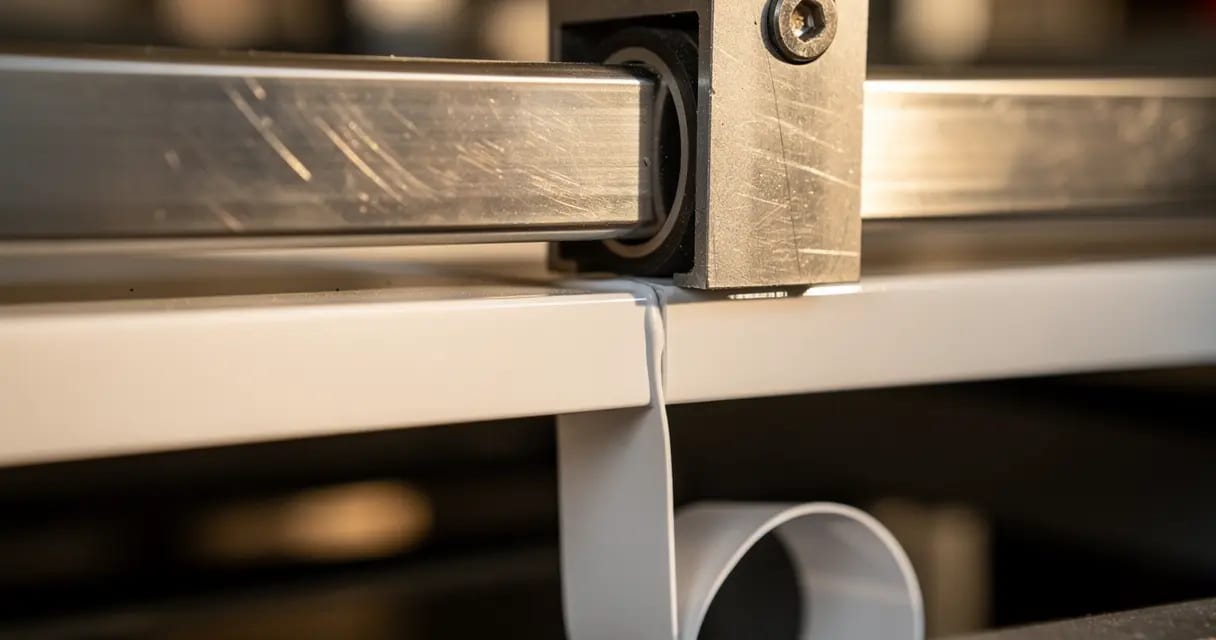
Open ten pages on melamine kitchen lifespan and the same number comes up: ten to fifteen years, melamine filed under budget tier, edge delamination named as the limit. The number is not invented. Melamine cabinet edges do lift at the corners, after years of use near a sink or a dishwasher. But edge delamination is not a property of melamine. It is a property of how the cabinet box is built: panel thickness, edge band thickness, hardware. Here is why, with the numbers that make the difference.
What the top search results get right
Most online guides file melamine under entry-level: accessible price, durability rated average, a ten-to-fifteen-year horizon before replacement. Corner delamination, near the sink or under the dishwasher, is the symptom most often cited.
The observation is accurate. An edge that lifts after ten years of use is not an exception, it is a documented symptom. What these pages leave out is the cause. They treat delamination as a limit of the material. It is a limit of the construction: a panel too thin, an edge band too thin, undersized hardware. Two melamine kitchens, built differently, do not age the same way.
That ten-to-fifteen-year average mostly comes from general estimates, not from tracking specific kitchens over time. An average number hides the gap between a budget build and a solid one, and that gap is exactly what this post measures.
The real failure point: the edge, not the surface
The melamine face itself rarely fails. It is a thermally fused laminate on the panel: a uniform, abrasion-resistant, non-porous surface that is easy to clean. After fifteen years of daily use, a well-installed melamine front keeps its colour and texture. That is not where the problem starts.
The edge band is the thin strip glued to the exposed cut edge of the panel, where the core would otherwise sit open to the air. It is the only part of the cabinet box in direct contact with a kitchen's humidity and heat cycling: splashes at the sink, dishwasher steam, condensation behind a built-in oven. When the edge band's glue line is thin or poorly fused, moisture works its way in at the corners and the edge lifts. That is the real failure point.
That is why delamination always shows up in the same places: door corners, the base of a cabinet under the sink, the exposed edge of a drawer. Not across the whole surface. The surface holds. The joint gives.
In Gaspésie, coastal humidity adds extra stress to the same mechanism. Cycles of damp and dry air put more strain on the edge band's glue line than a stable indoor climate would. That is one more reason edge thickness, not just panel thickness, belongs in the decision.
18 mm, a 2 mm edge, hardware: the three numbers that decide
Three numbers separate a cabinet box that lasts twenty-five years from one that shows wear after ten: panel thickness, edge band thickness, hardware class.
| Element | Budget construction | Workshop standard |
|---|---|---|
| Panel thickness | 16 mm | 18 mm |
| Edge band thickness | About 0.4 mm, thin film | 2 mm, thermally fused ABS edge |
| Hardware | Standard hinges and slides | Soft-close hinges, full-extension slides |
A 2 mm edge band bonds over a wider contact surface than a 0.4 mm one, and holds up better under flex at the corners, exactly where CNC cutting creates the most exposed angle. An 18 mm panel resists sagging under the weight of dishes better than a 16 mm one. Soft-close hardware cuts down on the repeated impact that, over time, fatigues the edge band's bond every time a door closes. These are not finishing details. They are the three variables that decide whether a kitchen holds for ten years or twenty-five.
None of these three choices change the number of available colours or the door style. They change what happens after ten years of daily use. That is why they belong in the conversation before the order goes in, not after.
What 30 years in one workshop lets you verify
Most durability numbers online come from manufacturer estimates or warranty terms, not real tracking. The workshop has a different record: the same workshop, the same method, over decades. It is not a lab study. It is a field record, and it can be checked.
Founded in 1994, the workshop built melamine kitchens more than thirty years ago. Some are still in service today. These are not estimates: they are cabinet boxes built to the same panel and edge band standard as the ones leaving the workshop this year.
That record has an honest limit: it covers one construction method, the workshop's own, not the whole industry. It says nothing about cabinets built elsewhere with a 16 mm panel and a thin edge. It says what an 18 mm, 2 mm-edge build lets you verify: it holds well past ten years.
Routine care matters too, even on a solid build. Wiping up standing water, avoiding repeated impact on door corners, and checking hardware tightness once a year all extend an edge band's life, no matter which manufacturer made the panel.
Uniboard, Olon Cashmere, Sublime, AGT: name the panel, not the category
“Melamine” is not a product, it is a category. A Uniboard panel, an Olon Cashmere panel, and an imported budget panel share the word melamine and nothing else: core density, edge system, and CNC cutting tolerance differ from one manufacturer to the next.
- Uniboard: high-end panels, a wide range of colours and textures, North American manufacturing.
- Olon, Cashmere collection: matte texture, soft touch, the finish requested most often at the workshop.
- Sublime Collection: textured surfaces, a contemporary look.
- AGT: technical panels, a wide palette.
Asking “which manufacturer” instead of “is it melamine” changes the answer. The panel's name tells you the core density, the edge system, and often the real warranty. The category alone tells you none of that.
The question worth asking before buying stays simple: which manufacturer, what panel thickness, what edge thickness. A precise answer to those three questions is worth more than any durability promise stated as a percentage.
Our melamine materials →See the melamine panels we install
The workshop works with Uniboard, Olon, Sublime Collection and AGT, on cabinet boxes built to 18 mm with a 2 mm edge band. Browse the materials library to see the available textures and colours.
Frequently asked questions
Does a melamine kitchen really last only ten years?
Not if it is built properly. The ten-to-fifteen-year figure describes a real failure point: edge delamination. That is not a limit of melamine as a material, it is a limit of a panel that is too thin with an edge band that is too thin. The workshop has melamine kitchens built more than thirty years ago still in service.
Why do melamine cabinet edges lift over time?
The edge band is the strip glued to the cut edge of the panel. It is the only part in direct contact with a kitchen's humidity and heat cycling. A thin or poorly fused edge band lets moisture in at the corners, and the bond gives. The melamine face itself stays intact.
What panel and edge thickness should I look for in a durable kitchen?
An 18 mm panel with a 2 mm edge band holds up better than a 16 mm panel with a 0.4 mm edge, especially at the corners where CNC cutting exposes the most stressed angle. Soft-close hardware also cuts down on the repeated stress that fatigues the edge band's bond.
What melamine panel manufacturers does the workshop use?
Uniboard, Olon (including the Cashmere collection), Sublime Collection and AGT. Each manufacturer has its own core density and its own edge system. Naming the panel tells you more than naming the category “melamine.”
How do I recognize well-built melamine before I buy?
Ask three numbers: panel thickness, edge band thickness, and hardware class. A supplier who answers those three questions precisely is building to a verifiable standard. A supplier who only says “it's melamine” tells you nothing about how long the cabinet will last.