The hardware decides how long your cabinets last, not the door
Two kitchen quotes can look identical and age very differently. The difference is not on the door. It is in the hardware: the hinges, the drawer slides, and the thickness of the edge banding.
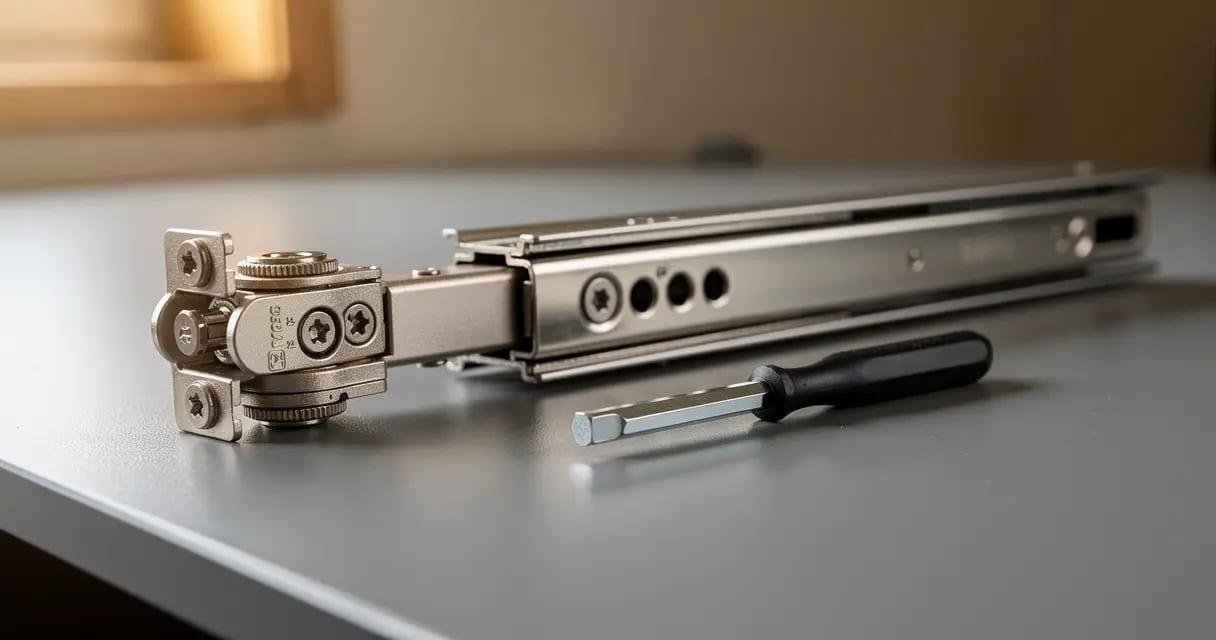
A kitchen gets judged on the door first: the colour, the texture, the finish. The door is not what decides whether a cabinet holds up for ten years or loosens after two. That work falls to the hinges, the drawer slides, and the edge banding on the panel, opening after opening, drawer after drawer. Here is what to look for on a kitchen cabinet quote before you sign.
Hinges: integrated soft-close, opening angle, three-way adjustment
A kitchen door hinge opens and closes several times a day, for years. Three features decide whether it holds that pace.
- An integrated soft-close damper slows the door in the last few degrees of closing, instead of letting it slam. A hinge without one closes with a hard snap, and that repeated impact wears the mechanism and loosens the cabinet screws over time.
- A standard opening angle runs around 110 degrees. Some hinges open to 165 or 180 degrees, for corner cabinets or a door that needs to clear a neighbouring drawer. A hinge limited to 90 or 95 degrees can block the door before it clears the opening.
- Three-way adjustment lets the door be aligned after installation: height, depth, and side to side. A hinge with only two-way, or one-way, adjustment is harder to correct as the cabinet shifts with the seasons, and the door ends up out of line from one end of the kitchen to the other.
On a quote, a hinge with integrated soft-close and three-way adjustment gets named as such, with its opening angle specified. A line that just says "hinges included" says nothing about what matters.
Drawer slides: full extension, undermount, load rating in pounds
A kitchen drawer carries more weight than a door, and it carries it in motion, several times a day. The slide underneath it gets judged on three points.
- Full extension lets the drawer open to its complete depth. Partial extension, the cheaper option, leaves part of the drawer out of reach at the back of the cabinet. For a kitchen drawer, full extension should be the standard, not the upgrade.
- An undermount slide sits under the drawer and stays hidden once the drawer is closed. A side-mount slide sits on the sides and shows when the drawer is open. Both carry the load, but undermount gives a cleaner look and a quieter drawer.
- Load rating is given in pounds per pair. A utensil drawer rarely carries more than 30 to 40 pounds and does fine on a standard slide. A pot drawer, or a drawer holding small appliances, carries more, and its rating should show up on the quote when the drawer is deep.
Soft-close exists for slides too, not just hinges. On a drawer that closes several times a day, it is the same wear at work, just on rails instead of a pivot.
What is on a quote, and what never is
A kitchen quote almost always spells out the door finish: colour, texture, sometimes the panel supplier. It rarely spells out the hardware holding those doors in place.
- The number of hinges per door shows up sometimes. Their opening angle and adjustment type, almost never.
- Panel thickness, usually 16 mm or 18 mm melamine, shows up often. Edge banding thickness, almost never.
- The panel supplier gets named freely. The hardware brand and model often stay a generic line item: "hardware included."
- The warranty usually covers the cabinet box and the finish. It rarely spells out what it covers on hinges and slides, which are the parts that wear out first.
A thinner panel with a richer-looking finish can look better on a quote, while a thicker panel, a thicker edge, and named hardware will outlast it without showing up in a photo. How long a cabinet lasts comes down to the construction and the hardware, not just the visible finish on the panel.
Edge banding: 0.5 mm, 1 mm, 2 mm, and why the gap shows up ten years in
Edge banding is the strip that seals the cut edge of a panel, exactly where moisture and impact reach it first. Its thickness is measured in millimetres, and the gap between the common thicknesses does not show up at delivery. It shows up ten years later.
| Edge banding thickness | At delivery | After several years |
|---|---|---|
| 0.5 mm | Thin, nearly invisible, the least expensive to apply | Peels more easily at the corners, lets moisture reach the panel |
| 1 mm | More noticeable to the touch, a slightly rounded corner | Holds up better against impact and moisture, the common thickness for a kitchen |
| 2 mm | A more defined edge, a more solid feel to the touch | Withstands repeated impact (pots, door handles), stays sealed at the corners that take the most use |
Edge banding thickness does not show up in a quote photo. It has to be asked for. A supplier who knows their panels answers in millimetres, not in adjectives.
Repair instead of replace: what good hardware makes possible
Quality hinges and slides get replaced piece by piece, without touching the door or the cabinet box. The boring pattern for concealed hinges, a 35 mm hole in the door, is shared across most manufacturers, which makes one hinge swappable for another without redrilling.
- The soft-close damper wears out before the rest of the hinge. On a good hinge, it gets replaced on its own, without swapping the arm or the cup.
- Three-way adjustment absorbs the building's movement. A door that goes out of line after a few years gets corrected with a screwdriver, without taking anything apart.
- A slide that squeaks or catches gets replaced by removing a few screws, without touching the drawer box itself when the model is standard.
- Generic hardware, with no brand or model identified, makes this harder: you have to guess at the replacement part instead of ordering it.
That is why hardware gets named on a serious quote. A replaceable part extends the life of the whole cabinet. An anonymous one sometimes forces a full door replacement over one worn-out damper.
Have your quote checked before you sign
Bring in your current quote, and we will go through the hardware with you: hinges, slides, edge banding thickness. Atelier Multidécor builds custom kitchen cabinets in Saint-Siméon-de-Bonaventure, in the Gaspé, since 1994, CNC cutting and hand finishing under one roof.
Frequently asked questions
What is three-way hinge adjustment?
It is the ability to adjust a kitchen door in three directions after installation: height, depth, and side to side. This adjustment corrects the misalignment that shows up as the cabinet shifts with the seasons, without taking the door off.
What is the difference between a full-extension and a partial-extension drawer slide?
Full extension lets the drawer open to its complete depth. Partial extension leaves part of the drawer out of reach at the back of the cabinet. For a kitchen drawer, full extension gives complete access to the contents.
Why should edge banding thickness show up on a quote?
Edge banding seals the cut edge of the panel against impact and moisture. A 0.5 mm edge costs less to apply but peels more easily at the corners over the years. A 1 mm or 2 mm edge holds up better, and the gap between them shows up after years of use, not at delivery.
Does a heavier kitchen door need different hardware?
Yes. A larger door or a deep drawer needs hinges or slides with a higher load rating. A pot drawer, for example, carries more than a utensil drawer, and its slide should be chosen accordingly.
Can a hinge or slide be repaired instead of replacing the cabinet?
Often, yes, when the hardware is identified and standard. A hinge's soft-close damper can be replaced on its own. A slide that catches can be swapped without touching the drawer. It is generic, unidentified hardware that makes this kind of repair difficult.