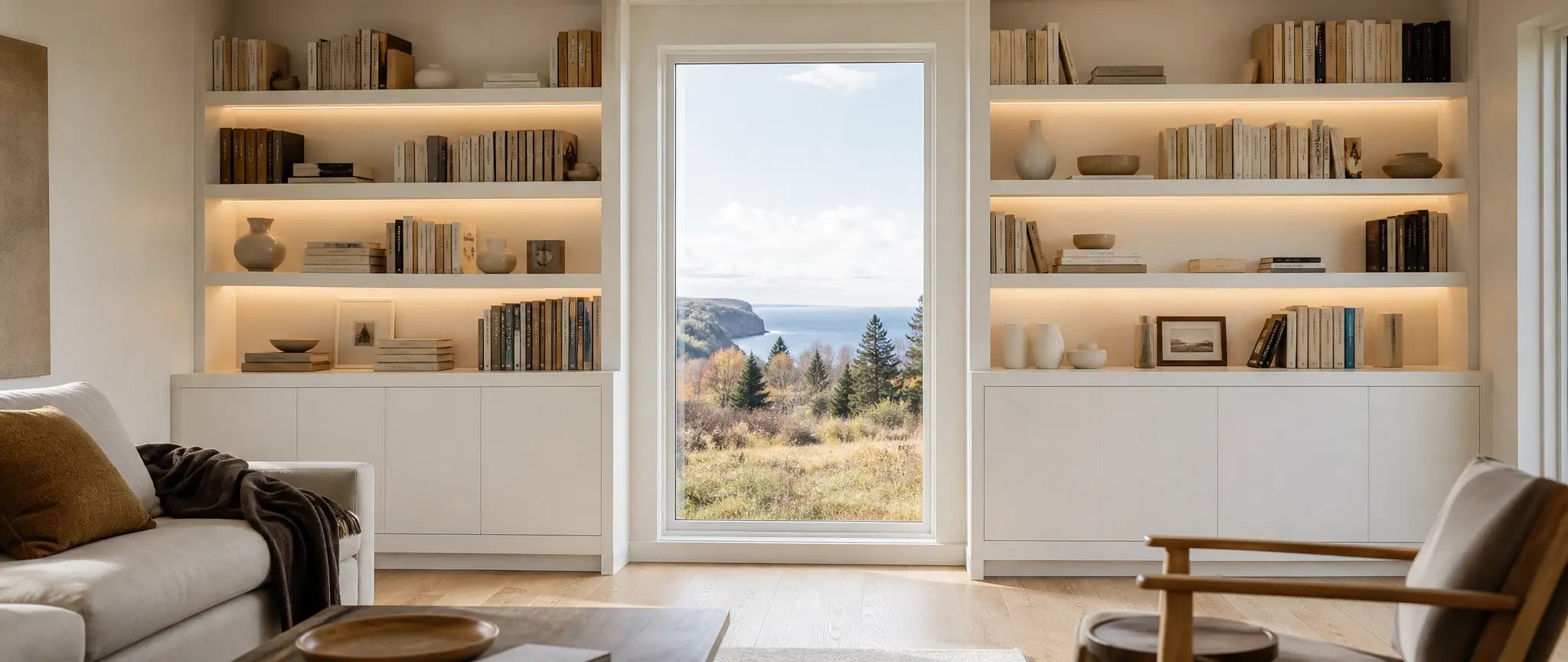
Custom wall bookcase: shelf span, depth and wall anchoring
A wall bookcase built to your dimensions fits the room from baseboard to ceiling. These are the numbers that decide whether it stays straight and feels right: span, depth, lighting and the way it is fixed to the wall.
A custom wall bookcase comes down to three choices: how far each shelf spans, how deep it is, and how it is anchored to the wall. Built to your room's measurements, it avoids the gaps and the leftover space that come with a catalogue unit.
This guide covers what people ask on the first call: how far a shelf of books can reach before it bows, which depth to pick, how to work around a window or a door. The figures are common practice. The workshop adjusts them to your wall and to what you will store.
How far can a shelf of books span before it sags?
A shelf bows first at its centre. The longer the span (the distance between two uprights), the more it sags, and much faster than the span itself: doubling the distance multiplies the deflection by far more than two. Bound books are heavy, around 17 lb per linear foot (25 kg per metre), a common order of magnitude.
- A 3/4 in (18 mm) melamine panel loaded with books holds well at about 30 in (75 cm) of span. That is a rule of thumb, not a standard.
- A 5/8 in (16 mm) panel calls for a shorter span.
- To cover more distance, add an intermediate upright.
- You can also stiffen the shelf with a rail under its front edge.
- Light objects (frames, vases, paperbacks) tolerate a longer span.
Every bookcase is a piece of custom cabinetmaking: the workshop can build it to your dimensions and checks the span of each shelf at the drawing stage, against the load you plan to put on it.
Which depth should you choose, and are adjustable or fixed shelves better?
A shelf that is too deep lets books slide to the back, out of sight. One that is too narrow lets them hang over the edge. Depth follows what the bookcase carries.
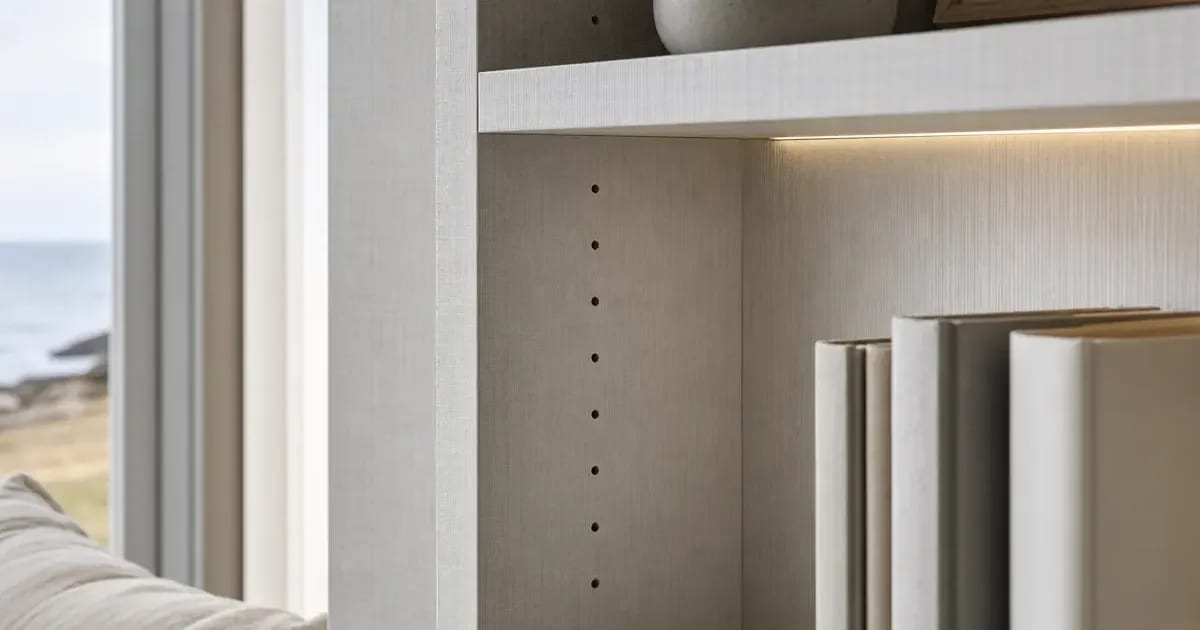
Adjustable shelves sit on a row of holes spaced 1 1/4 in (32 mm) apart, a common system. They let you change the height when your books change. A fixed shelf stiffens the cabinet and gives a cleaner line. A good compromise mixes both: fixed shelves at a few key levels, adjustable ones between them.
| Use | Common depth | Worth knowing |
|---|---|---|
| Paperbacks | 6 to 8 in (15 to 20 cm) | Little wasted space behind the books |
| Novels and bound books | 10 to 12 in (25 to 30 cm) | The most common depth |
| Large books and albums | 12 to 14 in (30 to 35 cm) | Plan the clear height between shelves too |
| Frames and decor | 6 to 10 in (15 to 25 cm) | A shallow shelf keeps objects in view |
| Closed base cabinet | 16 to 20 in (40 to 50 cm) | Doors or drawers, with a landing surface on top |
Common-practice guides. A custom build adjusts them to the room and to what goes inside.
How do you add lighting and closed base cabinets?
An LED strip tucked under a shelf edge lights the books without a visible fixture. The drawing can include a groove to hold it and a route for the wire to the power source. Connecting to the mains is a job for an electrician: the workshop prepares the bookcase and does not do electrical work.
Closed base cabinets, with doors or drawers, hide games, files and cables. Heavy items go there, close to the floor. Their top gives you a landing surface, since they are often deeper than the shelves above. If the bookcase surrounds a television, see our guide to the custom TV unit.
How do you build around a window or a door?
A custom bookcase is built in sections and fitted around openings. Walls are seldom square, so measurements are taken on site.
- Around a window: one section on each side, with a return on the wall to frame the opening. Leave clearance for the casing and the window sill.
- Over a door: a bridging cabinet (a header) joins the sections on either side, while the door still swings freely.
- In front of a baseboard heater or an air grille: leave the clearance warm air needs to circulate.
The workshop's portfolio gives a sense of how custom furniture fits into a room. A 2D or 3D plan can be prepared on request before anything is built.
Does a wall bookcase need to be anchored to the wall?
Yes, and so does any tall piece loaded with books. A unit that tips over is a hazard, especially with children in the house. It is fixed into the wall studs through a mounting rail at the back of the cabinet, with screws suited to the wall. Drywall with no stud behind it needs an anchor made for that kind of wall.
A wall or floor that is out of square needs an adjustment too. It is absorbed with trim pieces and a notched baseboard rather than visible shims. In the Baie-des-Chaleurs the workshop handles installation on residential projects. Elsewhere in the Gaspé, installation or delivery is discussed on request, case by case.
Melamine or another finish: what suits a bookcase?
Textured melamine is the workshop's most common finish: a uniform surface, tough, easy to clean, in a wide range of colours and textures. The panels come from suppliers such as Uniboard, Olon (including its Cashmere collection), Sublime Collection and AGT. On a bookcase it gives shelves you wipe down with a cloth and tones that match the room.
Other finishes exist: thermoplastic, polymer, polyester, laminate, and solid wood for projects that call for it. The materials guide compares their uses. Every piece is made to order: whether it can be done, and when, is confirmed on the first call, based on the workshop's schedule.
The spans and depths in this post are common cabinetmaking practice, not a standard. Since we cannot vouch for an outside source, the panels are described on the Atelier Multidécor materials page.
A bookcase sized to your wall?
Tell us about the room, the dimensions and what you will store. In business since 1994, the workshop tells you plainly what can be built. Phone: 418-534-4167.
Frequently asked questions
How deep should a wall bookcase be?
For novels and bound books, 10 to 12 in (25 to 30 cm) is the most common depth. Large books need 12 to 14 in (30 to 35 cm). A custom build sets the depth to the contents and to the space in the room.
How much weight can a bookshelf hold?
It depends on the panel thickness, the span between uprights and how the shelf is supported. A linear foot of bound books often weighs about 17 lb (25 kg per metre). The workshop checks each shelf's span at the drawing stage, against what you plan to store.
Does a wall bookcase have to be fixed to the wall?
Yes. A tall, loaded unit can tip over, especially with children around. It is fixed to the wall studs with suitable screws, or with an anchor made for the wall when no stud is within reach.
Can you build a bookcase around a window or a door?
Yes. The bookcase is built in sections that frame the opening, with a bridging cabinet over the door where needed. Measurements are taken on site, because walls are seldom square.
Do you build bookcases anywhere in the Gaspé?
The workshop offers its full service in the Baie-des-Chaleurs: measuring, design, delivery and installation. For the rest of the Gaspé, a project is discussed on request, case by case. Ask on the first call.