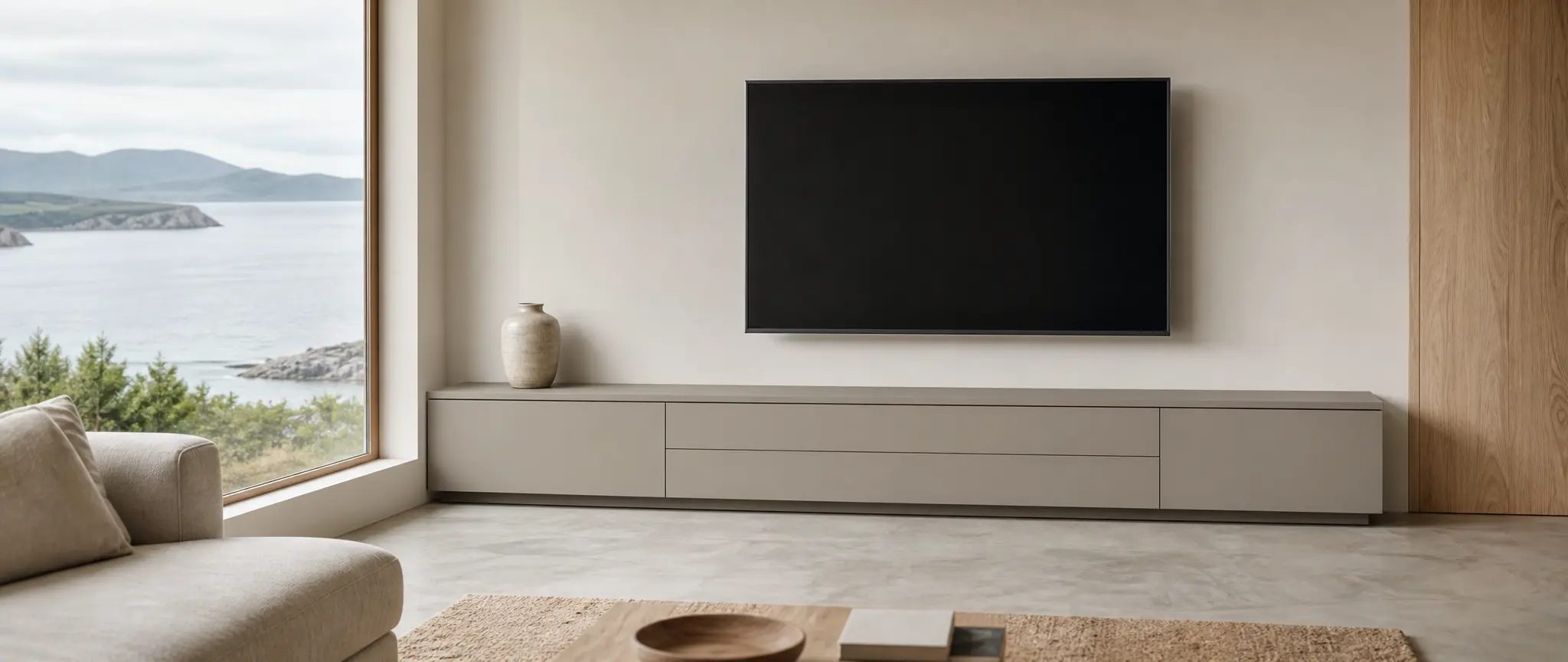
Custom TV unit: how to choose between a low cabinet and a built-in wall
A custom TV unit is sized from your screen, your room and the gear you own. Here is how to choose between a low cabinet and a full wall, and what to plan for cables and console heat.
A custom TV unit is drawn from three measurements: the width of your screen, your viewing distance and the equipment it has to hold. Atelier Multidécor builds it to your dimensions, most often in melamine, at its workshop in Saint-Siméon-de-Bonaventure on the Baie-des-Chaleurs.
This post answers the questions that come up most: low cabinet or built-in wall, height and width, cables, console ventilation, closed or open storage, and finishes. The sizes below are common industry standards. A custom build adjusts them to your room.
Low TV cabinet or built-in wall: what is the difference?
A low cabinet is a long sideboard under the screen. A built-in wall runs the full height of the room and sets the screen into the whole unit. Here is what each one holds and how it is built:
- Low cabinet: one long carcass under the screen, with doors, drawers and shelves for the equipment. The screen mounts on the wall or sits on a stand.
- Built-in wall: carcasses from floor to ceiling, a recess for the screen, closed storage on each side and open shelves.
- Corner or uneven wall: each carcass is cut to measurements taken on site, not to a catalogue width.
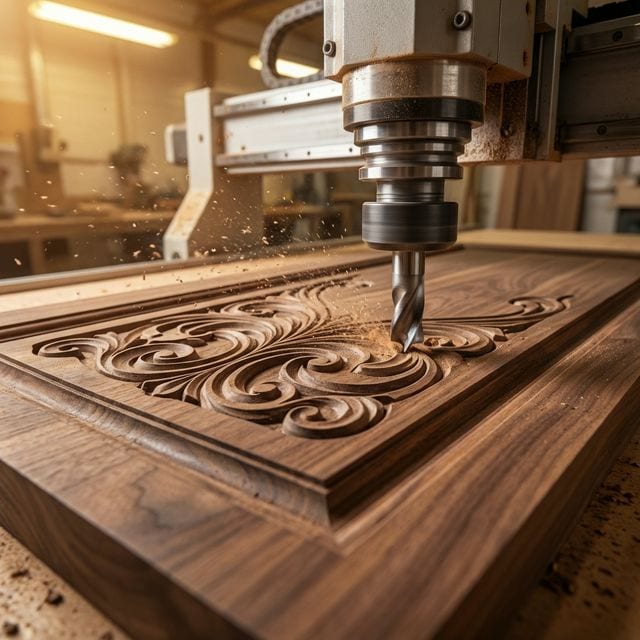
The choice depends on the room and on what you want to store. A low cabinet suits a living room where the wall stays clear. A full wall suits a home where books, games and equipment need to live in one place. The workshop's custom fabrication covers design from plans, CNC machining and hand finishing. A 2D or 3D plan can be prepared on request.
How do you size a TV unit to the screen?
Start from the screen, not the cabinet. A 16:9 TV is about 0.87 times its diagonal in width. A 65 in (165 cm) screen is therefore close to 4 ft 9 in (144 cm) wide, without the bezel or the stand. The unit should be at least as wide as the screen. These are the usual reference points:
- Width: the screen's width, plus room on each side for speakers or shelves.
- Screen height: the centre sits roughly at seated eye level, around 3 ft 3 in (100 cm) from the floor in most living rooms.
- Low cabinet height: common standards run from 18 to 24 in (45 to 60 cm). The screen is then set above it.
- Depth: 16 to 20 in (40 to 50 cm) to hold a console and a receiver, with room for cables behind.
Viewing distance sets the sensible screen size for the room. A common guide puts the viewer 1.2 to 1.6 times the diagonal away. The table applies that guide to four common screen sizes as of November 2026. Always check the data sheet for your own model.
| Diagonal | Width | Height | Viewing distance guide |
|---|---|---|---|
| 55 in (140 cm) | 4 ft (122 cm) | 27 in (68 cm) | 5 ft 7 in to 7 ft 3 in (1.7 to 2.2 m) |
| 65 in (165 cm) | 4 ft 9 in (144 cm) | 32 in (81 cm) | 6 ft 7 in to 8 ft 6 in (2.0 to 2.6 m) |
| 75 in (191 cm) | 5 ft 5 in (166 cm) | 3 ft 1 in (93 cm) | 7 ft 7 in to 9 ft 10 in (2.3 to 3.0 m) |
| 85 in (216 cm) | 6 ft 2 in (188 cm) | 3 ft 6 in (106 cm) | 8 ft 6 in to 11 ft 6 in (2.6 to 3.5 m) |
Calculated from the 16:9 ratio, without bezel or stand. Other viewing-distance guides exist. A custom unit is fitted to your actual screen.
What do you need to plan for cables and console ventilation?
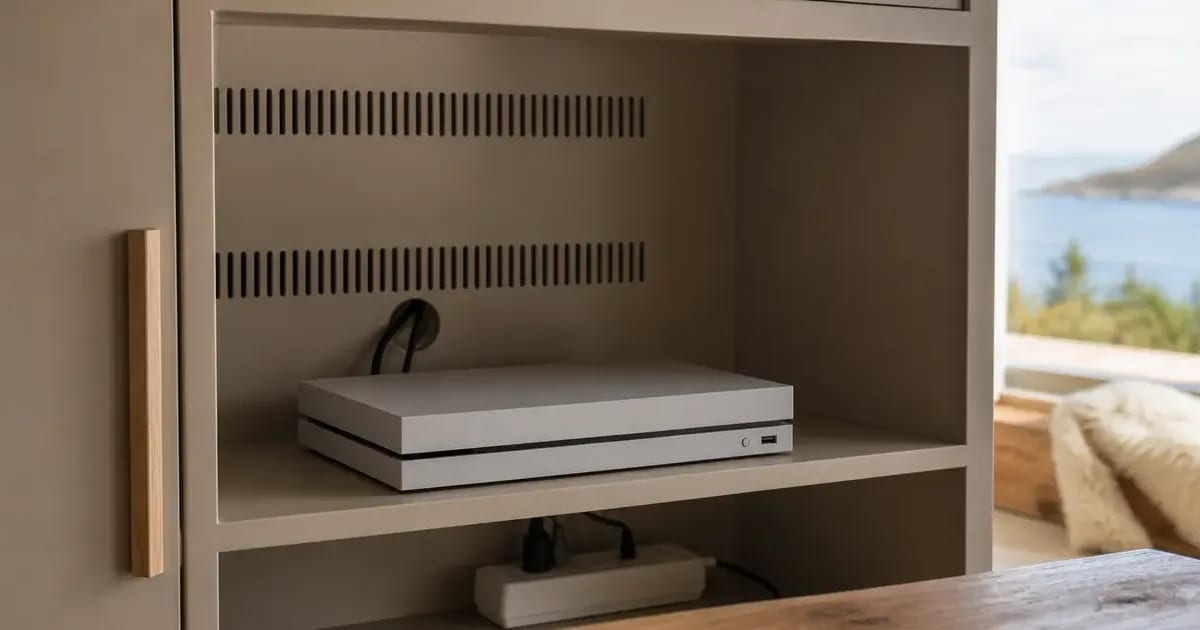
Game consoles, receivers and amplifiers give off heat. Each device's manual states the clear space to leave around it. A custom unit builds that in from the drawing:
- ventilated openings in the back panel or the sides of the carcass, in line with the equipment;
- shelves set at the exact height of each device, with air above it;
- cable passages drilled through the shelves and the back, so devices connect without taut cords;
- a space for a power strip that you can reach without emptying the unit;
- an open compartment, or a door that opens fully, so the remote reaches the equipment.
Running wires inside the wall or adding an outlet behind the screen is an electrician's job. The workshop builds the unit and its cable passages. It does not do electrical installation.
Closed or open storage: what goes behind the doors?
Closed storage hides boxes, controllers and cords. Open storage keeps the soundbar, books and anything you want to display within reach. Most units mix the two:
- flat doors for controllers, games, cords and albums;
- drawers for discs, cards and small items;
- open shelves for the soundbar and books;
- a ventilated recess for the router, so it does not overheat in a closed carcass.
Fronts come in melamine, polymer or thermoplastic, depending on the look you want. Our post on melamine, polymer and thermoplastic explains what each surface offers.
Which melamine should you pick for a TV unit that lasts?
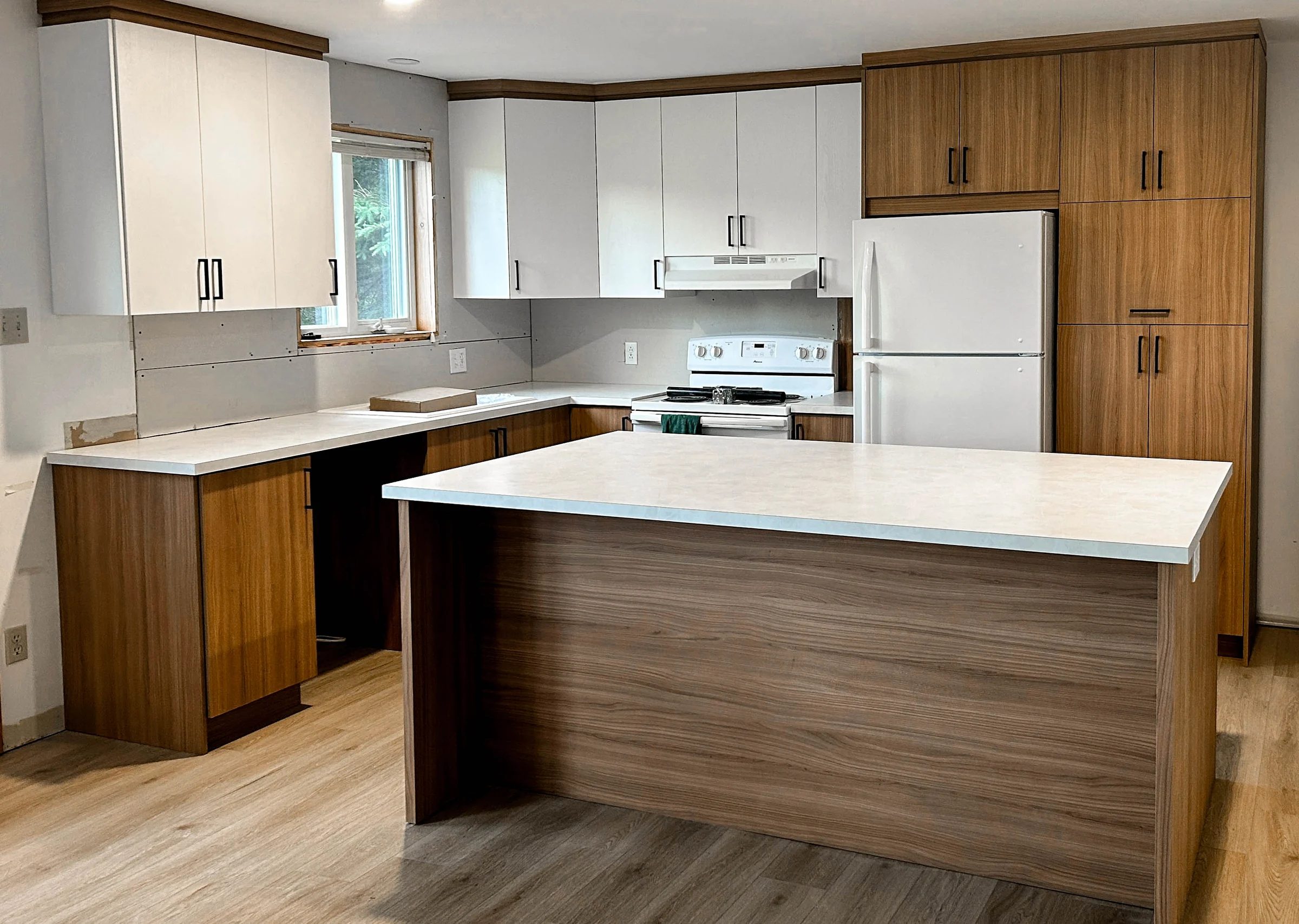
For a living-room unit, melamine is a durable contemporary choice. The surface is uniform, hard-wearing and easy to clean, and the range of colours and textures is wide. The workshop works with panels from four suppliers:
- Uniboard;
- Olon, including its Cashmere collection, with a matte texture and a soft touch;
- Sublime Collection;
- AGT.
The CNC cuts each part to your unit's dimensions. A matte surface such as Olon's Cashmere reflects less room light than a glossy one, which matters around a screen. Our guide to materials and finishes lays out the options.
How do you order a custom TV unit from the workshop?
An order for a TV unit follows four steps:
- Send the wall measurements, your screen's diagonal and the list of equipment to house.
- The workshop checks feasibility and proposes a layout: low cabinet or full wall, doors, drawers, shelves.
- You pick the finish. You receive a quote, and nothing starts before you approve it.
- The unit is built, then installed within the Baie-des-Chaleurs. Elsewhere in the Gaspé, installation is discussed on request, case by case.
Feasibility and timing are confirmed on the first call, based on the work already in the shop. To see how the workshop works before you phone, browse the portfolio.
Screen dimensions are listed on your TV maker's data sheet. Since we cannot cite a public standard with certainty, we point to the finishes described on the Atelier Multidécor materials page.
A TV unit to draw to your measurements?
Send us your screen's diagonal and the wall measurements. In business since 1994, the workshop tells you what can be made, and when. Phone: 418-534-4167.
Frequently asked questions
What height should a TV unit be?
Common standards for a low cabinet run from 18 to 24 in (45 to 60 cm). The centre of the screen sits roughly at seated eye level. A custom unit sets the height to suit your sofa and your screen.
How wide should a unit be for a 65 in (165 cm) TV?
A 65 in (165 cm) screen is close to 4 ft 9 in (144 cm) wide, without the bezel or stand. The unit should be at least that wide, and wider if you want shelves or speakers on each side. Check the data sheet for your model.
Do you make a TV unit in wood?
Most of the workshop's units are in melamine, polymer or thermoplastic. Solid wood is possible on request, for projects that call for it. Describe your idea on the first call and we confirm what can be done.
How do you ventilate a unit that holds a game console?
Follow the device's manual, which states the clear space it needs. A custom unit includes ventilated openings in the back and shelves at the right height, with air around the console.
Do you install a TV unit outside the Baie-des-Chaleurs?
Installation and delivery are offered within the Baie-des-Chaleurs. For the rest of the Gaspé, they are discussed on request, case by case, depending on the unit and its size. Ask when you request a quote.