Melamine, Polymer, Thermoplastic: Choosing a Finish Without Choosing a Budget
Most kitchen finish comparisons read like a price list, melamine at the bottom. That is the wrong question to ask first.
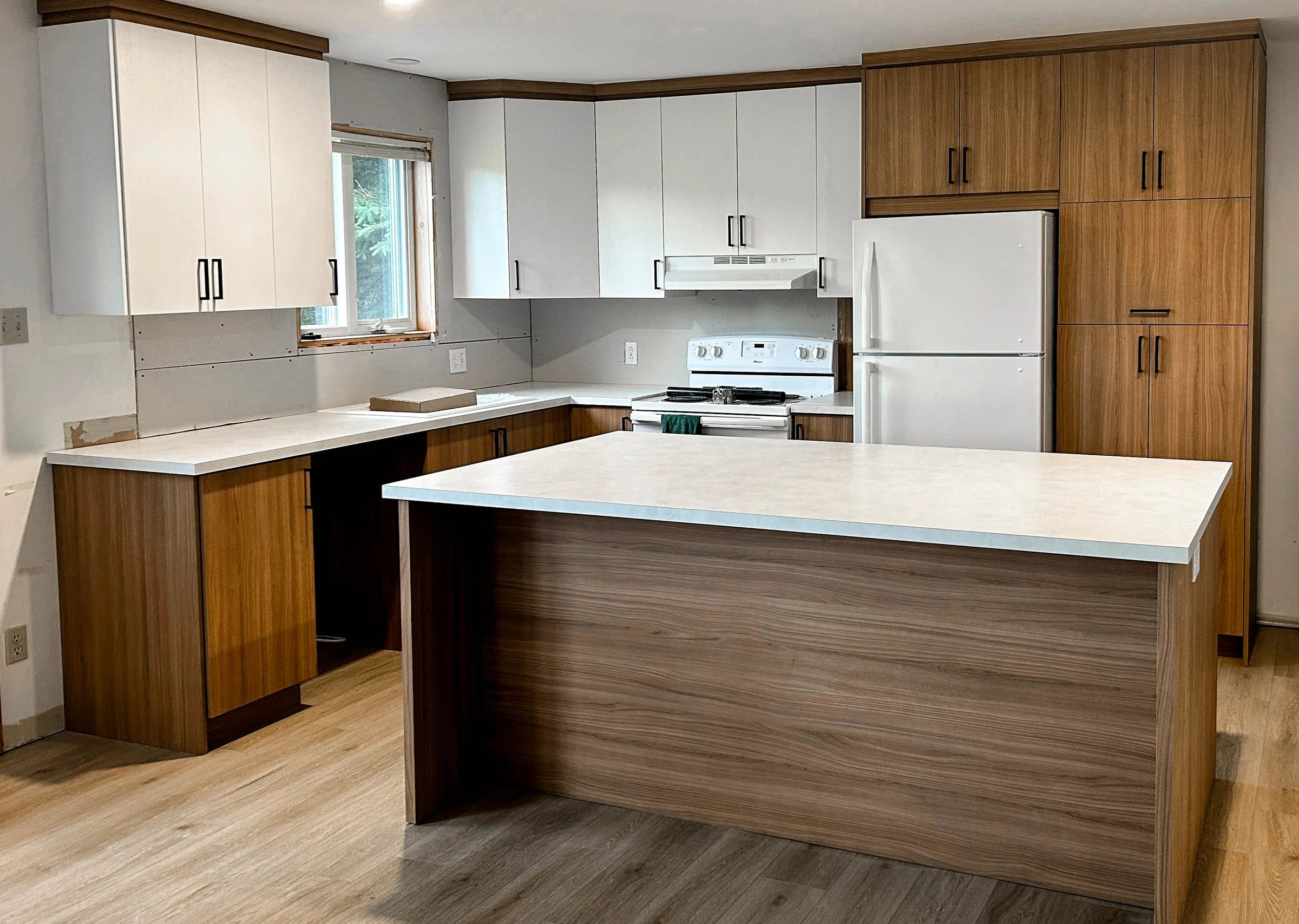
A kitchen is not one surface: it is a cabinet next to the oven, an island with rounded corners, a vanity that takes on humidity every morning, a drawer opened fifty times a day. Each situation puts a different physical demand on the finish, and the four main finish families do not behave the same way under each one. This guide orders finishes by what they do, not by what they cost.
Four finishes, four different physical behaviours
Four words show up in nearly every kitchen quote, and they do not name the same thing.
- Textured melamine (TFL) is a particleboard or MDF panel with a decorative paper thermally fused onto it with melamine resin. The result is a flat, hard surface available in a wide range of colours and textures. Once fused, the resin does not soften again.
- Matte or satin polymer is a polymer coating applied or pressed onto a profiled MDF door front. Unlike a flat sheet glued edge to edge, a pressed polymer can follow a machined contour and wrap the profile without the visible edge-band line of a flat panel.
- Thermoplastic is not primarily a look, it is a process. A film is heated, then vacuum-pressed onto a cut and shaped MDF panel. The film molds itself to the profile, curves included, with no seam.
- Polyester, often in high-gloss or satin finish, is a resin coating applied at the factory. The glossy version shows fingerprints faster than a matte one, which changes daily upkeep more than it changes the material's durability.
Four processes, four behaviours. Melamine and polyester are flat panels, cut and edge-jointed piece by piece. Polymer and thermoplastic are pressed coatings that wrap a profile already shaped. That manufacturing difference, more than the price tag, decides what each finish does well.
Heat, humidity, wear: what each room demands
The same kitchen holds several microclimates, and a finish that excels in one can be the wrong choice in another.
| Demand | Where it shows up | Finish that holds up |
|---|---|---|
| Sustained heat | Cabinet next to the oven or range wall | Textured melamine (heat-cured resin, stable) |
| Constant humidity | Bathroom vanity, island near the sink | Polymer or thermoplastic (continuous wrap, fewer exposed seams) |
| Repeated impact | Kitchen drawers, pantry doors | Textured melamine (hard, abrasion-resistant surface) |
| Daily upkeep | Island, integrated handles, high-touch surfaces | Matte or satin finish (melamine, satin polymer) over high-gloss polyester |
Heat. A cabinet right next to an oven or built into a range wall takes on sustained heat, day after day. Melamine resin is heat-cured: it does not soften or warp under this kind of ordinary use heat. A thermoplastic coating is applied under heat at the factory, which does not make it a fragile material, but the trade caution stands: keep a heat-pressed panel a reasonable distance from a sustained heat source rather than mounting it directly against one.
Humidity. A bathroom vanity or an island next to the sink takes on water every day, often in the same spot. A flat panel like melamine or polyester depends on its edge to stay sealed: it is the seam, not the surface, that decides how it holds up over time. A polymer or thermoplastic wraps the profile in one continuous piece, with fewer seams exposed to water on the front face. It is not that melamine fears water, it is that edge construction matters more than the material choice.
Impact. A kitchen drawer opened several times a day, a pantry door hit by a grocery bag: textured melamine holds up well against surface abrasion because its resin is hard and fused through, not just applied on top.
Upkeep. A high-gloss finish shows every fingerprint under kitchen lighting. A matte or satin finish, textured melamine or satin polymer, absorbs light differently and needs less wiping to stay presentable.
Curves and no-seam wraps: what only thermoplastic gives you
A rounded island end, a bar counter with a curved lip, a cabinet corner that follows a curve instead of a square angle: these are shapes a flat panel cannot follow without leaving a line.
Melamine and polyester are flat sheets. On a curve, they either need a visible seam or a separate bending step for the panel itself, one that does not apply to every thickness or every radius. Either way, the edge shows.
Thermoplastic works differently. The heated film is vacuum-pressed onto a profile that is already shaped, curves included. It molds to the contour, adheres across the whole surface including recesses and rounded edges, and leaves no seam line. It is the only one of the four processes that wraps a curved shape in one continuous piece, top to bottom, with no visible cut.
This is not a style argument. It is a real manufacturing constraint: if a project calls for a curved profile with a seamless finish, thermoplastic is the only one of the four that meets that specific requirement. The other three remain excellent choices elsewhere, on straight forms.
What the workshop builds in house, and what it has made, stated plainly
Stated plainly: the workshop does not build everything on site, and that is not a secret.
Cabinet boxes, shelves, and textured melamine doors are cut, profiled, and edge-banded right at the workshop, on the 4x8 CNC, from Uniboard, Olon, Sublime Collection, or AGT panels. Assembly and finishing are done by hand, under the same roof, in Saint-Siméon-de-Bonaventure.
Polymer or thermoplastic doors, especially curved profiles or molded shapes, need a vacuum-pressing step, a distinct process that runs on equipment the workshop does not have on site. These doors are ordered already formed from a specialized manufacturer, then received, fitted, and installed into the box built at the workshop. The workshop also has no paint booth: nothing is painted on site, in melamine or in polymer. These are factory-applied coatings, not paint.
This split is not a hidden compromise. It is the normal logic of the trade: a CNC-precision workshop cuts and finishes what a CNC cuts and finishes well, and calls on a specialized manufacturer for a process that needs different equipment.
Choosing room by room, not by overall budget
A full kitchen does not need one finish picked once for every room. The reverse logic, the one this guide makes, works room by room.
Against the range wall, textured melamine stays the most heat-stable choice. On the bathroom vanity, polymer or thermoplastic limits the seams exposed to daily tap water. On a rounded island end, only thermoplastic wraps the curve without leaving a line. On everyday drawers and pantry doors, textured melamine holds up to abrasion and cleans easily.
None of these decisions come from a price list. They come from looking at the room: what heats it, what dampens it, what touches it, what needs to take a shape. Melamine wins several of these decisions on the merits, because it is the workshop's most common finish and the one thirty years of kitchens still in service give the most real track record on.
Materials and finishes →Let's talk about your project's finishes
Write to us with the rooms involved and what each one is up against: heat, humidity, shape, upkeep. Atelier Multidécor has built custom cabinetry in Saint-Siméon-de-Bonaventure, Gaspésie, since 1994. CNC and hand finishing under one roof, for melamine, polymer, and thermoplastic alike.
Frequently asked questions
What is the difference between melamine and polymer for kitchen cabinets?
Melamine is a flat panel: a decorative sheet thermally fused onto a particleboard or MDF panel, cut and edge-banded. Polymer is a coating pressed onto an already-profiled panel, which lets it wrap a contour without the edge-band line of a flat panel. Both are durable; the choice comes down to the shape you need, not one material being better than the other.
Does thermoplastic hold up better to humidity than melamine?
Thermoplastic wraps a profile in one continuous piece, with fewer seams exposed to water on the front face. Melamine remains an excellent bathroom choice when the edge is well sealed: it is the joint construction, not the surface itself, that decides long-term performance.
Can melamine be curved?
A slight curve can be bent on certain thin panels, but a pronounced curve or a molded profile, like a rounded island end, needs a continuous wrap process. That is what thermoplastic offers and what a flat melamine panel cannot reproduce without a visible seam.
Which finish needs the least daily upkeep?
A matte or satin finish, textured melamine or satin polymer, shows far fewer fingerprints than a high-gloss polyester finish. On an island or integrated handles, both touched constantly, that detail matters more than the purchase price.
Does the workshop make all of these finishes on site?
No, and we say so plainly. Melamine boxes and doors are cut and finished at the workshop on our 4x8 CNC. Polymer or thermoplastic doors with curved profiles are ordered already formed from a specialized manufacturer, then fitted and installed here.