A custom mudroom for a Gaspé winter: the measurements that matter
Wet boots, slush, road salt and heavy parkas all land in the same few square feet. A custom mudroom sets the depths, the surfaces and the airflow so that everything is dry by morning.
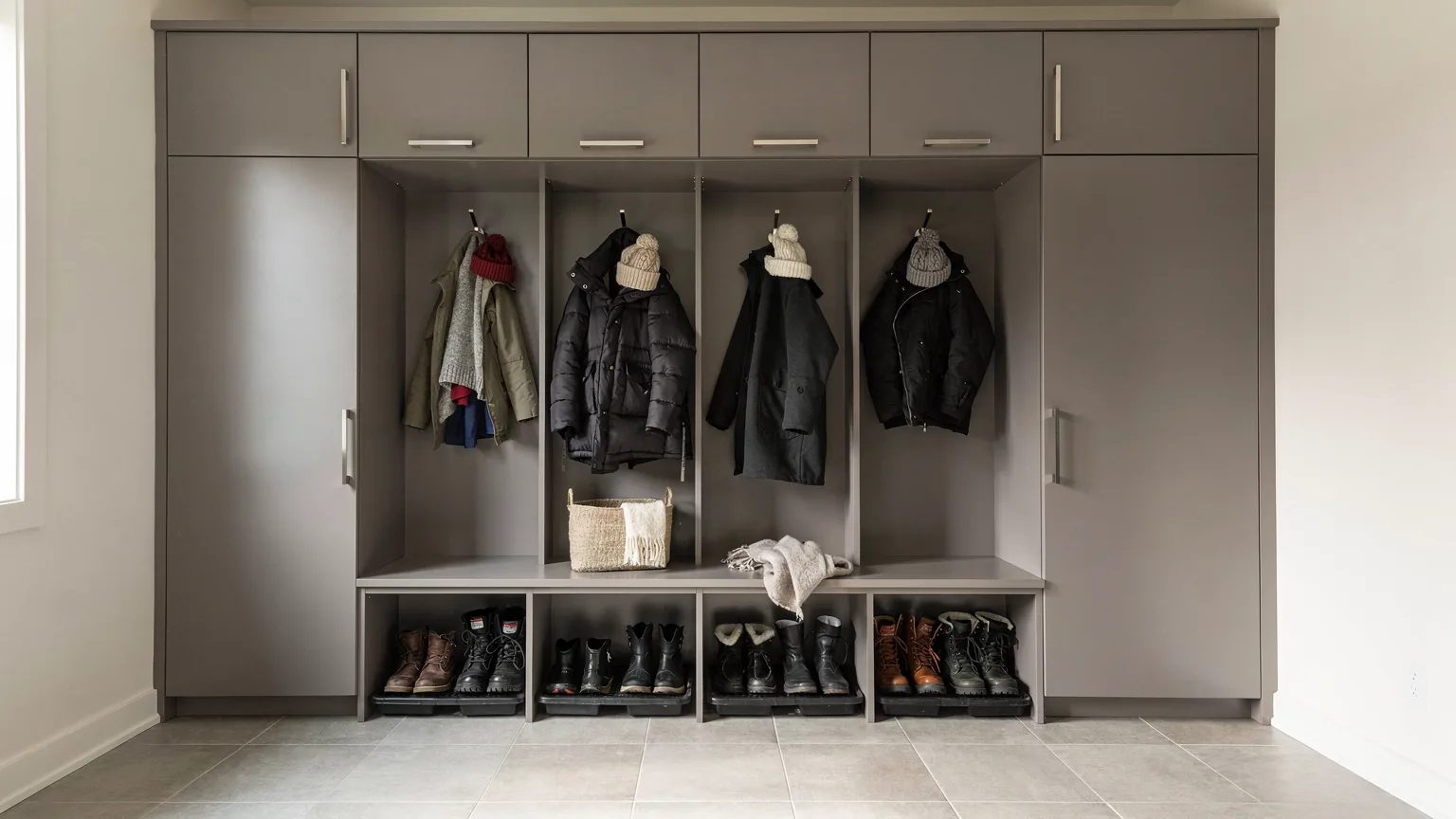
A mudroom has three jobs: hold the coats, dry the boots, and put up with water and salt for months. In the Gaspé, winter tests all three from December on.
This guide covers hook and hanger depths, entryway bench height, drying, lockers and surfaces. The numbers apply whether you have a full mudroom or one wall by the door.
Hooks or hangers: how deep does the closet need to be?
Depth comes down to one choice: hooks or hangers. Either works, but they claim different amounts of floor space.
- Coats on hangers need 24 to 26 inches (61 to 66 cm) of depth. Down parkas and snowmobile suits are thick, and they press against the doors in a shallow closet.
- Hooks alone need only 12 to 16 inches (30 to 41 cm). That suits a narrow hallway or a shallow entry.
- Adult hooks go about 60 to 66 inches (152 to 168 cm) off the floor.
- Children's hooks go between 36 and 48 inches (91 to 122 cm), where small arms reach.
These are the usual industry figures, and a custom build adjusts them to your household and your wall. Many entries mix both: hangers for the winter parkas, hooks for backpacks and everyday jackets. The workshop builds this kind of built-in storage to the exact measurements of your entry.
How tall and how deep should the entryway bench be?
The bench is where you sit to pull off wet boots, so its height matters more than its look.
- Set the seat 17 to 19 inches (43 to 48 cm) off the floor, about the height of a dining chair.
- A seat depth of 15 to 18 inches (38 to 46 cm) gives room for a boot without pushing into the walkway.
- Under the seat, a mudroom bench with storage holds baskets or a boot tray.
A ready-made entryway storage unit comes with fixed dimensions. A custom bench follows your wall to the centimetre. If you are weighing the two routes, our comparison of custom and ready-to-assemble closets lays out the differences.
| Part | Usual size | What it changes in winter |
|---|---|---|
| Bench seat height | 17 to 19 in (43 to 48 cm) | You take boots off sitting down, without bending far |
| Bench seat depth | 15 to 18 in (38 to 46 cm) | Room to set down a boot without blocking the walkway |
| Adult hooks, height | 60 to 66 in (152 to 168 cm) | Long coats clear the bench |
| Children's hooks, height | 36 to 48 in (91 to 122 cm) | A child hangs up a wet coat alone |
| Hanger closet, depth | 24 to 26 in (61 to 66 cm) | A down parka or snowmobile suit closes in without being crushed |
| Hooks only, depth | 12 to 16 in (30 to 41 cm) | Fits a narrow hallway, and coats hang in open air to dry |
These are the usual industry figures. A custom build adjusts them to your household and your wall.
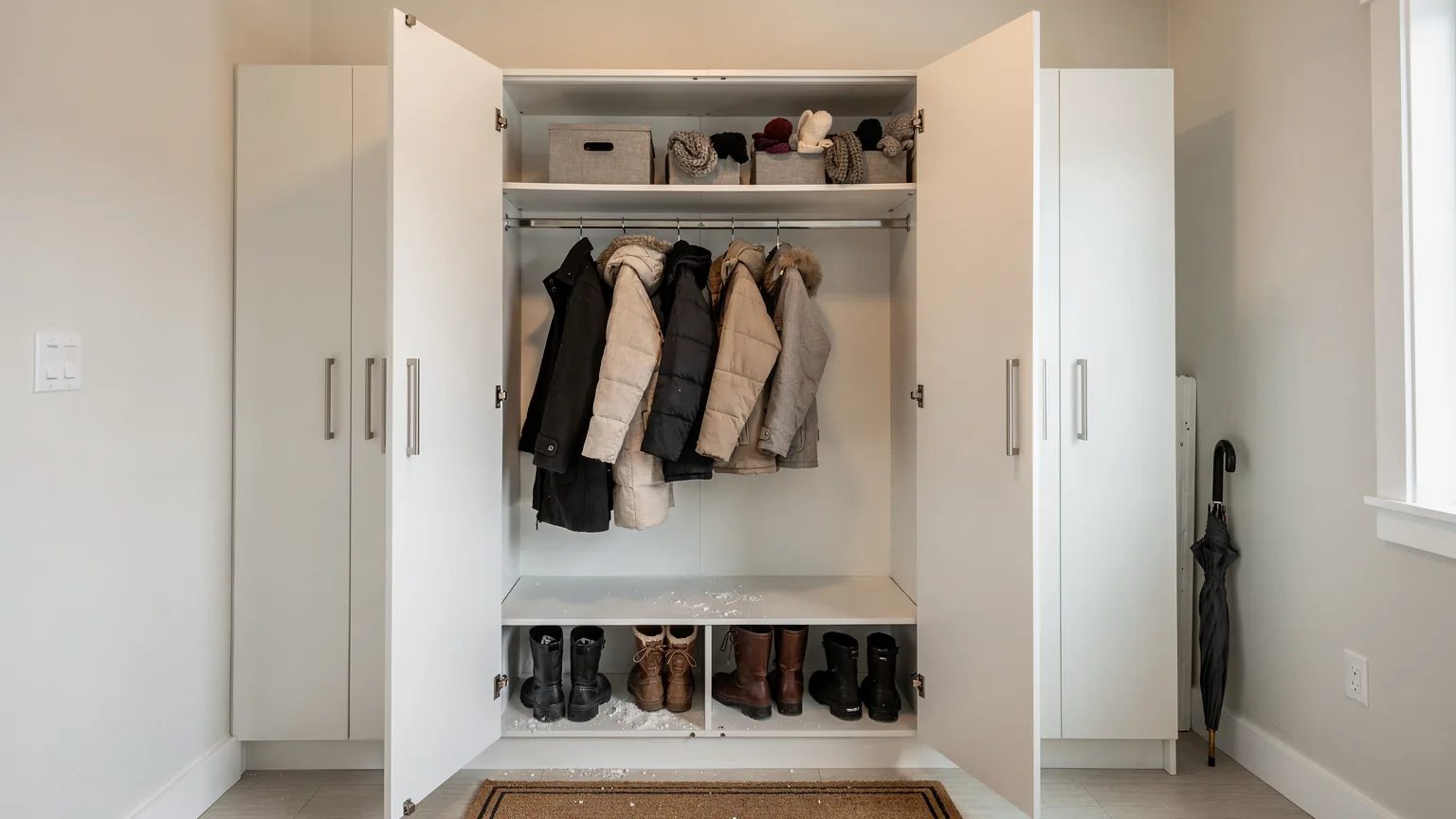
How do you get boots and coats dry by the next morning?
Damp boots in a closed cabinet stay damp. The water evaporates, but it needs somewhere to go, so the design has to let air move.
- A boot tray on the floor catches slush and salt. It lifts out and rinses clean without touching the cabinet.
- Open cubbies, with no doors, let air pass around parkas, hats and mittens.
- If you prefer doors, ask for ventilated ones: openings at the top and bottom let air in and out.
A closed room where moisture stays trapped wears down materials and can encourage mould. Drying is a design requirement, just like the number of hooks.
One locker per person, and closed storage for the off-season
In a family, everything mixes fast: hats, mittens, four sizes of boots. A locker per person solves it, and a well-planned mudroom has as many as there are people living in the house.
- Each locker gets its own hooks, a shelf for the hat and mittens, and a spot on the floor for boots.
- Every cabinet box is built to the room's measurements, so no space is lost between the lockers and the walls.
- A locker sized for a child lets the child put things away alone.
Above the lockers, closed cabinets hold whatever is out of season: sun hats, light jackets, sandals, or the winter gear in summer. Closed doors keep the clutter out of sight. A custom alternative to store-bought modules also uses the full wall height, up to the ceiling.
Which surfaces handle water and road salt?
The entry floor takes slush, sand and salt. The cabinet takes splashes and boot knocks.
- Melamine gives a uniform, hard-wearing surface that is easy to maintain. A damp cloth wipes off salt marks.
- The weak point of any panel is its cut edge. Edge banding sealed along the whole edge keeps water out.
- Keep panels about 4 inches (10 cm) off the floor, on a toe kick like the one under a kitchen cabinet. That limits contact with standing water.
The workshop works mostly in melamine, with panels from suppliers such as Uniboard, Olon (Cashmere collection), Sublime Collection and AGT. Panels are commonly 16 mm or 18 mm thick.
Lighting and outlets are an electrician's job. We leave the space in the cabinet, and the electrician does the wiring.
What if the mudroom is also the laundry room?
In many houses the entry and the laundry share one room. Wet clothes then go straight from the door to the washer.
- A washer and a dryer are each about 27 inches (69 cm) wide, so roughly 54 inches (1.4 m) for the pair.
- Allow several inches behind them for hoses and the dryer vent.
- A counter over the machines needs enough clearance to pull them out for service.
A plumber connects the water and the drain. The workshop builds the cabinets and the bench around the machines. For that room, see our custom laundry room cabinets.
To understand how moisture builds up and gets corrected in a home, see the Health Canada guide to moisture and mould.
Plan your entry before next winter
Bring the measurements of your entry and the number of people it has to serve, and we will draw up the plan with you. Atelier Multidécor builds custom built-in storage in Saint-Siméon-de-Bonaventure, in the Gaspé, since 1994, with CNC cutting and hand finishing under one roof. We serve the Baie-des-Chaleurs, and the rest of Gaspésie on request, case by case.
Frequently asked questions
How deep should an entry closet be?
For coats on hangers, plan on 24 to 26 inches (61 to 66 cm), especially with down parkas. Hooks alone need 12 to 16 inches (30 to 41 cm). These are the usual figures, and a custom build adjusts them to your room.
What height should an entryway bench be?
Set the seat 17 to 19 inches (43 to 48 cm) off the floor. That is chair height, low enough to take boots off without effort. Make it 15 to 18 inches (38 to 46 cm) deep.
How do you stop wet boots from going musty in entryway storage?
Let air move. A boot tray holds the water, and open cubbies or ventilated doors carry the moisture away. A sealed cabinet with no airflow keeps boots damp longer.
Do you need a separate room to have a mudroom?
No. One wall with hooks, a bench and a shelf is enough, even in a narrow entry. Hooks alone need only 12 to 16 inches (30 to 41 cm) of depth.
What material works for entryway storage exposed to road salt?
Melamine works: its surface is uniform, hard-wearing and easy to maintain. Insist on edge banding sealed along the whole cut edge, because that is where water gets in first.