Custom promotional items: the engraved wood run
A custom promotional item in engraved wood is produced in runs on a 915 x 458 mm laser bed. Here is what fits per bed, and what moves the cost of an order of 50 to 500 pieces.
What a wooden promotional item does better
An object engraved in wood gets kept, while a printed plastic item circulates for a few weeks and then disappears. How long the object survives is what separates the two, and it is measurable.
86% of US consumers recall the advertiser named on a promotional item they own. Average keep time sits at around seven months across the category. The figure comes from the Advertising Specialty Institute, known as ASI. It is the long-standing industry reference, not fresh data from this year. The Canadian promotional products market was worth 1.35 billion Canadian dollars in 2024, up 0.81% over 2023. That figure comes from the joint study by PPAI and Promotional Product Professionals of Canada.
We do not produce printed promotional items, and we engrave objects meant to be kept. It is the same line we draw in our post on engraved corporate gifts: there, the pieces are handed out in small numbers. Here, a single engraving is repeated across dozens or hundreds of copies. A corporate gift produced in a run is still an engraved object, made in quantity.
The wooden item is often presented as the eco-friendly promotional product by default. The direct data does not exist: no published study compares engraved wood promotional items with printed plastic ones. The available comparison comes from a Penn State life-cycle analysis of pallets, published in 2020. Wood there shows 71.8% to 80.3% less carbon footprint, on a single-use basis. It is a neighbouring category rather than the same one, and we cite it for what it is worth.
What we produce in runs
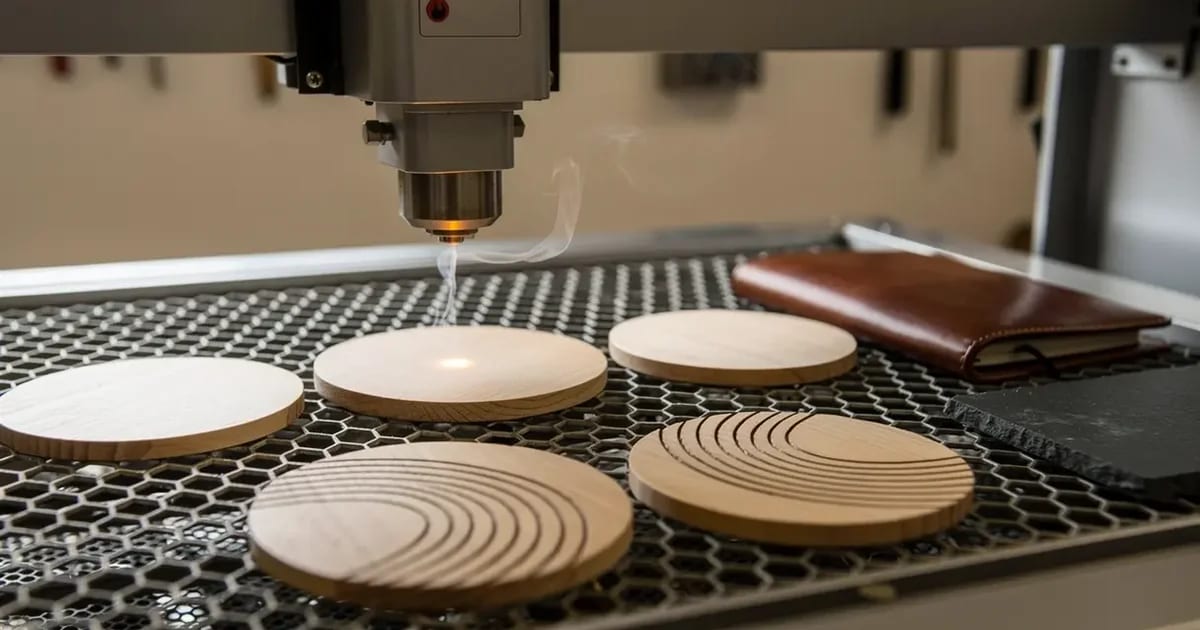
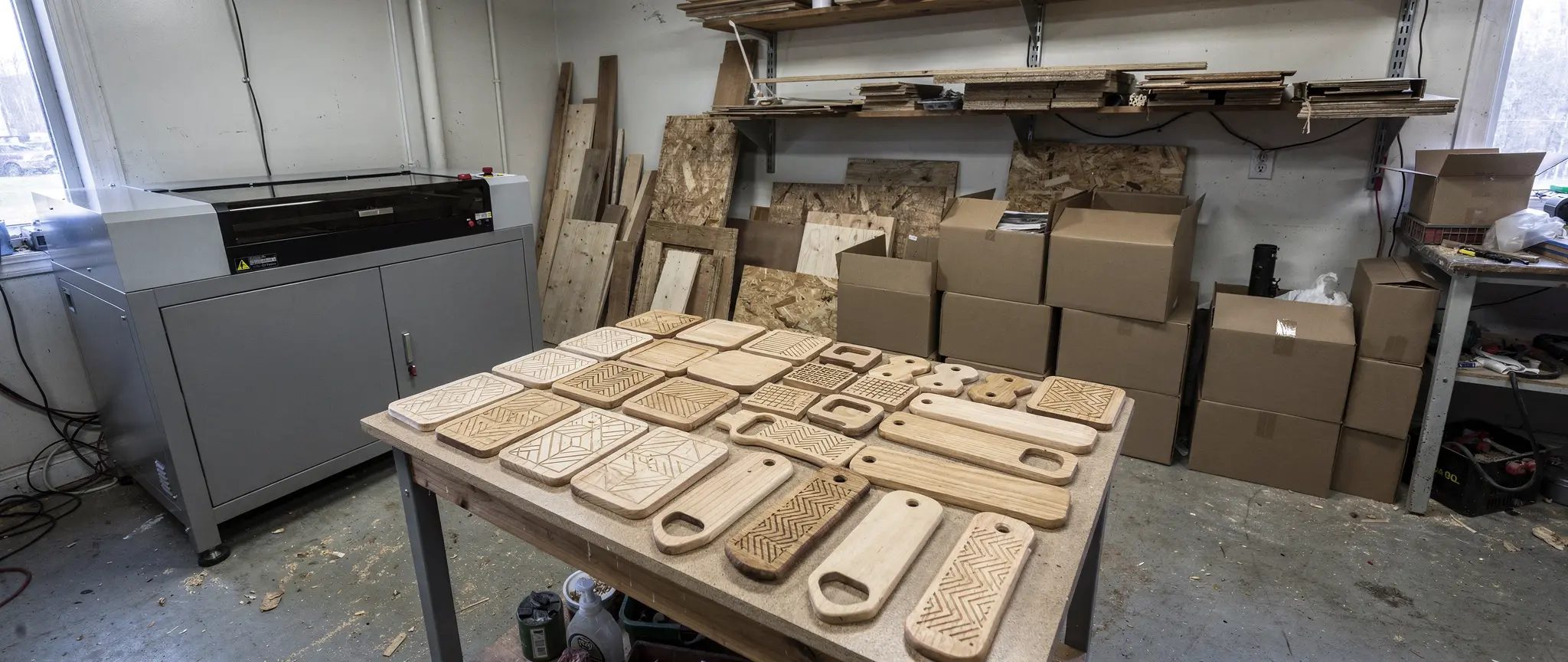
Keychains, coasters, tags, bottle openers with wooden handles, badges and medallions: anything that lies flat on the 915 x 458 mm bed.
Our 80 W xTool P3 CO2 laser engraves and cuts across that surface. The number of pieces per pass follows from the size of the object. The formats below are common ones, with 5 mm between pieces for cutting, and the count per bed follows from that spacing.
| Item | Common format | Per 915 x 458 mm bed | Operation |
|---|---|---|---|
| Product tag | 60 x 25 mm | 210 | Engrave and cut |
| Keychain | 70 x 30 mm | 156 | Engrave and cut |
| Round badge or medallion | 50 mm diameter | 128 | Engrave and cut |
| Bottle opener with wooden handle | 150 x 40 mm | 50 | Engrave only |
| Coaster | 100 x 100 mm | 32 | Engrave and cut |
An order of 200 keychains fits on two beds, while the same quantity in coasters calls for seven. That calculation is what structures a run, before material, finish or anything else.
On 3 mm basswood plywood, the xTool technical documentation recommends 30 mm/s at full power, in a single pass. We do not publish an hourly output rate: it depends on the material, the thickness and the engraved area. No major CO2 laser manufacturer publishes that number either, from Epilog to Glowforge.
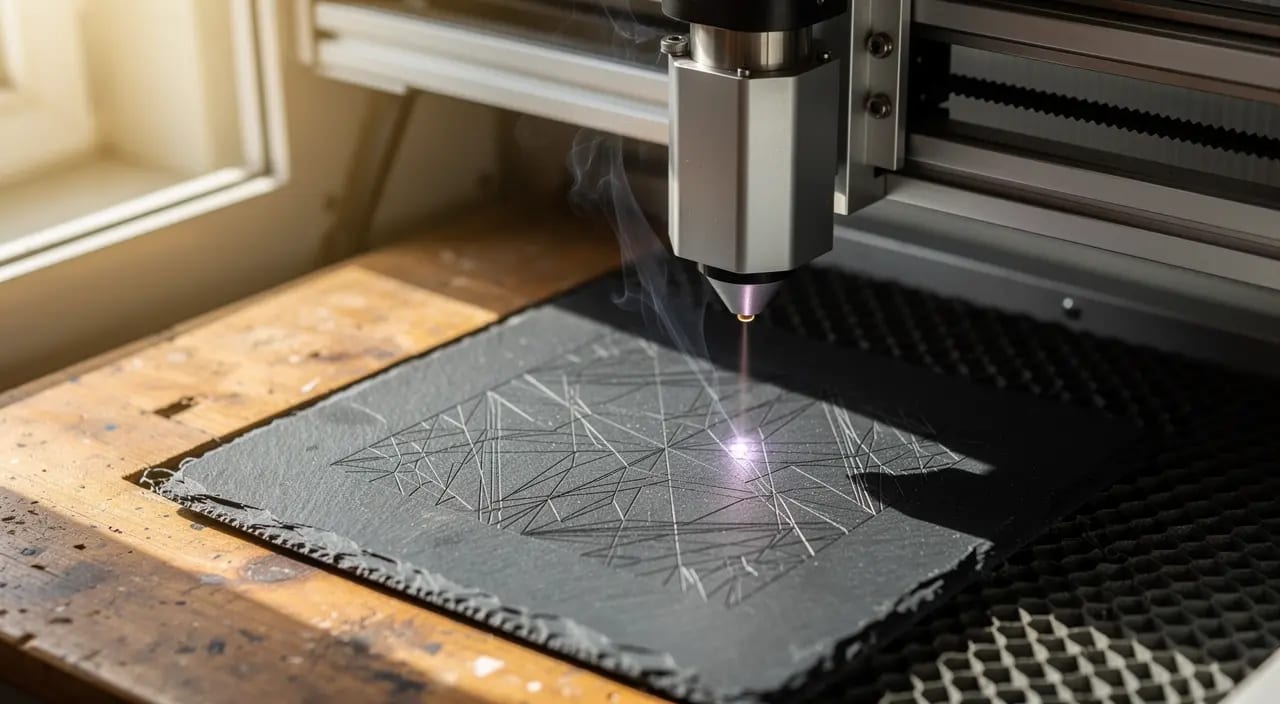
The materials the laser accepts: hardwood (walnut, oak, cherry, maple, ash), bamboo, acrylic, leather, glass and slate. Bare metal does not engrave on a CO2 laser, and only coated metal works. The beam removes the coating and reveals the metal underneath, which reads as an engraving. We say so before the order goes ahead, not after the pieces are made.
Formats and accepted materials are listed here.
What moves the cost of a run
Cost follows the quantity, the material, the engraved area, the operation requested and the state of the file supplied.
- Quantity. Machine setup, bed alignment and the test engraving happen once, whatever the length of the run. Going from 50 to 200 pieces does not multiply the cost by four.
- Material. Baltic birch plywood of 3 mm and solid walnut do not sit in the same column. Thickness also decides the number of passes needed for cutting.
- Engraved area. A line logo on a 70 x 30 mm keychain engraves quickly. The same keychain engraved in solid fill across its whole face takes several times as long.
- Operation. Engraving alone on an object already made asks less work than a piece cut, engraved, then hand-sanded.
- The file. A clean vector, one colour, strokes of at least 0.3 mm: the run goes straight into production. A low-resolution JPEG logo has to be redrawn before anything reaches the machine.
We do not publish prices, and the quantity, the material and the file decide the rest.
Send the quantity and the logo.
When to order: seasons, festivals and trade shows
Demand concentrates on the tourist season, the festival season and the business trade shows. Each one gets prepared a full season ahead of the date.
Gaspésie received 864,000 visitors in 2023, or 3.6% of all tourists who visited Quebec. The figure comes from the regional public land development plan of the ministère des Ressources naturelles et des Forêts, which restates data from Tourisme Gaspésie. An inn, a marina or a shop planning an engraved item for the summer prepares the run the previous winter. Ordering in June is already too late for that season.
Regional public land development plan, Gaspésie, ministère des Ressources naturelles et des Forêts
On the events side, Événements Attractions Québec counted 288 festivals, 158 corporations and 522 attractions among its members in 2024. A sponsorship is settled months before the date, and the item handed to the public carries the name. The run follows the event calendar, and never the other way around.
For trade shows, the Palais des congrès de Montréal welcomed 776,896 participants and visitors across 290 events during its 2023-2024 fiscal year. A run destined for a booth has to be in hand before setup begins. The week of the show itself is too late to start a run.
The year-end gift window follows another logic, covered in our post on corporate gifts. For a run of promotional items, the rule is simpler: count back one full season from the handout date. That is the point to open the conversation, not the month before the event.
A run to prepare
Planning a festival or a tourist season this year?
Frequently asked questions
What is the minimum quantity you accept for an engraved run?
We produce runs of 50 to 500 pieces, and we also accept smaller batches. Under 50 pieces, machine setup weighs more heavily on each unit. Send the quantity and the logo: we will tell you whether another format or material suits the order better.
Can you engrave a metal pen or a metal water bottle?
A CO2 laser does not mark bare metal, whatever the object. It works on coated metal: the beam removes the coating and reveals the metal underneath. An anodized pen or a painted bottle engraves, but a bare steel object does not. Wood, bamboo, acrylic, leather, glass and slate all engrave.
Do you deliver a run outside the Baie-des-Chaleurs?
Engraved pieces ship, unlike installed cabinets, so a run travels further. The Baie-des-Chaleurs receives our full service, and we serve the rest of Quebec on request. That happens case by case, with no lead time or rate announced in advance. Write to us with the destination and the quantity: we confirm what is workable before the run starts.