Corner cabinet options: how to stop losing the kitchen corner
The corner is the hardest square foot in a kitchen. Two runs of cabinets meet there, and half the volume ends up out of reach. Here are five options, what each one reaches, and what to watch for.
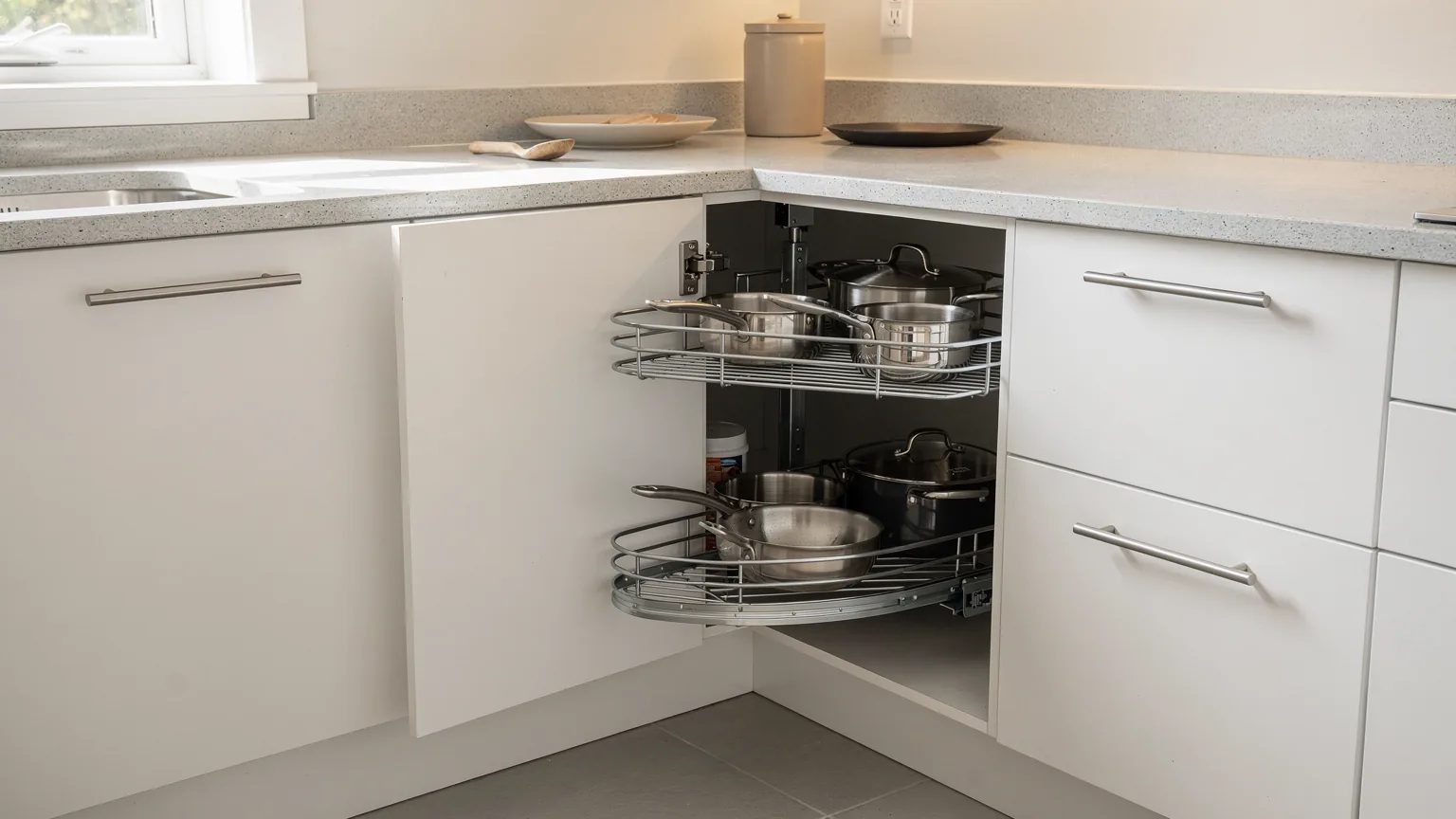
A corner cabinet loses half its volume by default: whatever sits at the back of a blind corner cannot be reached without a mechanism. A lazy Susan, a pull-out unit, drawers or a diagonal corner each fix that differently, and each one costs space.
Shoppers also search for "corner kitchen cabinet". It is the same question: how to get at what you store in the corner. We compare the options, then show how a custom layout sizes the corner so doors and drawers clear each other.
Why is the corner the hardest square foot in a kitchen?
Two runs of base cabinets meet at a right angle. Each is a standard 24 in (61 cm) deep. The corner box ends up boxed in. One side is closed off by the neighbouring cabinet, and the opening that remains leads into a deep, narrow volume. Three problems follow.
- The back is out of reach. You kneel and push an arm through the opening to get at what is stored there.
- Doors collide. A corner door opened to 90 degrees can hit the handle of the drawer next to it.
- Handles cross. Two drawers on perpendicular runs, pulled at the same time, strike each other at the corner.
These problems get solved on the plan, before anything is built. Catalogue cabinets come in 3 in (7.6 cm) width steps, and the corner is made to fit the room afterwards. At Atelier Multidécor, every cabinet box is built to the room's measurements, corner included.
Blind corner, lazy Susan, diagonal: which corner cabinet reaches what?
Five approaches come up for a kitchen corner. Four are base cabinets. The fifth is an upper.
- Blind corner with a pull-out mechanism: the box extends behind the neighbouring cabinet. A carriage slides out of the opening, bringing the contents toward you.
- Lazy Susan: round shelves rotate on a central post inside a two-door corner cabinet.
- Diagonal corner: an angled door cuts across the corner at 45 degrees, in front of a five-sided box.
- Corner drawers: the corner is filled with full-depth drawers instead of a door.
- Upper corner cabinet: a 12 in (30 cm) deep box, with rotating shelves or a blind corner.
The table below sets them side by side. The same idea, shelves that come out to you, works in a custom pantry cabinet too: full access beats lost depth.
| Option | What it reaches | What it costs in space | What to watch |
|---|---|---|---|
| Blind corner with pull-out mechanism | Nearly all the contents, brought to the opening | Wall length: the box runs behind its neighbour | An opening wide enough for the carriage to clear the frame; load rating |
| Lazy Susan | Most of the volume, by rotation | A square box whose corners behind the round shelves stay unused | Tall items fit poorly; load limit per shelf; rotation that does not rub |
| Diagonal corner | A five-sided volume, with a wasted triangle at the back | More wall length, and the corner pushes out into the room | A wide door that swings into the walkway; dead space behind the door |
| Corner drawers | Everything, drawer by drawer, with no digging | A box wider than a standard cabinet | Clearance for the neighbouring handles; full-extension slides and load rating |
| Upper corner cabinet | Shelves within arm's reach, by rotation or through the door | The whole corner, at 12 in (30 cm) deep on each side | Shelves set too high; a door that hits the neighbouring cabinet |
Standard dimensions are a starting point. A custom layout adjusts each one to the room.
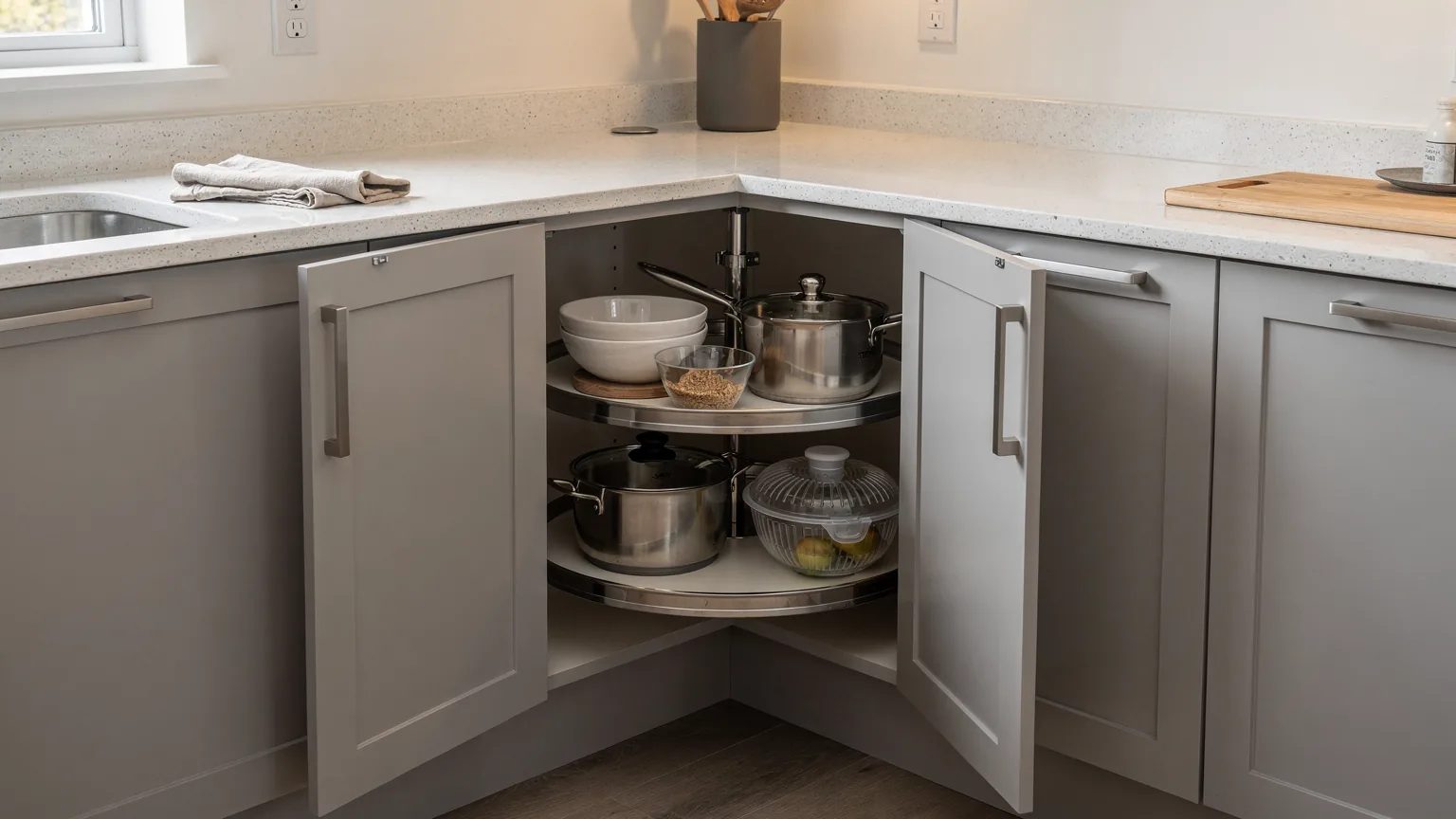
How does a custom layout size the blind corner and the filler?
The blind part of a corner is the section of the box that hides behind the neighbouring cabinet. Its width depends on four measurements, and the plan adds them up before any cutting.
- The depth of the neighbouring cabinet: a 24 in (61 cm) base cabinet hides that much of the corner's width.
- The opening width the mechanism needs to slide out without touching the frame.
- Panel thickness, commonly 16 mm or 18 mm, which comes off the usable opening.
- How far the neighbouring handles stick out, which sets the width of the filler.
A filler is a narrow panel set between the corner box and the first neighbouring cabinet. It moves the neighbouring door or drawer back, so handles clear each other and the corner door opens to 90 degrees. A catalogue absorbs that gap with a fixed width. A custom plan calculates it from the hardware. That calculation belongs to planning a custom kitchen, ahead of every other choice.
Without a filler, neighbouring handles knock together, and an open door stops against the drawer beside it.
Why does hardware matter most in a corner?
In a corner, the hardware does the work the space cannot. A carriage or a lazy Susan moves pots and pans at every opening, in the spot where an adjustment is hardest to make. Four things are worth checking.
- Load rating: a mechanism full of pots carries far more than a utensil drawer. Its rating in pounds should appear on the quote.
- Hinge opening angle: a corner cabinet often needs 165 or 180 degrees, against roughly 110 degrees for a regular door.
- Soft-close: a mechanism that snaps back shut works its fasteners loose over time.
- Adjustment: a carriage and a door that shift with the seasons need to be corrected without taking anything apart.
We cover these points in our piece on kitchen cabinet hardware. For a corner, the rule is simple: choose the mechanism first, then size the box around it.
Which corner option fits your kitchen?
The right choice depends on the shape of the room and what you store in the corner. These pointers help you decide.
- Short wall: the lazy Susan, whose corner box stays compact.
- Lots of large pots: a high-capacity pull-out mechanism, or corner drawers.
- Narrow walkway in front of the corner: skip the diagonal corner, whose door swings into the room.
- Upper cabinets: add an upper corner box only if the shelves stay within arm's reach.
Atelier Multidécor builds every cabinet box to the room's measurements, the corner one included. See how we make custom kitchen cabinets, from the plan through installation or delivery.
For clearances around doors, drawers and appliances, see the NKBA kitchen planning guidelines, a North American reference.
Plan the corner before it is cut
Bring the plan of your room, and we will go through the corner with you: mechanism, blind section, filler. Atelier Multidécor builds custom kitchen cabinets in Saint-Siméon-de-Bonaventure, in the Gaspé, since 1994, CNC cutting and hand finishing under one roof.
Frequently asked questions
What is a blind corner cabinet?
It is a box that partly extends behind the neighbouring cabinet. The opening stays narrow, and you cannot reach the back by hand. Without a pull-out mechanism, about the back half of the volume is lost.
Lazy Susan or pull-out mechanism: which should I choose?
A lazy Susan suits a short wall, because its box stays compact. A pull-out mechanism needs more wall length, but it brings the contents to the opening and holds tall items better. In both cases, ask for the load rating.
How do I keep doors and handles from colliding at the corner?
Use a filler between the corner box and its neighbour. It moves the neighbouring door or drawer back, so handles clear each other and the door opens to 90 degrees. Its width is calculated on the plan, from the hardware you choose.
Do I need a corner cabinet in an L-shaped kitchen?
Every L-shaped kitchen has a corner, whether or not it holds a useful cabinet. Without a mechanism, it turns into lost volume. With a lazy Susan, a carriage or corner drawers, the corner becomes real storage.
How do I use the corner of the upper cabinets?
An upper corner box, 12 in (30 cm) deep, can take rotating shelves or a blind section. Keep light items there, within arm's reach. Shelves set too high only work with a step stool.