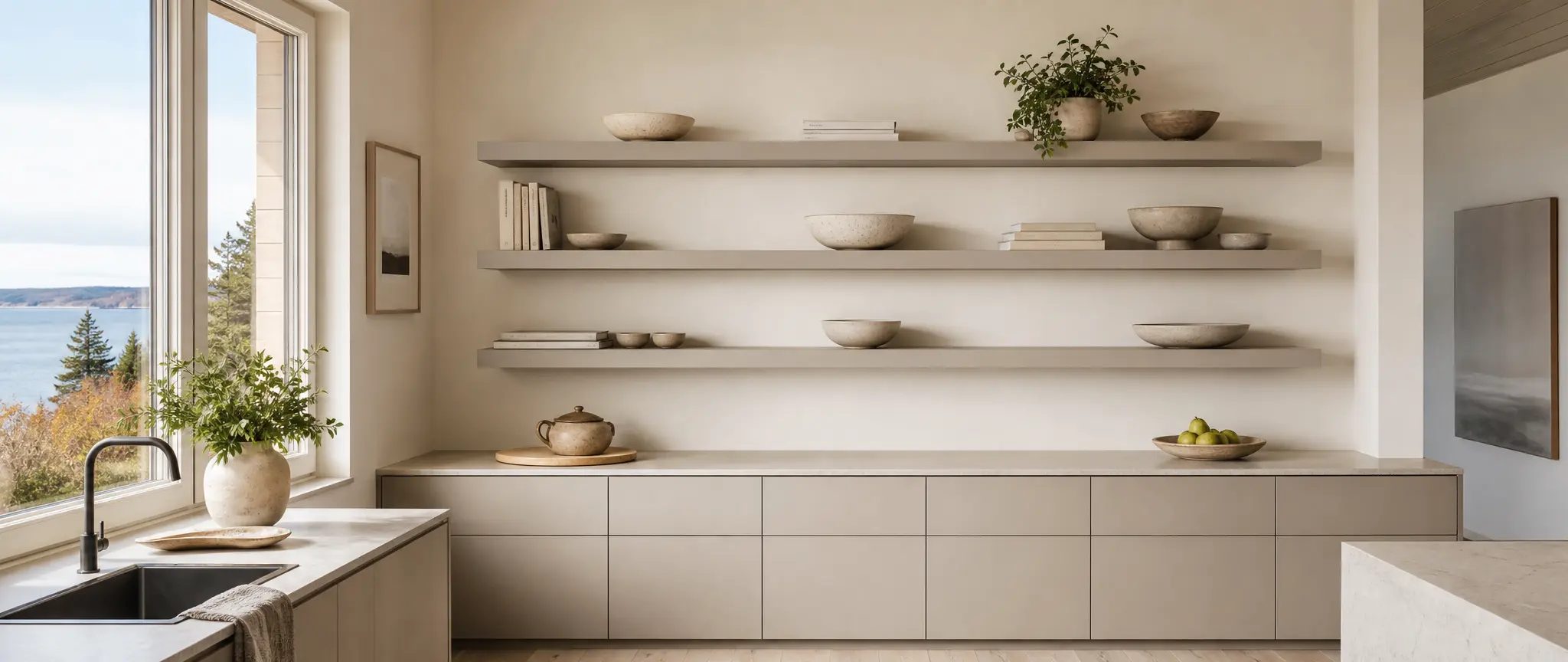
Custom floating shelves: hidden brackets, load and wall fixing
A floating shelf sits on a support you cannot see. This guide covers the bracket types, fixing by wall type, depth, thickness and length, for a shelf made to your dimensions.
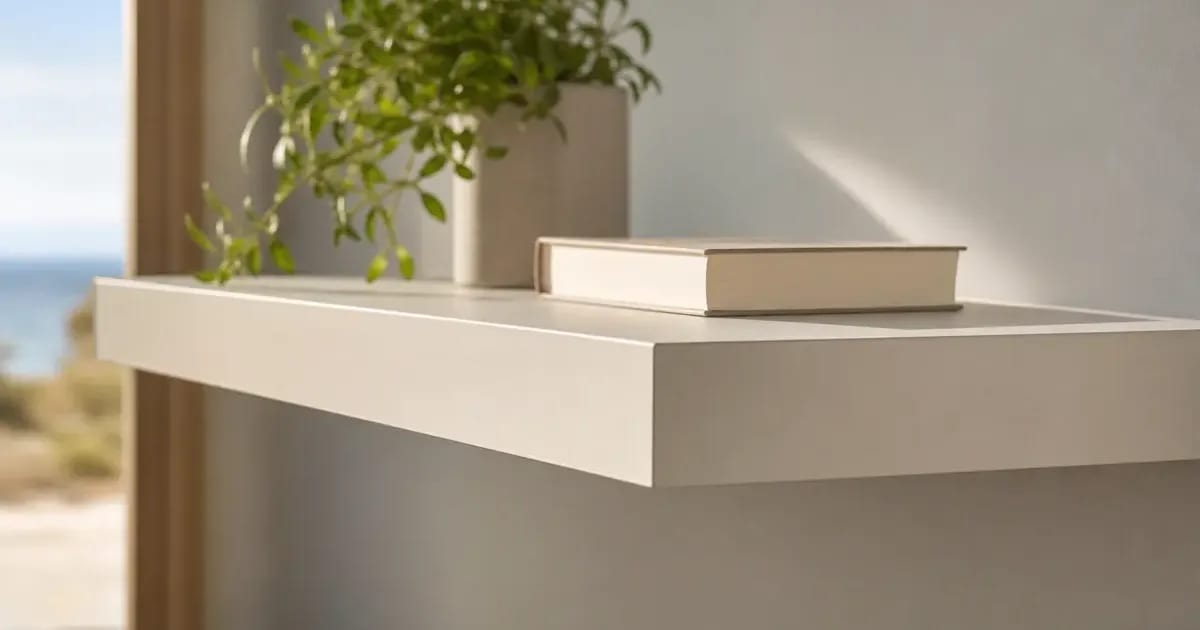
A custom floating shelf is a shelf whose supports disappear inside its thickness: steel rods or a steel plate are fixed to the wall, and the hollow or drilled shelf slides over them. The load it carries depends on three things: the bracket, the fixing and the wall. Atelier Multidécor makes these shelves to your dimensions, in the Gaspé.
This post covers hidden brackets, fixing into a stud, concrete or drywall, common depths and thicknesses, matching a kitchen or bathroom, and how long a shelf can run. The workshop does not publish a load figure: the build is confirmed in the quote, based on your wall and the intended use.
How do the hidden brackets of a floating shelf work?
A floating shelf does not hide the bracket, it houses it inside the shelf. Three builds are common.
- Steel rods: bars fixed to the wall, over which the shelf slides. Holes are drilled in the back edge of the shelf, to the depth of the rods.
- A steel plate: a flat plate screwed to the wall that slips into a hollow shelf. This is the build for the thick, block-shaped shelf.
- A fixing cleat: a strip of wood or metal screwed to the wall, into which a groove in the shelf locks.
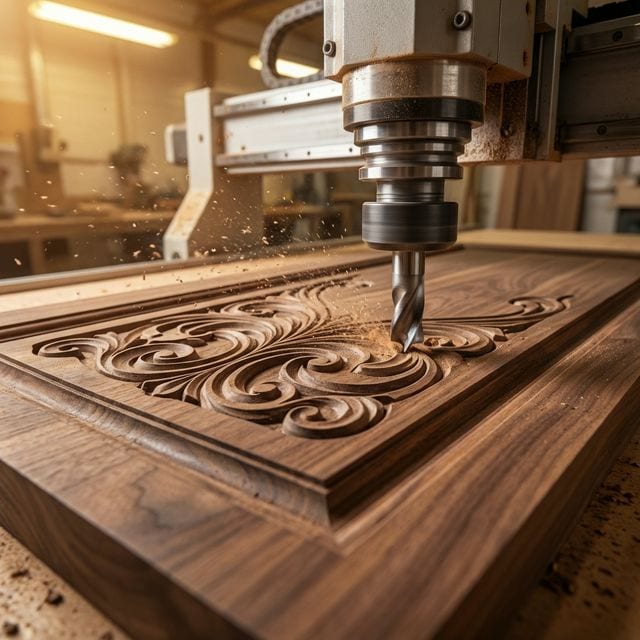
Whatever the build, the precision of the housings matters: too much play and the shelf tilts. The workshop machines these housings on the CNC, which keeps the fit tight between the bracket and the shelf. This work is part of our custom cabinetry services.
How much load can a floating shelf carry?
There is no single figure. A shelf holds as well as its weakest link, and that link is often the wall. A row of paperbacks and a stack of dishes ask very different things. Five factors decide:
- the depth of the shelf: the deeper it is, the harder the load pulls on the upper fixings;
- the number of fixings and where they sit in the wall;
- the type of wall: stud, concrete or drywall alone;
- how the load is spread, evenly or concentrated at the front;
- the panel and the build of the shelf itself.
The workshop gives no generic load figure. We ask what the shelf will carry (books, dishes, plants, decorative objects) and we confirm the build in the quote. If the load is heavy, say so on the first call.
How do you fix the shelf: stud, concrete or drywall?
The fixing is the least visible part and the most decisive. The same bracket is not installed the same way in every wall.
- Wood or steel stud: this is the strongest fixing in a residential wall. Studs are often spaced 16 in (406 mm) or 24 in (610 mm) on centre, so the bracket positions are planned around them.
- Concrete or masonry: anchors designed for that material are set in holes drilled with the right bit. The choice of anchor depends on the exact material of the wall.
- Drywall alone, with no stud behind: drywall anchors suit light loads only. For a shelf that will carry books or dishes, aim for a stud or plan a reinforcement.
- Tiled wall, as in a bathroom: drilling needs a suitable bit, and pipes must be located before you drill.
Before drilling, locate electrical wires and pipes. If a wall hides any, that is work for an electrician or a plumber: the workshop does not do either.
In the Baie-des-Chaleurs, the workshop can install the shelf. Elsewhere in the Gaspé, installation is discussed on request, case by case, or the piece can be delivered on request, with its brackets, for you to install yourself.
What depth and thickness should a floating shelf have?
The usual figures are a starting point, and a custom piece adjusts them to the use. A shelf for books and dishes is often 8 to 12 in (20 to 30 cm) deep. A shelf for frames and small objects needs only 4 to 6 in (10 to 15 cm).
- 4 to 6 in (10 to 15 cm) deep: frames, spices, candles.
- 8 to 12 in (20 to 30 cm) deep: books, dishes, plants.
- Visible thickness of 1 1/2 to 2 in (38 to 50 mm): the look of a block, which houses a plate or rods.
- A thinner shelf: a single panel, for a light, discreet shelf.
Common panels are 5/8 in (16 mm) or 3/4 in (18 mm) thick. A shelf with a thick look is therefore built by joining a top, a bottom and an edge around the bracket. The materials and finishes available are chosen at this stage. A deeper shelf needs a longer bracket and more fixings: we go over it in the quote.
How do you match the shelf to a kitchen or a bathroom?
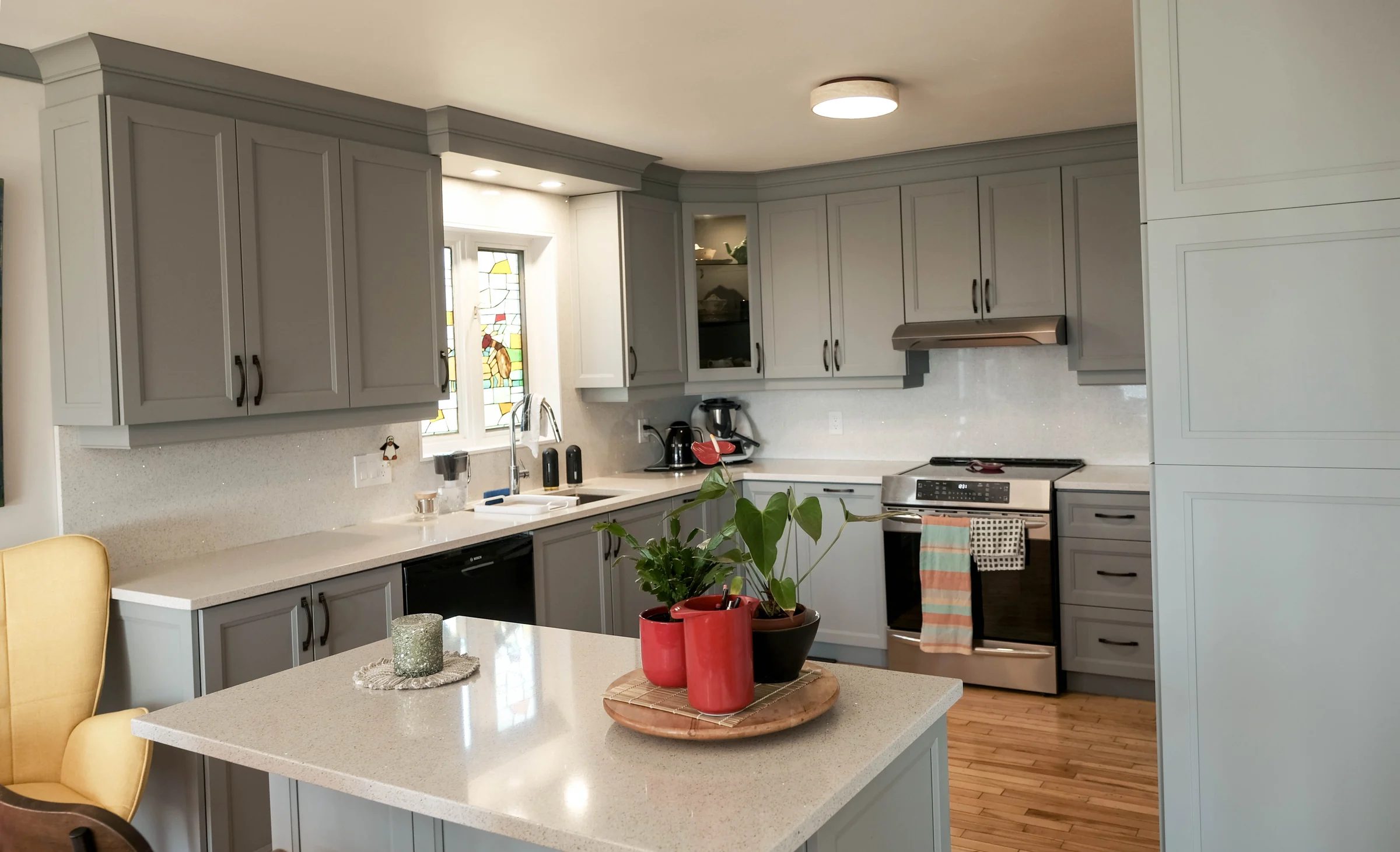
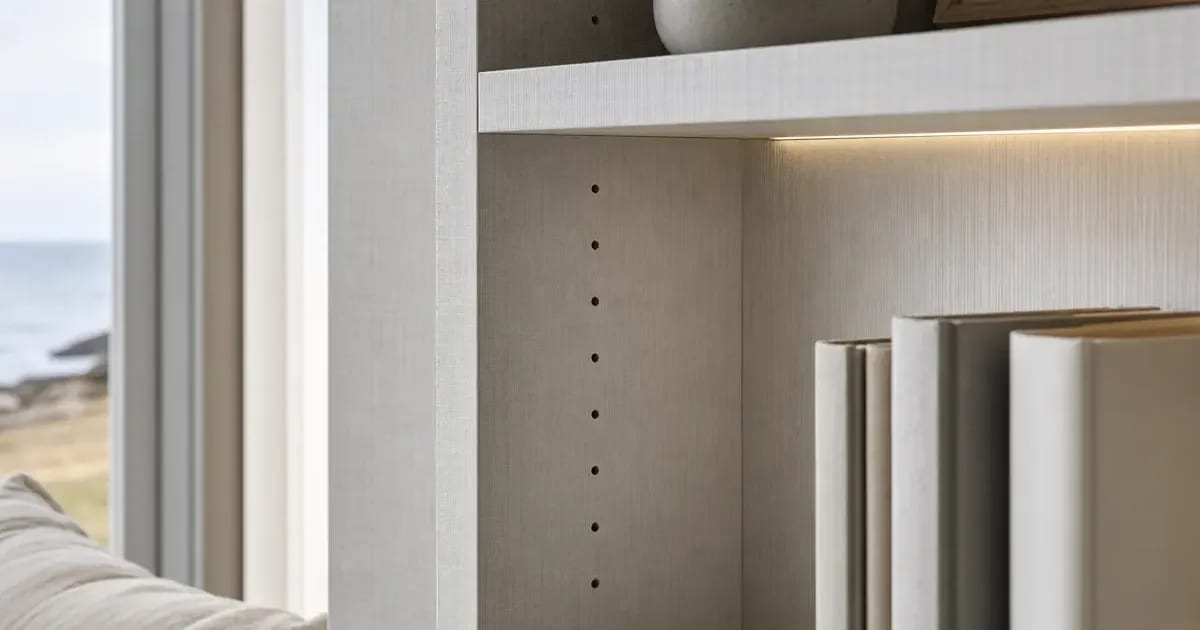
The workshop builds the shelf in the same melamine as its cabinets. Melamine gives a uniform, hard-wearing surface that is easy to maintain, in a wide range of colours and textures. Panels come from suppliers such as Uniboard, Olon, Sublime Collection and AGT. A shelf pairs with new custom kitchen cabinets made by the workshop, with the same finish and the same edge.
- New kitchen: the shelf takes exactly the finish of the cabinets.
- Existing kitchen: bring a door sample or the manufacturer's reference, and we look for the closest shade.
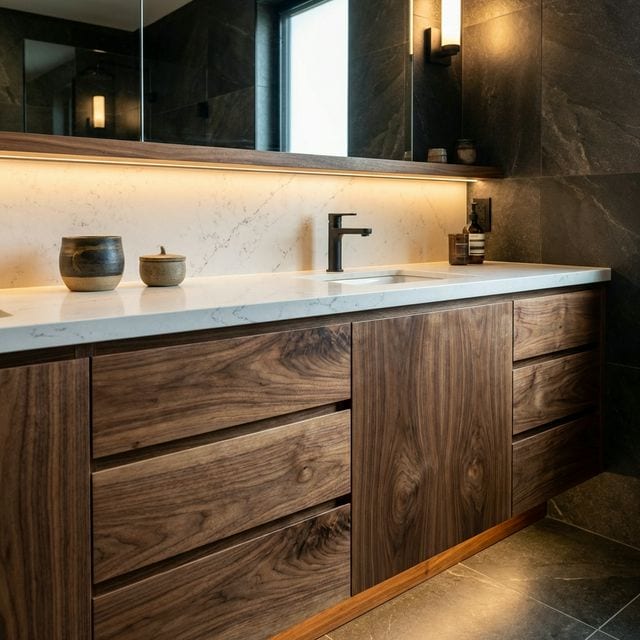
- Bathroom: we settle the edge finish and the distance from the shelf to the shower in the quote.
An exact match with an existing finish is not always possible: panel batches change, and a finish ages. We confirm it against a sample before manufacturing starts.
How long can a floating shelf be?
Common melamine panels measure 4 x 8 ft (122 x 244 cm). A one-piece shelf can therefore run up to about 8 ft (240 cm). Beyond that a joint is needed, and the joint is planned so that it lands on a bracket.
Length also affects strength. A long shelf sags if it is overloaded or poorly supported. We then plan more fixing points, lined up with the studs where possible.
If you want several shelves or a full wall, a custom wall bookcase suits better than a row of floating shelves. We can talk through both on the first call.
The common stud spacings of 16 in (406 mm) and 24 in (610 mm) are described in the article Framing (construction) on Wikipedia (accessed November 2026).
A floating shelf to build?
Give us the length, the depth, the finish you want and the type of wall. In business since 1994, the workshop tells you plainly what can be made. Phone: 418-534-4167.
Frequently asked questions
How much weight can a floating shelf hold?
It depends on the bracket, the depth, the number of fixings and the wall. The workshop does not publish a generic figure. Tell us what the shelf will carry, and we confirm the build in the quote.
Can a floating shelf go on drywall alone?
Drywall anchors suit light loads only. For books or dishes, aim for a stud behind the drywall or plan a reinforcement. Locate it before you choose the position.
Can you match the shelf to my existing kitchen?
We look for the closest shade from a door sample or a manufacturer's reference. An exact match is not always possible, and we confirm it against a sample before building.
What thickness should a floating shelf be?
A visible thickness of 1 1/2 to 2 in (38 to 50 mm) gives the look of a block and houses the bracket. A thinner shelf suits a light load. The thickness is chosen with the workshop, based on the use.
Do you install floating shelves?
Yes, in the Baie-des-Chaleurs, for residential projects. Elsewhere in the Gaspé, installation is discussed on request, case by case. The piece can also be delivered on request, for you to install yourself.