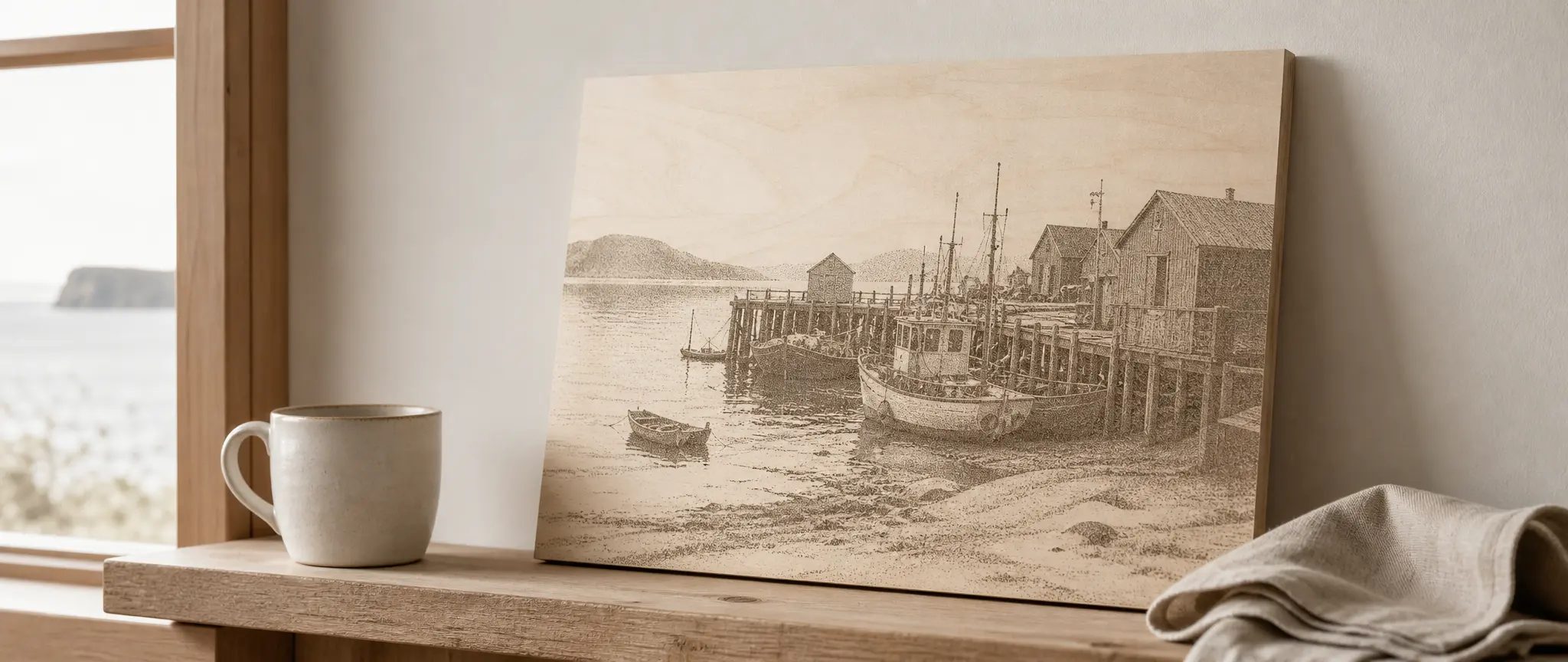
Photo on wood: laser-engraved or printed, which should you choose?
An engraved photo on wood is not a printed photo. The laser draws the image in brown dots on pale wood, with no colour. Here is how it renders greys, which photos work and which wood to pick for a gift that is built to be kept.
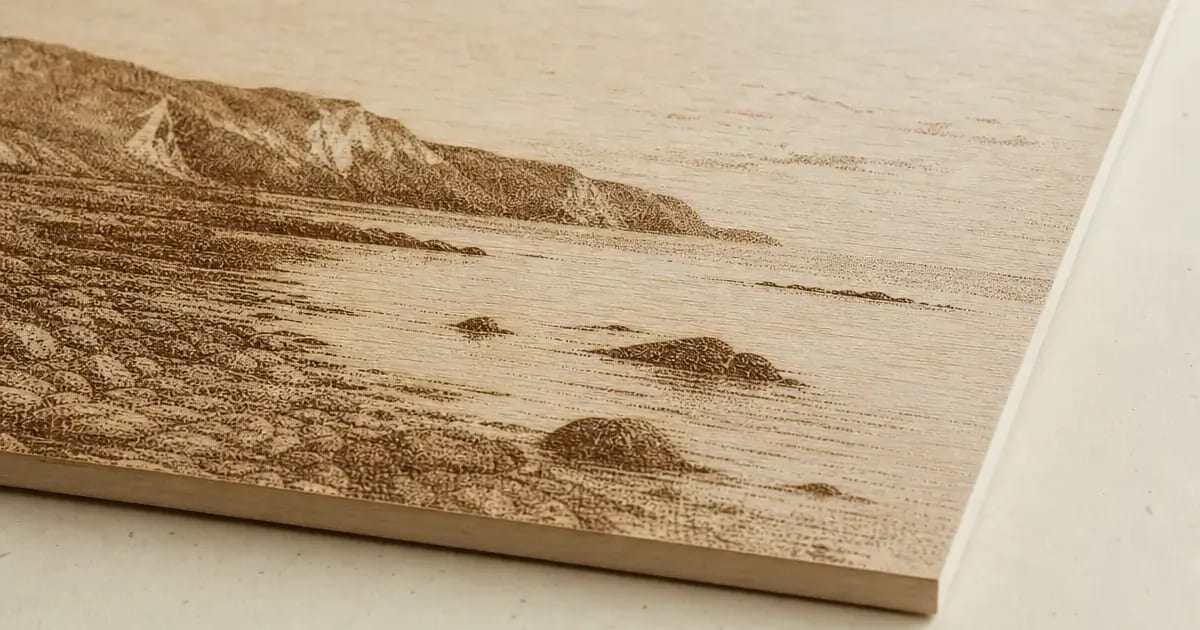
An engraved photo on wood is marked into the surface by a laser: the image appears in shades of brown on the pale tone of the wood. A printed photo on wood lays down ink, so it carries colour. Atelier Multidécor engraves with a laser at its workshop in Saint-Siméon-de-Bonaventure, in the Gaspé Peninsula.
The right choice depends on the photo and the gift. An old, high-contrast photo of grandparents engraves very well. A holiday snapshot with bright colours does less well, because a laser cannot reproduce colour. This post explains the difference so you know what to expect before you order.
What is the difference between an engraved photo and a printed photo on wood?
An engraved photo is marked into the wood by a laser. A printed photo is ink sitting on the surface. The two methods give different results, and the right one depends on what you want to keep from the photo:
- laser engraving renders the image in shades of brown, from pale to dark, depending on how much wood is marked;
- a printed photo can reproduce the colours of the original, because it uses ink;
- in both cases the grain and tone of the wood stay visible and affect the result;
- an engraving is part of the wood: there is no layer added on top of the surface.
This post is about laser engraving, the process the workshop uses. If your photo lives mostly through its colours, an engraving will not reproduce them: it translates them into wood tones. The table below sums up the two approaches.
| Criterion | Laser engraving | Printed photo |
|---|---|---|
| Result | Shades of brown on the tone of the wood | Colours of the original photo |
| Principle | The laser marks the wood surface in dots | Ink is laid on the surface |
| Photos that suit it | Sharp contrast, simple background, a large enough subject | Photos where colour matters |
| Role of the wood | It supplies the light tones of the image | It is the base the ink sits on |
The final result depends on the photo, the wood and the size. The workshop confirms feasibility on the first call.
How does a laser render the greys of a photo?
A laser marks wood in dots. To render the greys of a photo, the file is converted into a screen of dots, the same principle as the pictures in a printed newspaper. The darker an area of the photo, the closer together the dots. The lighter the area, the more spread out they are.
- A dark area becomes a cluster of tight dots, so a deep brown;
- a grey area becomes a medium density of dots, so a mid brown;
- a light area becomes a few spaced dots, so nearly bare wood;
- the white of the photo does not exist in an engraving: the tone of the wood plays the white.
Up close, you can see the dots. From a normal viewing distance, like a frame on a wall, the eye blends them into one continuous image. An engraved photo reads better at arm's length than with your nose against it.
The dot screen also explains the limits of the process. Detail smaller than the gap between two dots is lost. A tiny face in a group photo turns into a smudge, and a very soft gradient can show in steps. A well-prepared file reduces these effects without removing them.
Which photos engrave well on wood?
Contrast matters more than fine detail. These are the marks of a good photo to engrave:
- sharp contrast between the subject and the background;
- a simple background: a wall, a sky, a field, rather than a crowded room;
- a subject large enough in the frame: a face, a couple, a boat, a house;
- a sharp, well-lit photo, without dark areas where everything merges;
- the original file, not a screenshot or a copy squeezed by a messaging app;
- an old black-and-white photo, scanned cleanly: its greys are already the greys of an engraving.
Avoid a group photo with small faces, a backlit photo, and a scene whose different colours turn into the same grey once converted. Send your photo to the workshop: we tell you whether it suits engraving, and whether another photo from the same set would give a better result. Our guide to engraving materials and objects shows what each material looks like once engraved.
Which wood for an engraved photo: maple or birch?
The wood plays the part of the paper. The lighter and more even it is, the more readable the photo. Maple and birch are two common choices for that reason:
- maple: a pale hardwood with a fine, tight grain, which keeps the detail of a face or a landscape;
- birch: a pale wood with a discreet grain and a slightly warmer tone, which gives a softer result;
- a dark wood: best avoided for a photo, because the laser leaves little contrast on it.
In both woods the grain runs through the image. A board with an even grain gives a cleaner portrait than a heavily figured one, whose lines blend into the subject. We confirm on the first call which species are available for your piece.
What size should an engraved photo on wood be?
The workshop's 80 W CO2 laser engraves on a 36 x 18 in (915 x 458 mm) bed, as of November 2026. That is the limit for one piece. Here are some guides by subject:
- a single portrait or a couple: 5 x 7 in (13 x 18 cm), a common photo size, is enough;
- a family portrait: 8 x 10 in (20 x 25 cm) or larger, so each face stays readable;
- a landscape, a boat or a house: a horizontal format, wider than tall;
- below the photo: a line of engraved text with names, place and date.
The larger the photo, the more detail it can show. A small size stays readable if the subject is simple. Like any custom project, each photo is reviewed before it is accepted: the workshop confirms the size, the wood and feasibility on the first call.
Is an engraved photo on wood a good gift for grandparents?
Yes, and it is one of the most common uses. A photo of an old wedding, the family house or a grandchild, engraved on a panel they will keep, sits on a shelf or hangs on a wall. Here are a few ways to mount it:
- an engraved wooden panel, to set on a shelf or hang;
- a custom-made wooden frame around an engraved photo;
- a line of text engraved below the photo: names, the year, a place in the Gaspé;
- several copies of the same engraving, so each child in the family has one.
For other engraved pieces, see our Christmas gift ideas in wood. We confirm on the first call whether your piece can be made and whether the workshop's schedule allows it.
The principle of the dot screen, which renders greys through the density of dots, is described in the Wikipedia article Halftone.
A photo to engrave?
Send us the photo, the size you want and the text to engrave below it. In business since 1994, the workshop tells you plainly whether the photo suits, and what can be done. Phone: 418-534-4167.
Frequently asked questions
What is the difference between an engraved photo and a printed photo on wood?
Laser engraving marks the wood in dots and renders the image in shades of brown. A printed photo lays down ink and can reproduce colour. Both show the grain of the wood. The workshop engraves with a laser.
Which photos engrave best on wood?
Those with sharp contrast, a simple background and a subject large enough in the frame. A portrait, a couple or a boat engraves better than a group photo with small faces. Send the original photo and the workshop tells you whether it suits.
Can you engrave a colour photo on wood?
Yes, but it comes out in shades of brown, not in colour. The laser turns each colour into a grey, then into dots. If colour is the heart of the photo, a printed photo renders it better than an engraving.
Which wood should I choose for an engraved photo?
A pale wood with a fine grain, such as maple or birch. The wood supplies the light tones of the image, so the paler and more even it is, the more readable the photo. A dark wood leaves little contrast for an engraving.
How do I have a photo engraved at the workshop?
Describe the idea by phone or email, and send the original photo with the text to engrave. The workshop confirms feasibility, size and schedule. You receive a quote, and nothing starts before you approve it.