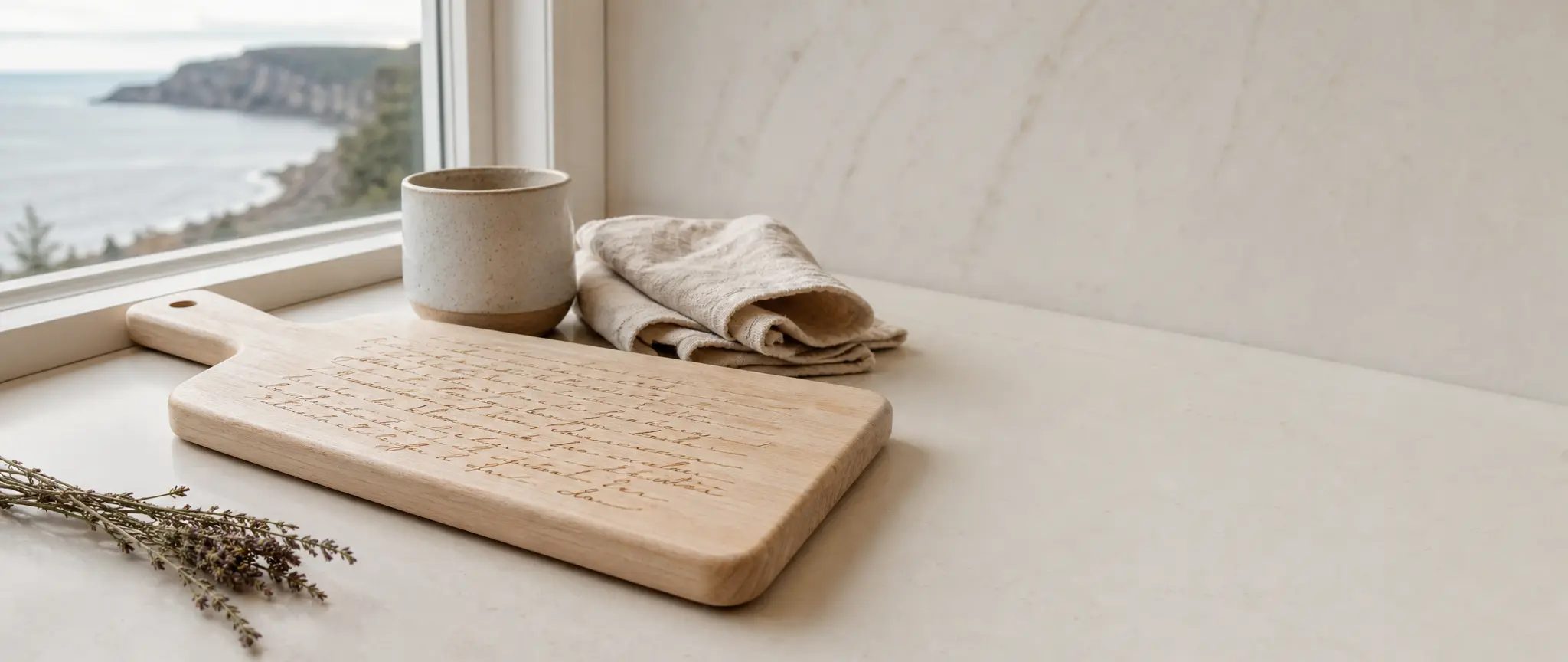
Personalized cutting board: engraving a grandmother's handwritten recipe
A grandmother's recipe card, with her handwriting and its stains, can become a family cutting board. Here is how it is prepared, engraved and looked after.
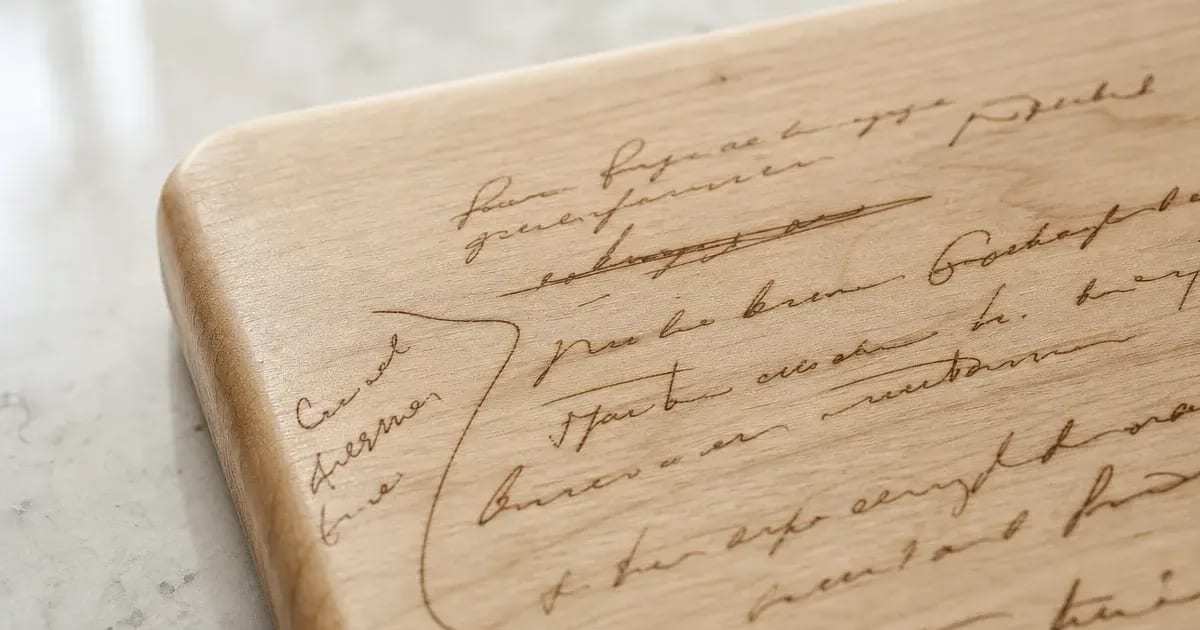
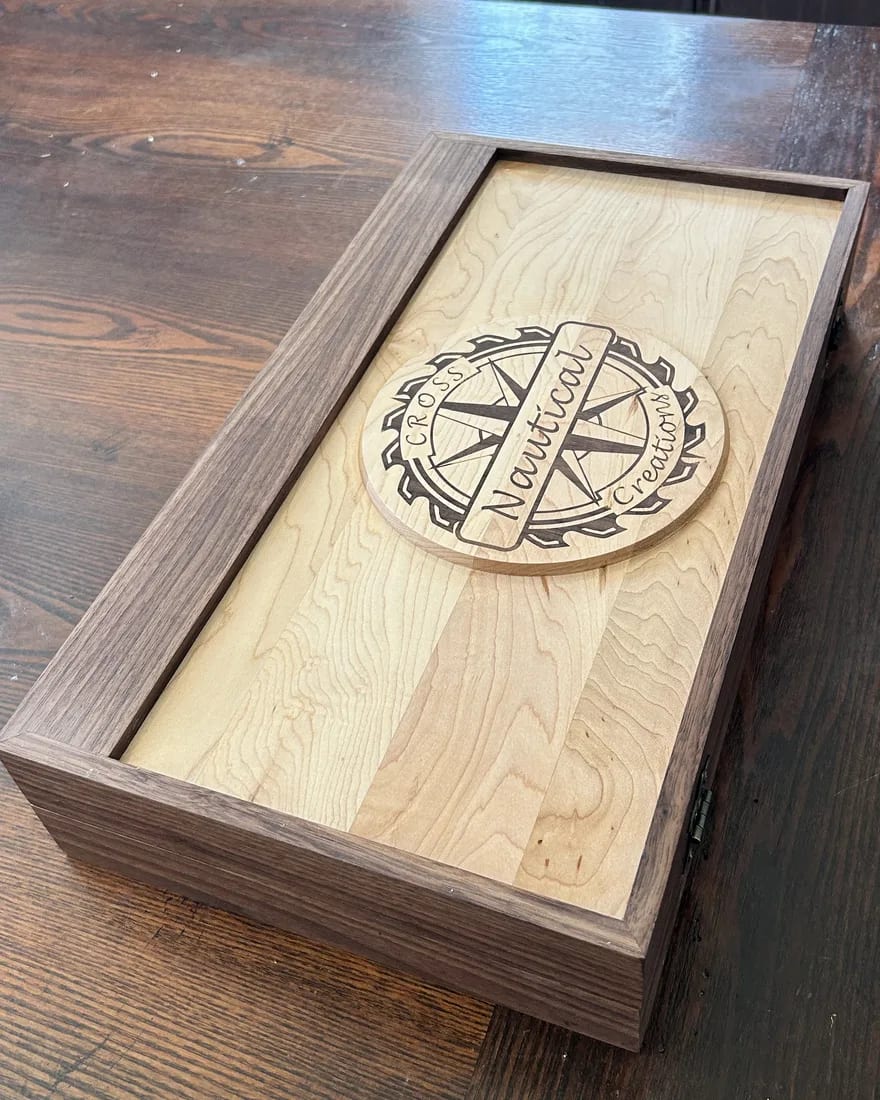
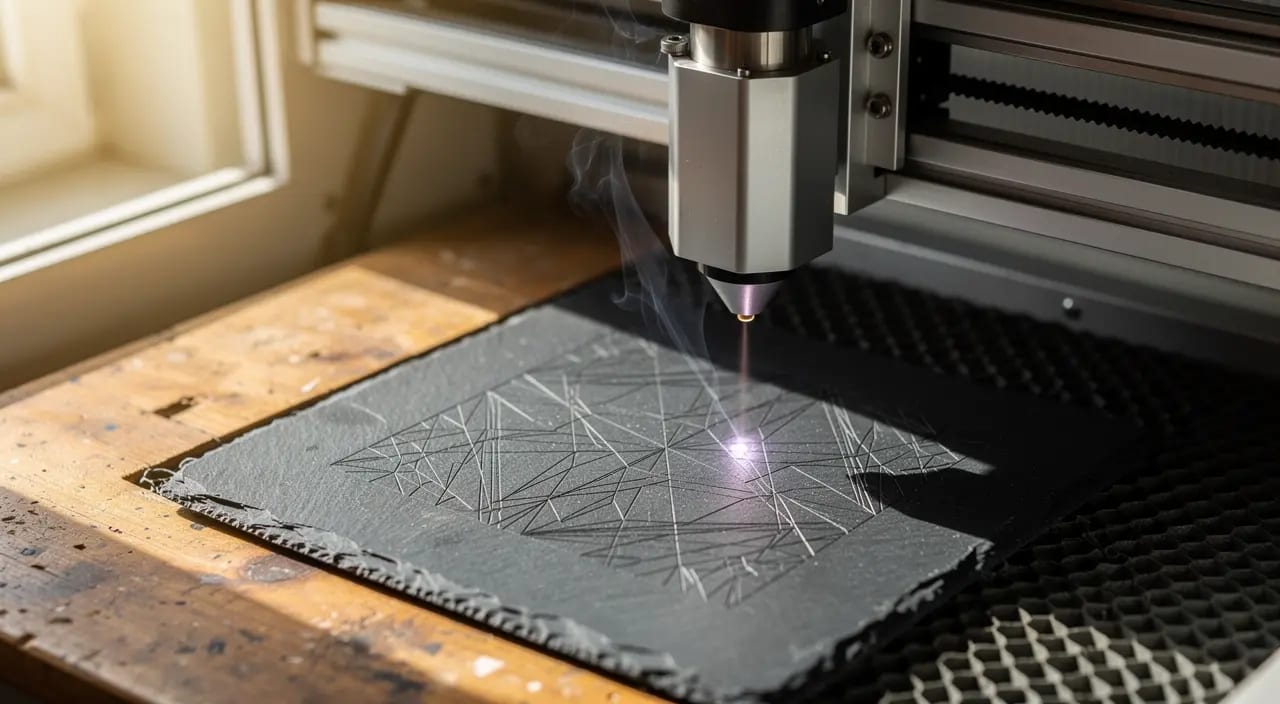
Yes, a handwritten recipe can be engraved on a cutting board from a plain photo of the card. The workshop's CO2 laser reproduces the handwriting, loops and crossed-out lines included, on the decorative face of a hardwood board. The other face stays smooth for cutting.
Atelier Multidécor makes these boards to order in Saint-Siméon-de-Bonaventure, on the Gaspé Peninsula. This post explains which face to engrave, which wood to pick and how to send us the recipe image. Whether the board can be made, and when, is confirmed on the first call.
Can a handwritten recipe be engraved on a cutting board?
Yes. The laser engraves an image file: it does not read the writing, it reproduces it. A sharp photo of the card is enough, with no retyping. The engraving can keep:
- the shape and slant of the letters, and the pressure of the pen or pencil;
- the notes in the margin, the quantities crossed out and rewritten;
- the signature or initials of the person who wrote the card;
- your choice of the stains and folds in the paper, or a cleaned-up background.
The workshop's 80 W CO2 laser engraves on a 36 x 18 in (915 x 458 mm) bed, as of November 2026. A recipe card fits, even enlarged, with room left for a title and a family name.
Why engrave the decorative face and keep the cutting face plain?
A cutting board has two jobs: to serve as a display or serving board, and to take the knife. We suggest engraving one face only, the decorative one, and keeping the other flat and bare. Three reasons:
- a knife scratches the engraving and in time wears away the fine lines of the handwriting;
- engraved lines are small hollows where moisture and food residue settle more easily;
- a recipe stays readable longer when the board mostly serves to display it.
The plain face flips over and cleans like any other board. Which face to engrave is confirmed when you order.
Which wood suits an engraved cutting board?
A fine-grained hardwood suits a kitchen board, and maple is one of the most common choices. It is pale, which gives the engraved handwriting contrast. The wood mostly changes how the engraving looks:
- maple: light wood, fine grain, a well-contrasted brown engraving, good for fine handwriting;
- walnut: dark wood, a quieter engraving, better for large lettering;
- cherry: a pinkish tone that darkens with time, medium contrast.
Which woods are available, and the size of the board, are confirmed on the first call. Our guide to engraving materials and objects shows what each material looks like under the laser. For the finish, a food-grade oil is the usual choice for a kitchen board, and we talk it through when you order. For fine handwriting, we recommend an edge-grain board, whose surface is flat and even, over an end-grain board, whose fibres stand upright.
| Wood | Colour | Engraving contrast | Suits |
|---|---|---|---|
| Maple | Light | High | Fine handwriting, small lettering |
| Walnut | Dark | Softer | Large lettering, a title and a family name |
| Cherry | Pinkish, darkening with age | Medium | Medium-sized handwriting |
Contrast varies from board to board, depending on the grain. The workshop confirms the wood and the engraving on the first call.
How do you send the recipe image?
A good image makes a good engraving. You need no equipment: a phone is enough. A few habits help a great deal:
- lay the card flat on a plain surface near a window, with no flash;
- shoot straight down, square to the card, with all four edges in the frame;
- if you have a scanner, 300 ppi is plenty;
- email the original file, not a screenshot taken from a messaging app;
- if the recipe continues on the back, send both sides;
- keep the original card at home: the workshop does not need the paper.
Tell us what to keep: stains and folds, or a cleaned-up background. Very faint writing or a thin pen may need the file cleaned up. We tell you before the machine starts, and we agree the layout with you: title, family name, date.
The same recipe on several boards
The file is prepared once, then engraved as many times as needed. One recipe can end up on several boards, one for each child or grandchild. It is a simple way to share a kitchen heirloom without splitting it.
The board is ordered like all our custom projects: you describe the idea, the workshop confirms it can be done, then you receive a quote. Nothing starts before you approve it. Pick the board up at the workshop in Saint-Siméon-de-Bonaventure, or have it delivered within the Baie-des-Chaleurs. Elsewhere in the Gaspé, delivery is discussed on request, case by case.
The holiday season is often busy at the workshop. We tell you on the first call whether your board can be ready for Christmas, or whether another occasion suits better.
How do you look after an engraved board?
A wooden board is treated like wood:
- wash it by hand in lukewarm water with mild soap;
- never put it in the dishwasher;
- dry it right away and store it on its edge so air reaches both faces;
- oil it now and then with a food-grade oil.
For more personalized pieces to give, read our post on wooden Christmas gift ideas.
Types of wooden boards and common woods are covered in the Wikipedia article "Cutting board".
A recipe to engrave?
Send us the photo of the card, the wood you want and the occasion. In business since 1994, the workshop tells you plainly what can be made, and when. Phone: 418-534-4167.
Frequently asked questions
Can a recipe be engraved from a phone photo?
Yes, if the photo is sharp, taken flat and well lit. Email the original file. We check legibility before engraving and tell you if the file needs cleaning up.
Can you cut on an engraved cutting board?
On the plain face, yes, as on any ordinary board. We advise against cutting on the engraved face: the knife scratches the writing and the hollows hold moisture.
Which wood should I choose for a handwritten recipe?
Maple gives the most contrast and suits fine handwriting. Walnut, which is darker, gives a quieter engraving. Cherry sits in between. Which woods are available is confirmed on the first call.
Can the same recipe go on several boards?
Yes. The file is prepared once, then engraved on one board or several. Tell us how many boards you want, and we confirm it can be done on the first call.
Can the board be ready for Christmas?
It depends on the work already in the shop. Every piece is made to order, and we tell you on the first call whether the schedule allows it. If it is not realistic, we say so instead of promising it.