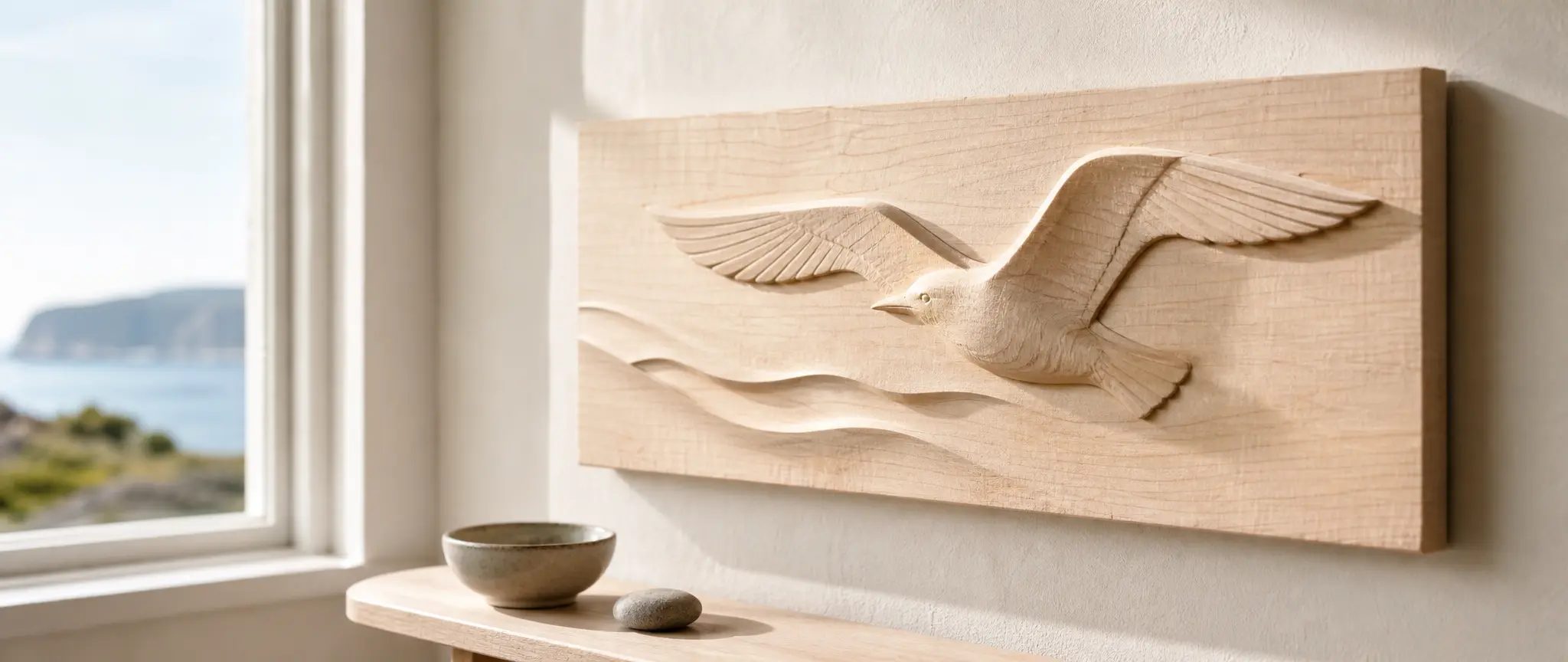
CNC wood carving: how a 3D file becomes a carved relief
A bird, a boat, a coastline, a logo: the CNC carves wood in relief from a 3D file, then the hand finishes it. Here are the steps, the subjects that work and the limits worth knowing.
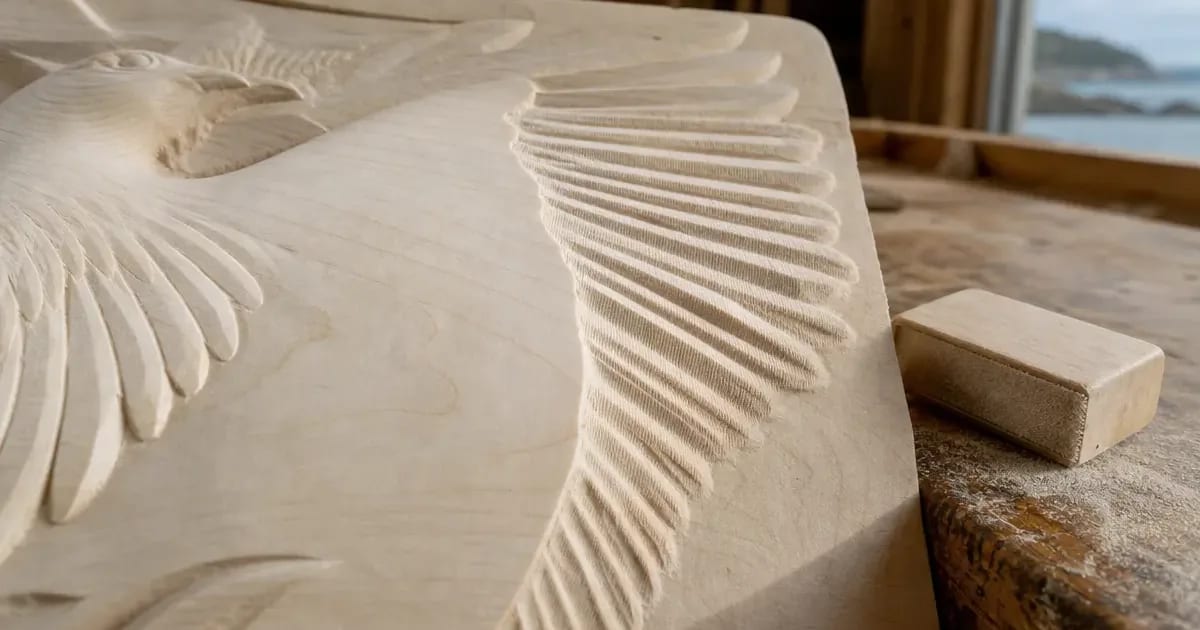
A CNC wood carving is a relief cut by a computer-guided bit from a 3D file, then sanded and finished by hand. Atelier Multidécor can make these carved panels to order at its workshop in Saint-Siméon-de-Bonaventure, in the Gaspé.
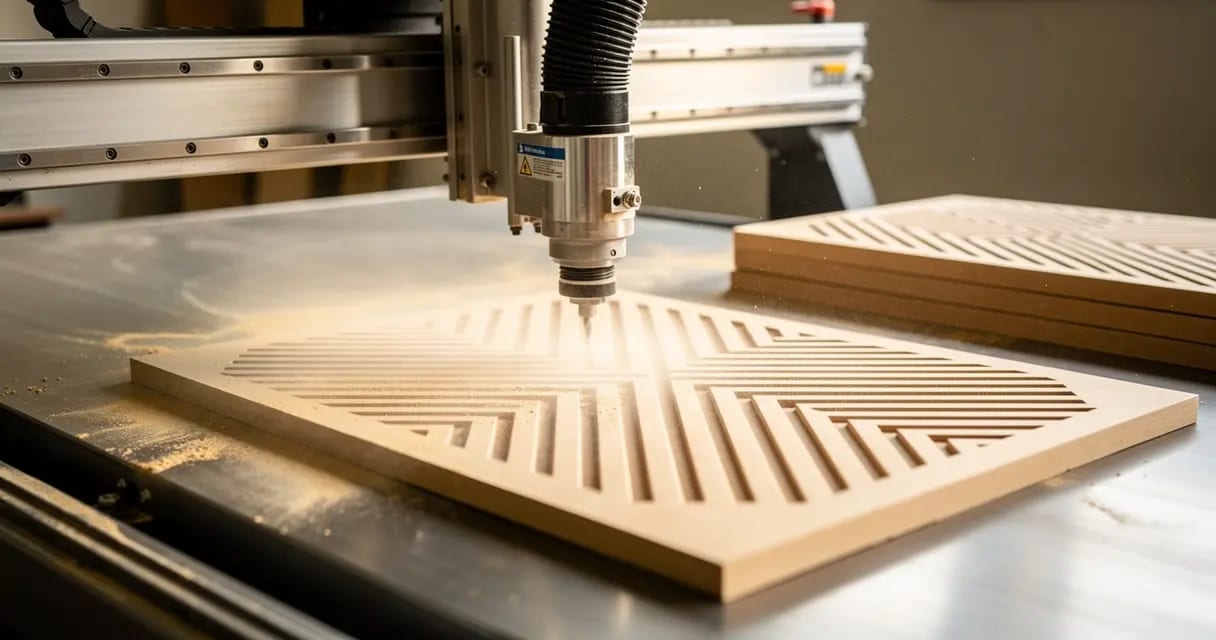
The machine works in passes: roughing to remove the bulk of the wood, then a finishing pass with a ball-nose bit to shape the surface. This post covers each step, the subjects that carve well, how to choose the wood, and the uses, from wall art to signs. Whether a piece can be done, and when, is confirmed on the first call.
How does a 3D file become a carved relief in wood?
A CNC wood cut follows a flat outline. A relief varies in depth: everything starts from a 3D file in which each point of the surface has a height. The software turns that file into toolpaths, the exact route the bit follows. The bit follows those paths in all three dimensions: left-right, front-back and up-down. The steps are:
- The subject: a drawing, a reference image or a 3D model. A 2D or 3D plan can be prepared on request.
- Scaling: the size, the wood thickness and the maximum depth of the relief are set.
- Roughing: a larger bit removes most of the wood and leaves a thin layer to finish.
- Finishing: a ball-nose bit goes back over the surface, line by line, and shapes the curves.
- Hand work: sanding out the bit marks, reworking details, oil.
The machine shapes the volume; the hand finishes the surface. That is what separates a carved relief from a plain cut-out. The real size of your piece is confirmed on the first call.
Which subjects carve well on a CNC?
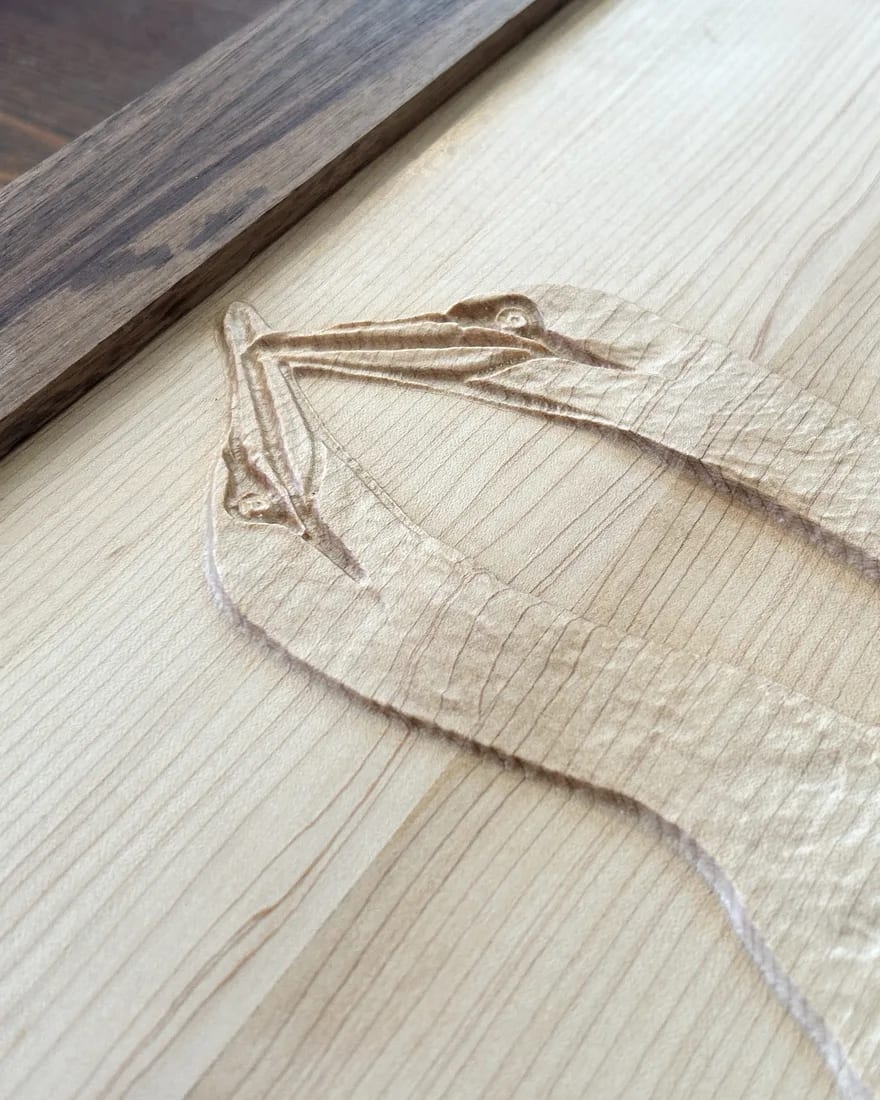
A relief is seen from the front. Subjects with well-separated planes read clearly: a bird's silhouette, the hull of a boat, a stretch of coastline. The radius of the ball-nose bit sets the smallest possible detail. An inside corner comes out rounded, and a very fine feather gets simplified.
- Birds and sea animals, as a silhouette or in medium relief.
- Boats, lighthouses and landscapes of the Baie-des-Chaleurs coast.
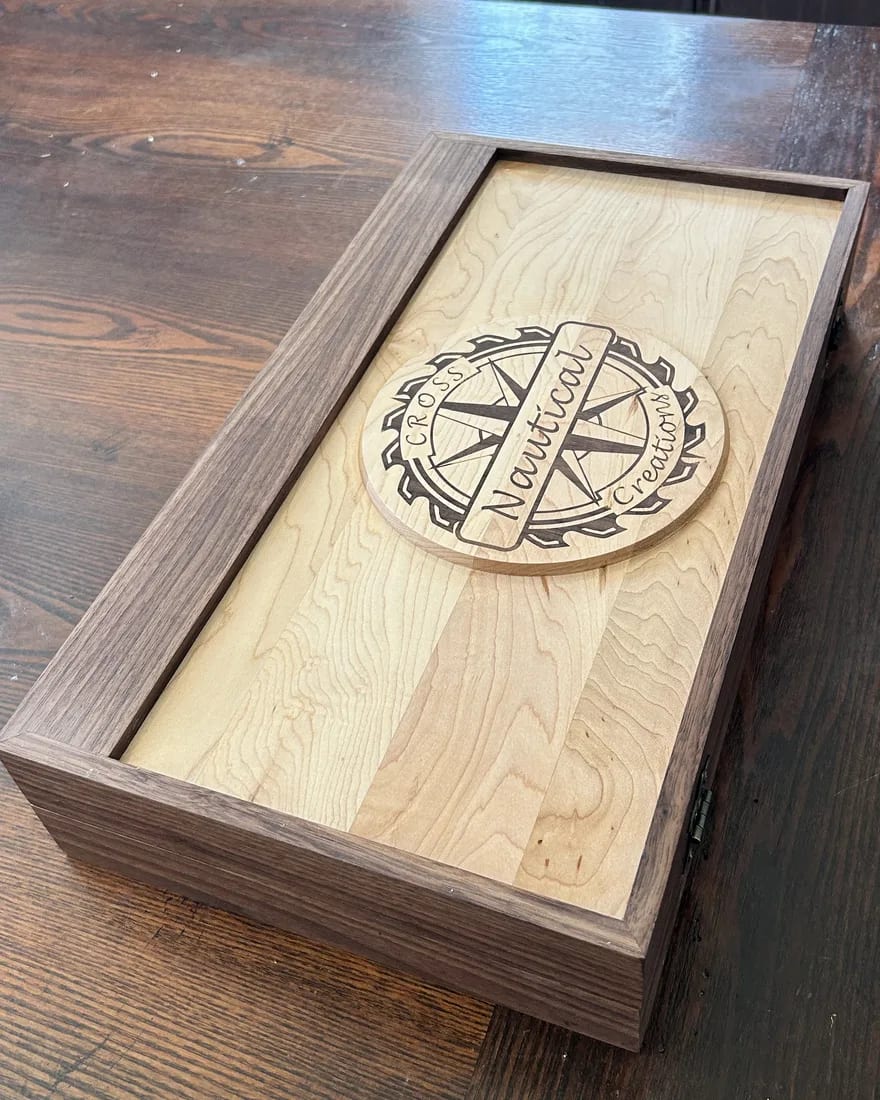
- Logos and lettering in relief, with clean levels.
- Repeating patterns, such as waves or leaves, for a decorative panel.
Some shapes cannot be carved as a relief: a hollow under an overhang or a detached ring needs another process. We say so at the drawing stage, before the machine starts.
| Subject | What reads well | Common use |
|---|---|---|
| Seabird | Clean silhouette, simplified plumage, well-separated planes | Wall art, medallion |
| Boat or lighthouse | Hull, sails and masts on distinct levels | Wall art, plaque, cottage sign |
| Coastline or landscape | Soft relief, waves, cliffs, a flat sky | Wall art, headboard |
| Logo or lettering | Clear levels, sharp edges, rounded inside corners | Sign, plaque |
| Repeating pattern (waves, leaves) | Even rhythm, uniform depth | Door panel, wall decor |
| Medallion | A single centred subject with a border | Gift, interior decor |
Every piece is made to order. Whether it can be done, and when, is confirmed on the first call.
What wood should you choose for a wood carving?
The wood sets how crisp the relief looks. A fine, tight grain cuts cleanly and keeps its edges. An open grain shows more of the figure and can chip on a fine detail.
- Maple (pale, fine grain) and cherry (warm pink, tight grain): precise reliefs.
- Walnut: deep brown, with strong figure that adds to the design, for larger reliefs.
- Oak and ash: open grain, more character, with fine details to simplify.
- Thickness: the wood has to be thicker than the relief is deep. A large panel can be glued up from several boards.
These species are general woodworking guidelines. The workshop confirms what it has in stock and what suits your subject on the first call. A piece meant for outdoors is discussed separately, because moisture and sun change the choice of species and finish.
What does hand finishing add after the CNC?
The ball-nose bit leaves fine ridges on the surface, like furrows in a ploughed field. Hand sanding removes them and softens the edges. Hand work also reshapes a detail the machine rounded off.
- Progressive sanding, from the coarsest grit to the finest, with the grain.
- Reworking details with hand tools: edges, hollows, the texture of plumage or waves.
- An oil finish that lets the grain show. The workshop does not paint its pieces.
A family name, a line of text or a date can be added by laser engraving on a flat border or on a matching plaque. The workshop's 80 W CO2 laser engraves on a 36 x 18 in (915 x 458 mm) bed.
What is a custom wood carving used for?
A carved relief is made for many uses, at home or in a business:
- Wall art: a bird, a boat or a map of the coast, mounted on a backing.
- Signs: a relief logo for a shop, a B&B or a cottage.
- The engraved commemorative plaque, with a carved motif and engraved text.
- Door panels: a carved motif in a panel, on the same principle as our CNC-machined doors and fronts.
As of November 2026, the workshop portfolio shows a gannet carved in relief and a carved medallion. Each piece is made to order: whether it can be done, and when, is confirmed on the first call.
Pick the piece up at the workshop in Saint-Siméon-de-Bonaventure, or have it delivered within the Baie-des-Chaleurs. Elsewhere in the Gaspé and in Quebec, delivery is discussed on request, case by case.
The principle of machining guided by a numerical file, which underlies the CNC, is described in the Wikipedia article on numerical control.
A subject to have carved in wood?
Describe the subject, the size and the intended use. In business since 1994, the workshop tells you plainly what can be done, and when. Phone: 418-534-4167.
Frequently asked questions
What is a CNC wood carving?
It is a relief cut by a computer-guided bit from a 3D file. The machine removes wood in successive passes, then the hand sands and finishes the piece. The result is a panel whose surface varies in depth.
Can you carve a logo or an image in wood?
Yes, if the subject has clear planes of depth. A logo with clean levels carves well. A highly detailed image gets simplified. Send us the subject: we assess it and tell you what is realistic before accepting the order.
What is the difference between CNC carving and hand carving?
The CNC reproduces a file precisely and gives an even volume. The hand then reworks details and softens the surface. Both work together in the workshop. A sculpture in the round, carved from every side, needs a different process.
How large can a carved relief be?
The size of a piece depends on the wood, the depth of the relief and handling. Describe your project: we confirm what is feasible, and the size, on the first call.
How much does a custom wood carving cost?
The price depends on the size, the depth of the relief, the species of wood and the hand-finishing time. Describe your idea and you will get a quote before anything starts.