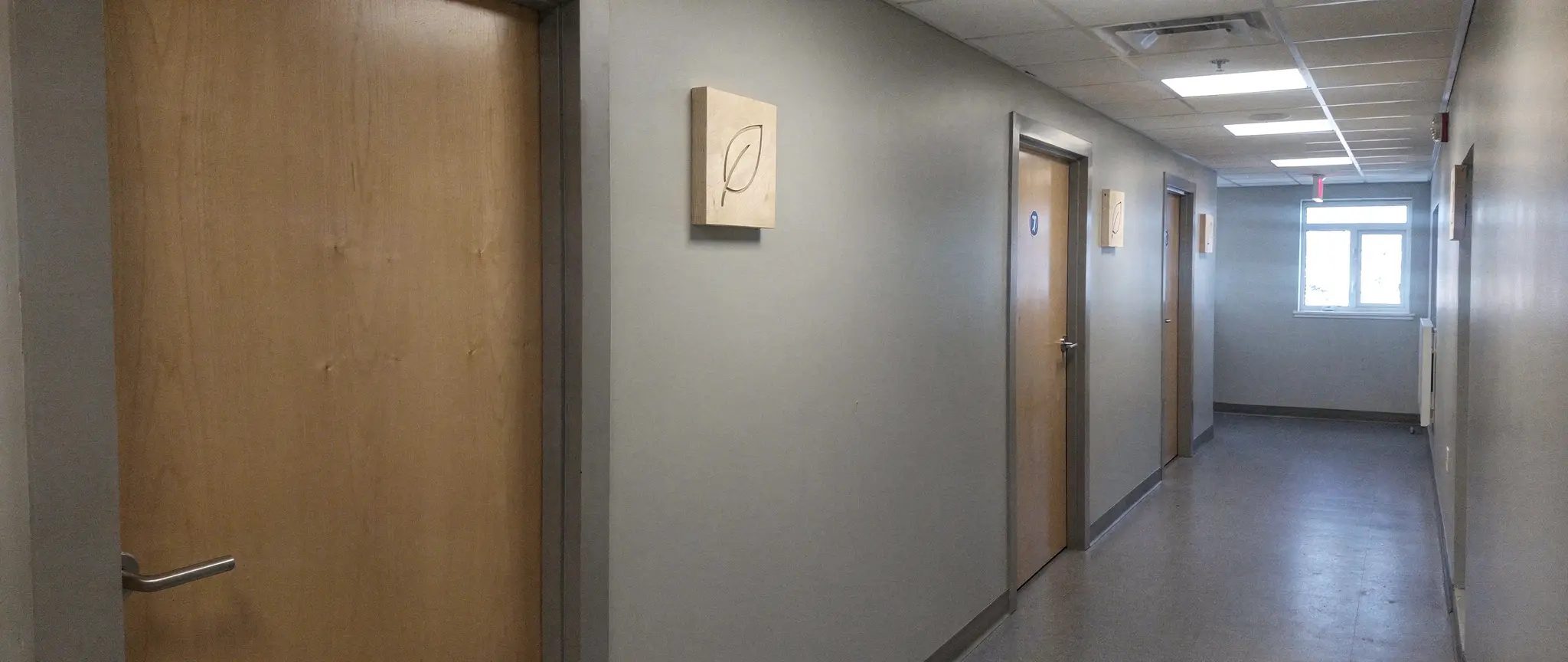
Engraved wood interior signage: ordering a run
One file, forty plates. Engraved wood interior signage identifies doors, rooms and directions in runs, with a relief that print does not have.
An office, a school or a town hall does not buy one plate. It buys forty, in the same style, with forty different texts. That is where engraved wood works well, and where a badly settled template repeats itself forty times.
What interior signage covers
Interior signage identifies the doors, the rooms and the directions in a building, in runs and in one style.
Four families come back through most of the orders we take.
- Door plates and room numbers identify each opening on a floor.
- Room, department and service names sit beside the door they name.
- Directional signs guide people through the corridors and the entrance halls.
- Desk plates and donor plates get engraved on wood or on slate.
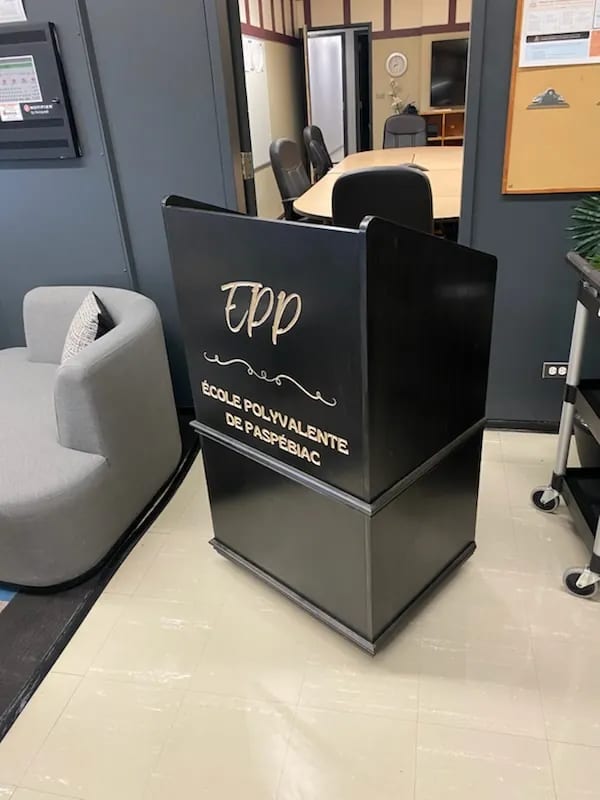
In 2026, we delivered a Baltic birch conference lectern to a high school in the Baie-des-Chaleurs. The name of the institution is engraved on the CNC. We also delivered black melamine school storage, with one-inch shelves, for classroom use. A run of plates follows the same logic: one approved drawing, then identical pieces.
The exterior follows other rules: see our post on the custom wood business sign.
Engraved wood, acrylic or aluminum: what holds up
Engraved wood gives real relief, and it gets repaired right on site. Printed acrylic costs less per unit, and a scratch on it cannot be recovered.
| Material | What it gives indoors | When it gets damaged | What it does not do |
|---|---|---|---|
| Engraved wood (CNC or laser) | Relief that reads in raking light | Sands down and reseals on site | No applied relief, no braille |
| Engraved or printed acrylic | Full colours, low cost | A scratched print gets replaced | No real depth |
| Aluminum | Stable surface, clean lettering | Gets replaced, never touched up | Does not match wood |
| Applied vinyl | Fast to install, editable text | Peels from the corner | Does not hold in a busy corridor |
The only lifespan figures published so far cover the exterior. According to the Canadian SignsDepot guide (2026), a wood sign holds three to seven years outdoors. Aluminum holds ten to twenty years according to SignsDepot and PivotalSigns (2026), and vinyl one to five. No study we found measures the lifespan of an interior plate. We say so here instead of inventing a number for it. Without UV and without rain, those figures act as a floor.
Are you comparing materials for a run of plates right now?
What the law requires indoors
Two separate regimes apply here: the language of the signage, and accessibility. Engraved wood satisfies the first one, and it does not always meet the second.
The Charter of the French Language requires French in public signage at section 58. Bilingual signage stays permitted as long as French is markedly predominant. Since June 1, 2025, sections 58.1 and 68.1 require French to take twice the space of any other language. The French text also has to stay legible on the same sign. According to the Office québécois de la langue française, the province's language regulator, that test covers signage visible from outside. Interior signage that cannot be seen from outside falls outside that test. Your door plates remain subject to section 58, not to the double-space test. According to Bernier Fournier Avocats (2025), a business of 25 employees and more must also hold a francization certificate.
Charter of the French Language, section 58 (LégisQuébec)
Accessibility answers to a second regime, and it is a stricter one. The Code de construction du Québec, the provincial building code, chapter I, section 3.8, has been in force since April 17, 2025. It requires visual and tactile signage with braille characters, according to the Régie du bâtiment du Québec, the provincial building authority. Exit stairwells, accessible washrooms and room names posted near doors all fall under it. The technical reference standard is CSA/ASC B651:23, published on January 27, 2023.
Engraving cuts into the surface and does not produce that raised relief. In its 2024 guidelines, Braille Literacy Canada writes that braille dots have to stand above the plate. Engraved braille, the same source adds, cannot be read by touch at all. According to Accessibility Standards Canada (CAN-ASC-24, signage section), tactile characters have to rise at least 1 mm above the surface. Domed braille dots have to measure 0.6 to 0.9 mm, according to that same source. We therefore claim no tactile compliance and no braille compliance on an engraved plate. An accessible washroom gets applied relief and domed braille, added by another process. The verification happens door by door, on every project we take.
2024 accessible signage guidelines (Braille Literacy Canada)
Ordering a run: file, template, fixing
A run starts from a single template and one list of texts. The drawing gets done once, and the engraving repeats after that.
The volume in this work comes from the institutional networks. The Centre de services scolaire René-Lévesque, the regional school service centre, runs 32 facilities across its territory. It counts 26 elementary and secondary schools among them, according to its 2024-2025 annual report. That comes to hundreds of doors that need to be identified.
The template. One sample plate carries the format, the margins, the typeface, the depth and the species. It gets approved on an engraved sample, never on a screen.
The list. A spreadsheet holds one line per plate: room number, first line, second line, quantity. That single file replaces forty separate purchase orders on your side.
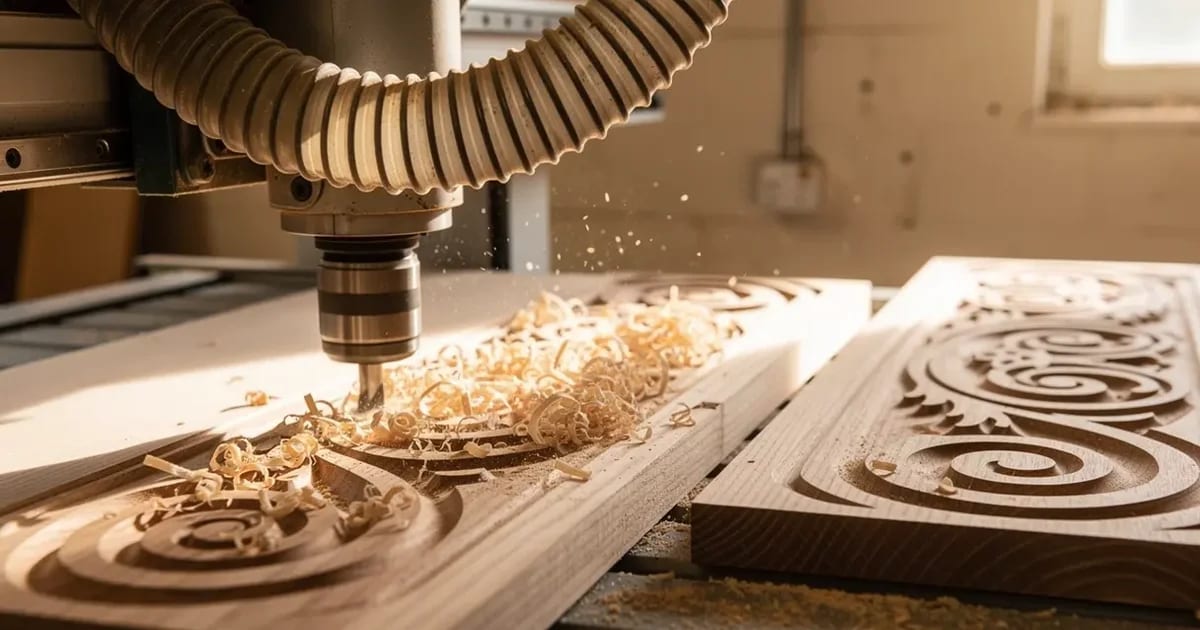
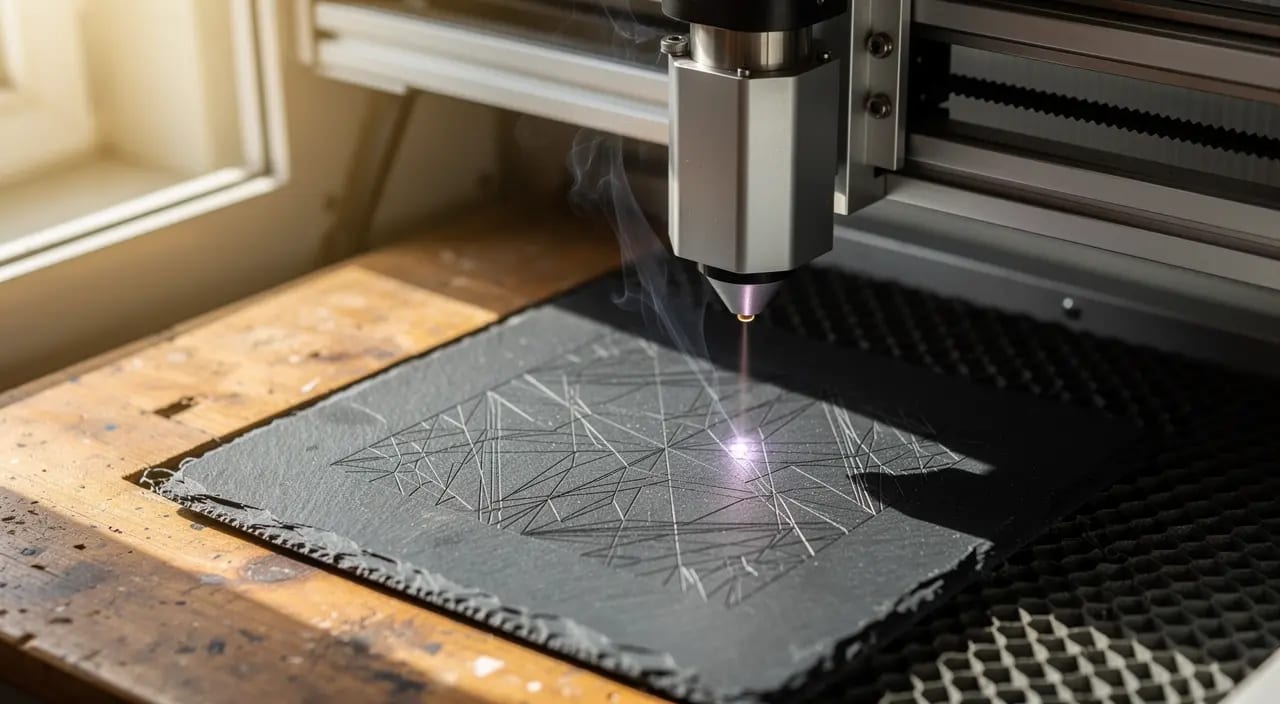
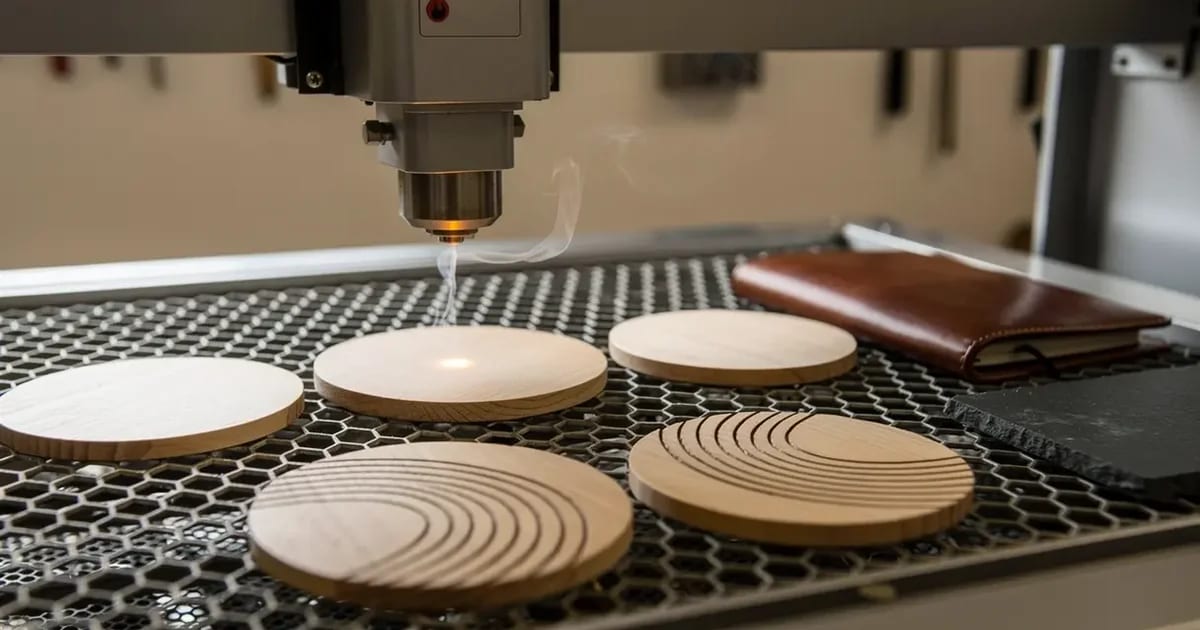
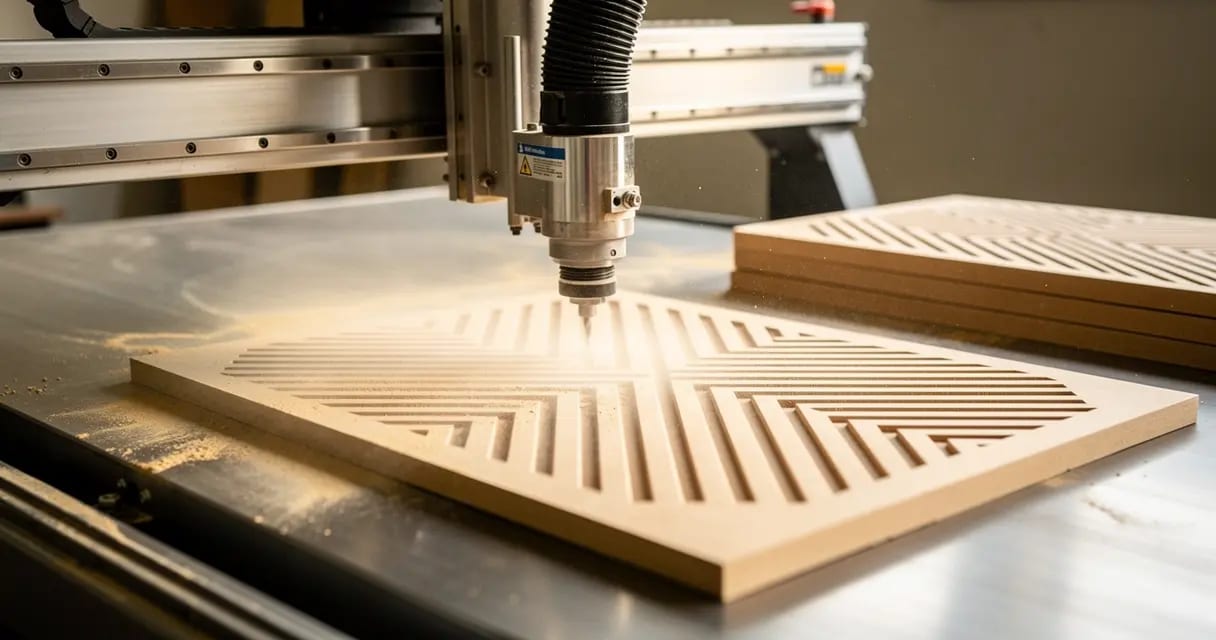
The machines. Our 80 W xTool P3 CO2 laser engraves 915 x 458 mm in one pass, to a tenth of a millimetre. Our 4 x 8 foot CNC (1220 x 2440 mm) carves 3 to 15 mm deep. That depth gives relief that reads from the end of a corridor. Both machines sit under the same roof, with the finishing done by hand.
The materials. We engrave hardwood (walnut, oak, cherry, maple, ash), bamboo, acrylic and slate. The laser also marks coated metal, because it burns the coating and uncovers the metal underneath. Bare metal stays outside what this laser is able to engrave.
The fixing. You choose between exposed screws, double-sided tape and machined standoffs. The decision gets made before the engraving, because the holes get drilled in the same setup.
The delivery. We make the plates here and we deliver them to you. Installation stays reserved for residential projects, and that limit does not move. You receive plates that arrive ready to mount on the wall.
Do you have a template to validate before starting the run?
When another material does better
Engraved wood is not the answer in every situation on a floor plan. Here are four cases where we will point you toward something else.
- Regulated signage needs applied relief and domed braille, not engraving.
- Text that changes often, like an employee name rotating every six months, needs an insert frame.
- The exterior changes the calculation, because salt, frost and UV all act on the material.
- A dark species engraved in recess reads poorly from the end of a corridor.
A list of doors to identify
Do you have a list of doors that need to be identified? Send it over with the texts and the quantities.
Frequently asked questions
Does an engraved wood door plate meet the accessibility standards?
No, not for the signage covered by the Code de construction du Québec. Since April 17, 2025, an accessible washroom or an exit stairwell requires raised characters and domed braille. Braille Literacy Canada (2024) writes that engraved braille cannot be read by touch. An engraved plate stays valid for signage outside that scope.
Can you engrave a bilingual plate inside a business?
Yes. Section 58 of the Charter of the French Language requires French, or bilingual signage where French is markedly predominant. The stricter double-space test, in force since June 1, 2025, covers signage visible from outside. According to the Office québécois de la langue française, the province's language regulator, interior signage not visible from outside falls outside that test.
Do you deliver plates outside the Gaspésie?
Yes. An engraved plate packs and ships, so it is the service with the widest reach in our catalogue, available across Quebec. Outside the Baie-des-Chaleurs, delivery gets handled on request, case by case, with no rate and no lead time promised in advance. We make and we deliver; installation stays reserved for residential projects.